
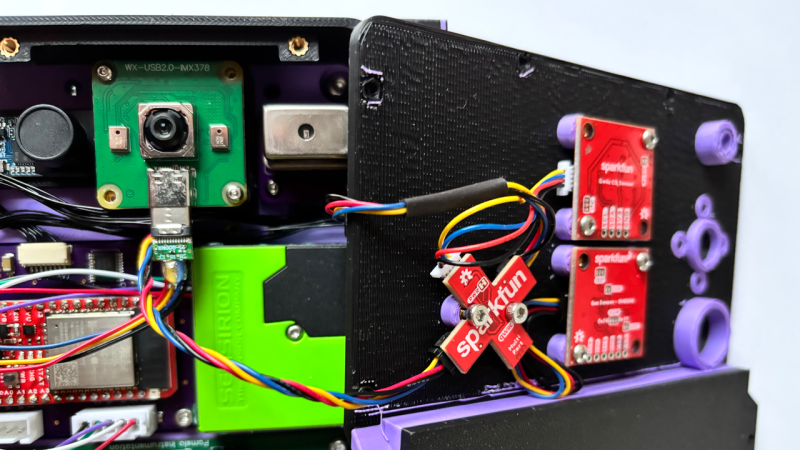
If you’re reading Hackaday there’s pretty good odds you’re at least somewhat fond of Star Trek. We’d bet good money most of you would quit your jobs today if a Starfleet recruiter showed up. That’s something you’d have in common with [PeterAJansen], who has been working for over a decade now to create something worthy of being called a tricorder. If his latest iteration, the Open Source Science Tricorder Cyberdeck, isn’t there yet, it’s pretty darn close.
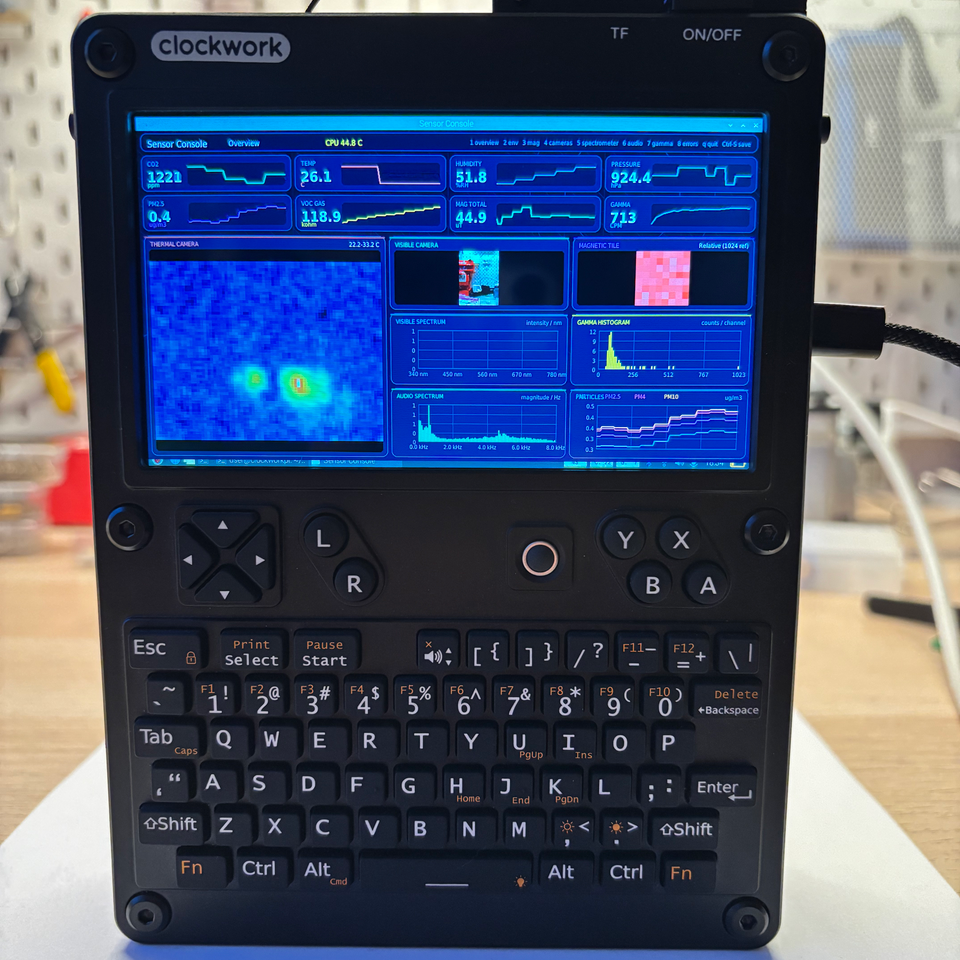
The “tri” in tricorder means three, but this device has more than three instruments– so did the ones on the show, come to think of it. You won’t be scanning for veteron radiation with this, but you do get a scintillation crystal to get a spectroscopic analysis of beta- or gamma-ray sources; there’s also a visible light spectrometer, thermal camera, and magnetic field camera along with a standard magnetometer and the usual environmental sensors to give you temperature, pressure, and humidity, plus particulate, VOC and CO2 concentration. Enough to explore an alien planet? That’s hard to say, but it seems like enough to explore this one.
The device is based around a Clockwork Pi uConsole, which takes care of the form-factor: a slabtop with a QWERTY keyboard and an IPS display in a nice screen, and a Compute Module 5 to crunch all that data. It might not be quite as stylish as the folding units seen on-screen in Star Trek, but it seems like an eminently practical form factor. There are videos of it in operation as well as being assembled on the GitHub repository, where you can get all the details needed to make your own. It is the Open Source Science Tricorder, after all.
This isn’t the first project we’ve seen chasing tricorder glory, but many of the others were more interested in screen accuracy than science. [Peter]’s earlier “arducorder” was a very notable exception to that trend.
Thanks to [MarcCote] for the tip! If your scanners pick up something interesting in cyberspace, remember our hailing frequencies are always open.











Or your phone with PhyPhox
https://phyphox.org/
pretty sure even the most tarted up phones are missing most of those sensors.
Though a 9dof IMU, GNSS, time-of-flight imager and laser rangefinder would be awfully useful to add to that sensor menagerie too.
Muon beams for dense objects
https://phys.org/news/2026-09-laser-muons-images-dense.html
That will take some doing.
There are numerous usbc sensors for eeg,ekg and various blood sensors. Including o2, blood pressure
There are numerous programs i would load 10 and 12 point eeg, ekg. BP, o2 the pdr and several first aid packages
Isn’t it open source? Tell us when you’re done.
Wow love your work
If layered, this would fit in a tricorder form factor.
It’s impressive but calling it a tricorder is like saying that kid in Texas built a digital clock, i.e. just wrong.
“Ah! A keyboard! How quaint.”
Makes me think of something, they often suspect asbestos and then to test it an expert has to take samples and look at them under a microsope. Meaning it can take a bit of time and allows them to ask a certain amount of money for the service to reflect individual persons being busy with it.
Now since we have neural networking/AI why don’t we just make a device that has a simple microsope (like you can fashion from webcams even) and some NN/AI to detemine if it is asbestos. Quick and easy and cheap.
Then when it’s done you can add it to the tricorder device of the article.
Then maybe expand it to recognise some other stuff, like pollen in the air and what kind it is.
Pity that HaD isn’t a place where people ever pick up on ideas. Oh well, the tech sites where people and companies did pick up ideas are all self-destroyed by their management.
Available
https://m.youtube.com/watch?v=B1S1lnW3bUc&pp=0gcJCTUMAYcqIYzv&ra=m