How Gut Bacteria May Affect The Outcome Of Cancer Immunotherapy

In the ongoing development of cancer immunotherapy, as well as our still developing understanding of the human immune system, there’s always been a bit of massive elephant in the room. The thing about human bodies is that they’re not just human cells, but also consist of trillions of bacteria that mostly live in the intestines. What effect these bacteria have on the immune system’s functioning and from there on immunotherapies was recently investigated by [Tariq A. Najar] et al., with an article published in Nature.

The relevant topic here is that of antigenic mimicry, involving microbial antigens that resemble self-antigens. Since these self-antigens are a crucial aspect of both autoimmune diseases and cancer immunotherapy there is considerable room for interaction with their microbial mimics. Correspondingly these mimics can have considerable negative as well as positive implications, ranging from potentially triggering an autoimmune condition to hindering or boosting cancer immunotherapy.

In this study mice were used to investigate the effect of such microbial interference, in particular focusing on immune checkpoint blockade (ICB), which refers to negative feedback responses within the immune system that some cancers use to protect themselves. In some immunotherapy patients ICB inhibiting using e.g. anti programmed cell death protein (anti-PD-1) treatment does not provoke a response for some reason.

For the study mice had tumors implanted and the effect of a particular microbe (segmented filamentous bacteria, SFB) on it studied, with the presence of it markedly improving the response to anti-PD-1 treatment due to anti-gens expressed by SFB despite the large gut-skin distance. Whether in humans similar mechanisms play a similarly strong role remains to be investigated, but it offers renewed hope that cancer immunotherapies like CAR T-cell immunotherapy will one day make cancer an easily curable condition.

Robot Never Misses Leg Day

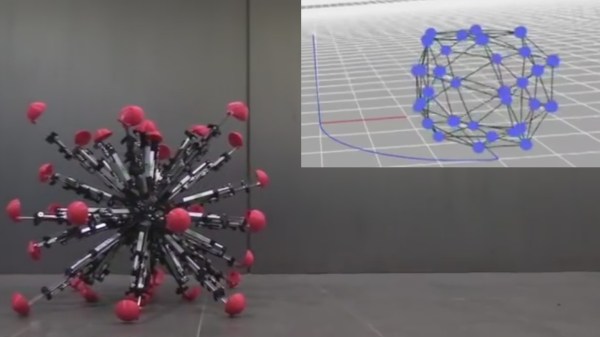
We have heard bipedal walking referred to as a series of controlled falls, or one continuous fall where we repeatedly catch ourselves, and it is a long way to fall at 9.8m/s2. Some of us are more graceful than others, but most grade-schoolers have gained superior proficiency in comparison to our most advanced bipedal robots. Legs involve all kinds of tricky joints which bend and twist and don’t get us started on knees. Folks at the Keio University and the University of Tokyo steered toward a robot which does not ride on wheels, treads, walk or tumble. The Mochibot uses thirty-two telescopic legs to move, and each leg only moves in or out from the center.

Multi-leg locomotion like this has been done in a process called tensegrity, but in that form, the legs extend only far enough to make the robot tumble in the desired direction. Mochibot doesn’t wait for that controlled fall, it keeps as many downward-facing legs on the ground as possible and retracts them in front, as the rear legs push it forward. In this way, the robot is never falling, and the motion is controlled, but the processing power is higher since the legs are being meticulously controlled. Expecting motion control on so many legs also means that turns can be more precise and any direction can become the front. This also keeps the nucleus at the same level from the ground. We can’t help but think it would look pretty cool stuffed into a giant balloon.

Some people already know of tensegrity robots from NASA, but they may not know about the toolkit NASA published for it. Okay, seriously, how did knees pass the test of evolution? I guess they work for this jumping robot.

Continue reading “Robot Never Misses Leg Day”