
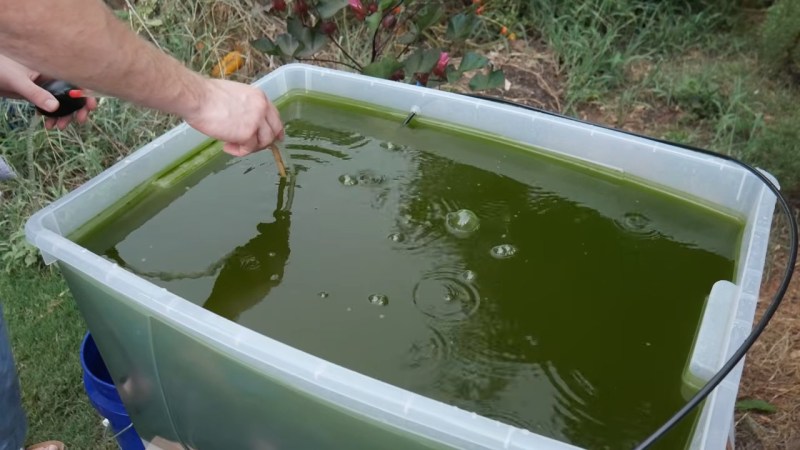
There’s one thing [Silent H] wants you to know before you watch his video about making biodiesel, embedded below: he started this project before he’d even heard of the Strait of Hormuz. No, he’s just independent-minded and wanted to try making his own fuel when diesel was– in retrospect– cheap as chips. That’s probably a good thing, because while [Silent] gets his pint of fuel at the end of the video, it’s not from algae; it’s from a backup crop of sunflowers.
As it turns out, he picked what was the perfect algae and the absolute worst algae for making biodiesel from: Chlorella Vulgaris. It’s perfect because it’s easy to grow, and easy to extract from the growth medium, as it sinks when it is ‘ripe’, and has a very high oil content. Of course [Silent] didn’t want to toss algae cakes into a steam powered canoe, he wanted diesel fuel for his vehicle. That’s where the project broke down: Chlorella Vulgaris cells are exceptionally tough, and if you can’t rupture the cell wall, you can’t can’t get out any appreciable oil. A few grams by solvent extraction is all he manages before switching to more tractable feedstock.
That feedstock is sunflowers, which give up their oil through the application of violent pressure. That is to say, he crushes the seeds in an oil press. Oil acquired, he goes on to transesterfy the stuff, extracting glycerine to produce biodiesel– a process ripe for hacking that you’d think we’d cover more often.
We have covered the algae growth side of things before, but that algae seemed to be destined for other uses than fuel.











I wonder if the the “molecular jackhammer” that’s being evaluated for destroying the membranes of cancer cells could be adapted to destroy the cell walls of algae?
I wonder if an ultrasonic cleaner would do the job
Or vacuum
“Pascalization” (High pressure processing) could be a thing to try to break the algae cell walls. However, 400-600 MPa is not really something one does readily with hand power
But how a strong a vacuum until the cell walls break ?
Deionised water perhaps, pull water into the cells via osmosis untill they pop.
a cleaner would be to weak, an ultrasonic homogenizer. Cavitation results in “messy” oil as it results in a soup if cellular fragments that require significant post processing to get a usuable clean oil.
the jackhammer required is enzymatic specifically Cellulase + Lysozyme + Protease
A better solution would be to ditch the current car-to-gas-station model of economic development and re-legalize cars which use gasifiers (like what we had in my country during 1950s when cheap fuel was not available anymore).
To the detriment to everyone in it’s vicinity. No thanks.
Gasifiers have been re-introduced to domestic heating because they allow you to burn a batch of wood slowly in an insulated “kiln”. It’s actually cleaner because the ashes are separated before the actual burner, so you get less particulate matter out of the smoke stack.
Carrying your own refinery and engine around with you is pretty limiting unless you plan to harvest fuel as you go through the wilderness. Especially if you want it to perform well, to be safe, to be clean, etc. Much easier to build such things in a stationary location where you can build them better and cheaper, then just carry the energy with you in a more stable and convenient form. Like in the form of a charged battery, which can also be recharged anywhere on the grid or anywhere with solar.
I’m shocked there’s not an enzymatic solution for this.
there is Cellulase + Lysozyme + Protease but it adds significant costs and processing time
Did lysis beads not work for the algae?
The biggest issue with biodiesel is that it tends to cause fouling of injectors. If your running and old Mercedes W124 based on classic sequential pump that’s probably not an issue but for anything more modern prepare for a very expansive reppair after some time of “saving” on fuel. I only use Shell V-Power or Orlen Verva in my VW Bora because what I would save on cheap fuel I would pay again in workshop fee and repair parts. Add to that cost of time when you cannot drive because your car is in workshop and biodiesel becomes very expensive indeed.
That’s one problem with biodiesel. But there is a longer-term problem with biodiesel which comes from its inherent lack of lubricity. Diesel engines don’t just burn diesel, the fuel injection equipment is lubricated by the diesel and commercial diesel fuel have long chain polymers that provide that lubricity that protect wear on the rotating surfaces (the ones that are running at massive pressures like 2000 bar). Commercial biofuels have several added lubricity modifiers, to do the same thing. Burning chip fat, or even homegrown sunflower oil/ algae based biofuel, will probably lead to the fouling you talk of, but it will ultimately lead to catastrophic failure unless you’re also adding in lubricity modifiers
You couldn’t be more wrong. Biodiesel is a solvent, it breaks down residul carbon deposits left by ULSD and increases lubriity in the fuel and the fuel system. This is basic stuff.
That is total nonsense. Putting a solvent through your diesel fuel pump will remove what little lubricating polymer additives were left.
Home made diesel has variable quality feedstock and requires fine adjustment of the catalysts to convert it, which isn’t easily or accurately done in small batch production, so you get leftover catalysts (acids/bases/alcohols), lipids and waxes in the resulting diesel.
Think of it like seasoning a cast iron skillet: when you put fat on hot metal, it polymerizes on the surface. The same polymerization can happen inside the fuel injection system with biodiesel that isn’t properly converted.
You’re wrong about the lack of lubricity; pure biodiesel innately has more lubricity than conventional diesel formulations, at least the ultra-low sulfur diesel ones used today. The fatty acid methyl esters in conventional biodiesel themselves can be used as a lubricity modifier for conventional diesel. Even a B20 blend will tend to have measurably better lubricity than the plain diesel it’s blended with.
Mind you, that’s not to say biodiesel doesn’t cause problems in modern diesel engines and have risks when used in older ones! And commercial biodiesel does have plenty of additives to address its disadvantages vs conventional diesel (and they can include lubricity modifiers).
Its cool that diesel engines can run on such a wide variety of fuels. I’m just a little sad because I doubt this could be done efficiently enough to be better than solar + EV.
It’d be so nice of fuel could be a battery for storage but it it can’t be done efficiently enough it’d just be a waste on the wider scale.
Now on a personal level it could be really cool to be able to make fuel for your own generator or the like.
One difference between this process and solar + EV is that this can be done with very little high tech infrastructure or exotic materials. Imagine MASSIVE shallow pools to grow the algae. These pools might be tended by people with pushbroom squeegie type tools. The whole process except a few steps could be massively scaled and low tech. This method also allows you to store large quantities of energy easily, something current electric technology cannot do.
I know of a massive shallow pool full of algae. Maybe that could be used as continuous feedstock for biodiesel production.
“Easily” is relative. It sounds very labor intensive ($$$) and still requires a lot of industrial chemicals, which you might not want to be handling in a low-tech environment “cottage industry” type of setting because of the spills, leaks, and accidents.
They exist, and have issues with the algae getting sick.
Looks at the injection pump tuning bill. Looks at the catalysator.
Personally I like the concept since EVs and solar have a lot of downsides. Working on an EV as a home mechanic is hard, they are expensive and the batteries can be dangerous. On top of that, the charging infrastructure isn’t great. (my hometown does not have a single charger, as far as I’m aware of)
The energy comes from the sun and would otherwise be wasted if it wasn’t absorbed, so in this case, efficiency might not be such a big issue.
IMHO efficiency isn’t the sole deciding factor.
The efficiency matters a lot here because it’s most people won’t have the surface area to grow enough algae to sustain a vehicle. Especially when you add in all the work to make the fuel and the dangerous chemicals if you want it to be proper diesel.
On the other hand a home can easily support enough solar panels and electrical infrastructure to charge a vehicle.
Does your town have any RV parks with electric hookups? Or mysterious stalks coming out of parking spaces that if you look online, it turns out they’re listed as a charger? A lot of times there’s electricity around and available, just not charging stations as such, nor fast charging.
That said, working on an EV as a home mechanic sounds very easy because there’s not much you need to do to it, and you don’t need to go near the battery.
According to Norwegian statistics, EVs require less maintenance for the first five years of ownership, but then towards 10 years the MOT rejection rate climbs to twice that of ICE cars, and by proxy the maintenance bill goes up in proportion. Reason being: they’re heavier so the suspension, springs, joints, brakes, etc. wear out sooner.
Surprised people aren’t trying propane.
If we could economically turn methane/natural gas into propane, then I could definitely see that working out. Propane can be stored as a liquid, is generally cleaner, and that would still be carbon neutral.
In Europe, we have CNG cars. You can buy a compressor and fill your car with methane from your home gas connection.
But it’s not very competitive against electric car.
That sounds awesome. I’m not sure where it stands on the environmental reasons for switching away from traditional fuels. But I’ve been thinking about an EV in large part so I wouldn’t have to wait in line at the gas station anymore. I want to charge at home. Natural gas would be a much faster way to do so.
Be happy with handling of high pressure flammable liquid or gas, either CNG or hydrogen. For industrial use eventually ok. But at home? After years of rafinery work I am opting for electricity.
CNG is nice but doesn’t store or transport as well as propane.
Though if it works well enough we could at least use that and existing methods to get natural gas from digesters to handle trash at the same time.
Hugo Oran, liquid propane is common, safe, and already used in tons of homes. CNG and LNG aren’t as nice but you have to allow for LPG.
One big downside of the CNG fueling network is that it leaks. Pipelines and joints leak, the tanks leak, breaks and failures happen – there’s a little bit of gas diffusing out of the system constantly. When people connect and disconnect hoses, you get a tiny puff of methane, repeated thousands and thousands of times per day. It all adds up to a significant source of greenhouse gas emissions.
It’s harder to convert a diesel than an Otto cycle engine. IIRC the equivalent amount of work lets you run a 60:40 propane:diesel mix. If somebody’s got a link to a guide to go all the way, that’s a hack we’d love to see!
Yes and no; no modification to the engine at all is required for older diesel vehicles (up to late 90s/mid 2000s) to run on biodiesel.
If you hear about people modding their engines on that era of cars, they’re probably doing it to run on vegetable oil directly, not biodiesel. That’s a whole different ballgame which usually involves complex fuel heating systems, multiple fuel tanks, switchover valves, and sometimes swapping fuel injector nozzles etc.
Newer diesel engines are much less forgiving of variations in fuel, to the point that conversions are essentially impossible. Somewhat ironically, a lot of this has to due with stricter emissions control regulations and the systems they require. Newer, fancier fuel injection technology is also a problem – it offers better efficiency and performance, but doesn’t play well with biodiesel.
I have not heard of converting a gas/otto cycle engine to run on a propane & diesel blend. Straight propane conversions, though, are trivial for carbureted engines and feasible for most fuel-injected ones.
Just realized that I completely misunderstood your comment (I lost track of who you were replying to and also apparently had a major brain fart).
So.. yeah. please disregard everything I said.
I could convert my car and run it on LPG (propane,) no problem. There’s places enough to fill the tank if I wanted to do that, and a local company that will install an approved tank and switchover system so that you can switch between the gasoline tank and the LPG tank.
Propane powered cars exist, and they are used.
Where I lived in Arkansas, they used LPG in tractors. Farm kids used to tell us “city slickers” about cooling their drinks on hot summer days by holding a soda bottle in front of the vent on the LPG tank, and giving it a good cold blast – but be careful ’cause if you cool it too fast the bottle will shatter.
I was not talking about the difficulty in converting an engine but in converting the gas.
I know we can use LPG effectively for fuel. The problem is a renewable source for it.
There are propane powered jeeps pulling trailers full of tourists through the Fantastic Caverns caves in Springfield, Missouri.
https://en.wikipedia.org/wiki/Fantastic_Caverns
Propane burns so much cleaner than gasoline or diesel that they don’t have to worry about polluting the caves or poisoning the people on the tours.
I was not talking about the difficulty in converting an engine but in converting the gas.
I know we can use LPG effectively for fuel. The problem is a renewable source for it.
From what I understand, you are right and it burns almost perfectly to water and CO2. Which is why it would be a good replacement.
Also used in warehouses with a similar requirement.
My company used to make bio diesel. But when you cut away the government subsidies it was about $300/gal. The algae was fermented in 20K gal. Femrmentors. About 5K gal. of dextrose was added. It ran for about 2 weeks. The batch was run across a drum dryer where it flaked and was placed into sacks of about 1/2 ton. The flake was ran into an extractor where the oil was pressed out. The remaining leftover was used as feedstock for cattle. It was too energy dependent in. 200HP motor for fermentor, steam, chilled water, and the sugar was expensive.
“plasma electrolytic decomposition” is not an option to break the cell walls. It is used to extract sugars (Xylose) from cellulose.
Guess they could’ve done some research beforehand; but who’d have thunk they’re hard to digest. Seems it’s a recognized concern: https://pmc.ncbi.nlm.nih.gov/articles/PMC8759652/ I wonder if some digestive enzymes (chitinase, peptidase, cellulase, amylase?) would be enough. (I wonder if the chitin-like polymers are “like” enough for the common enzymes to work?) The resulting soup will also be rich in sugar and amino acids, which after skimming could be yeast-fermented, and then lysed (salt? cooking? another enzyme?), and concentrated as a sort of enriched yeast extract that’s maybe hopefully not too disgusting? A clean process will be required as the solution will be quite… nutritious to everything else until everything’s split up and done (or salt-preserved).
Need the centrifuge used to clean Waste Motor Oil after the cell walls are broken.