
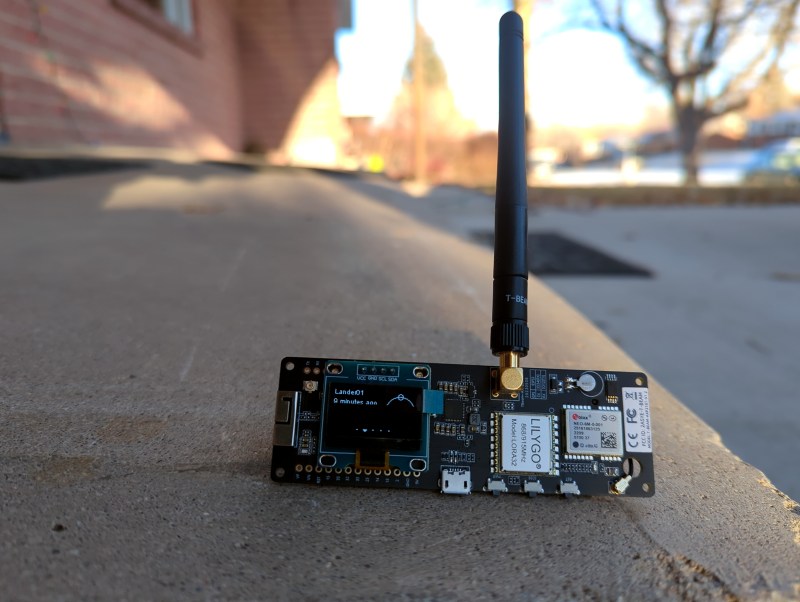
Although everyone has their own reasons for exploring a new hobby, one of the driving factors behind the popularity of Meshtastic and MeshCore has been the incredible accessibility offered by off-grid LoRa mesh networks. You don’t need any expensive hardware or a license to get on the air — armed with a $20 microcontroller dev board and open source software, you could be on the mesh in minutes. Then came the really exciting part, seeing who else was out there. The low barrier of entry and ad-hoc nature of these projects meant there was a good chance you’d soon find yourself exchanging messages with other like-minded folks in the area.
Or at least, that’s how it used to be. With the recent revelation that their default radio configurations have potentially been in violation of the Federal Communications Commission’s (FCC) regulations governing amateur usage of the 900 MHz industrial, scientific and medical (ISM) band, the users and developers of both Meshtastic and MeshCore have been sent scrambling. Getting in compliance isn’t necessarily a technical challenge. In fact, Meshtastic has already introduced changes aimed to address the issue and anyone running the latest alpha release can be sure that their initial radio configuration will meet FCC standards.
But unfortunately, this introduces a new problem. While it’s easy enough to get new installations of Meshtastic and MeshCore operating in a mode that keeps the FCC happy, doing so breaks compatibility with everything that’s already been deployed. The community will be fractured into distinct strata depending on when they first configured their hardware, with an added dash of confusion from the more rebellious users who will undoubtedly refuse to migrate over to the new settings.
What was once easy and accessible has just gotten a whole lot more complicated.
Wait, Are They Talking About Us?
So how is it that both projects could have gotten as far as they have without realizing that they may be in violation of regulations that date back to the 1980s? It’s actually a bit tricky to nail down the timeline. Nothing has changed recently in the rules, and while it’s possible there were some back-channel discussions, the FCC has made no public acknowledgement of Meshtastic, MeshCore, or the general handling of LoRa mesh networks.
But if we go back to October of last year, we can see the first signs of potential trouble. Issue #945 in the MeshCore GitHub repository points out that the default radio settings in the US for both it and Meshtastic would appear to run afoul of FCC regulation 15.247. Specifically the second paragraph of subsection (a), which dictates the minimum allowed bandwidth. Out of the box MeshCore operates at 62.5 kHz and Meshtastic uses 250 kHz, but the FCC says it needs to be 500 kHz or higher.
The resulting discussion, which spans several hundred messages and is still seeing activity as recently as this week, paints a fascinating picture and illustrates one of the reasons it’s taken so long for the issue to gain traction. Although the text of 15.247 may seem straightforward enough at first glance, there’s always room for interpretation with documents like this.
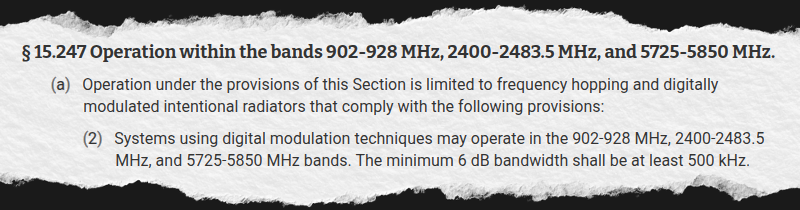
Some pointed out that subsection (a) states that it is “limited to frequency hopping and digitally modulated intentional radiators,” as evidence that it doesn’t apply as neither project utilizes frequency hopping. Others felt that the rules were only intended for devices with higher output power, and some even expressed a disbelief that the manufacturers would allow the modules to operate in a non-compliant mode in the first place.
Put simply they couldn’t decide if 15.247 was something they really had to worry about, and without any official word coming down from the FCC, were reluctant to throw the community into turmoil over it.
Philly Does Their Homework
While MeshCore users debated if they should switch over to 500 kHz, many Meshtastic users started exploring alternate radio configurations for a very different reason. Its default 250 kHz mode, known as Long Fast, was never designed for networks with hundreds of radios in an urban environment. Taking advice provided by the developers themselves, operators of large networks such as the one in Philadelphia started testing other modes to see if they would fare any better.
As it so happens, one of the modes tested by the operators of Philly Mesh this summer happened to be Long Turbo, one of the two available modes that utilizes a bandwidth of 500 kHz. Their findings, which have since been widely cited online, were underwhelming to say the least. Part of the problem seems to have been due to bugs which went undiscovered up until that point due to the relatively limited testing of Long Turbo mode. Unfortunately, even after the bugs were addressed upstream, they noted some of the hardware they tested seemed unable to operate properly when switched into 500 kHz mode.
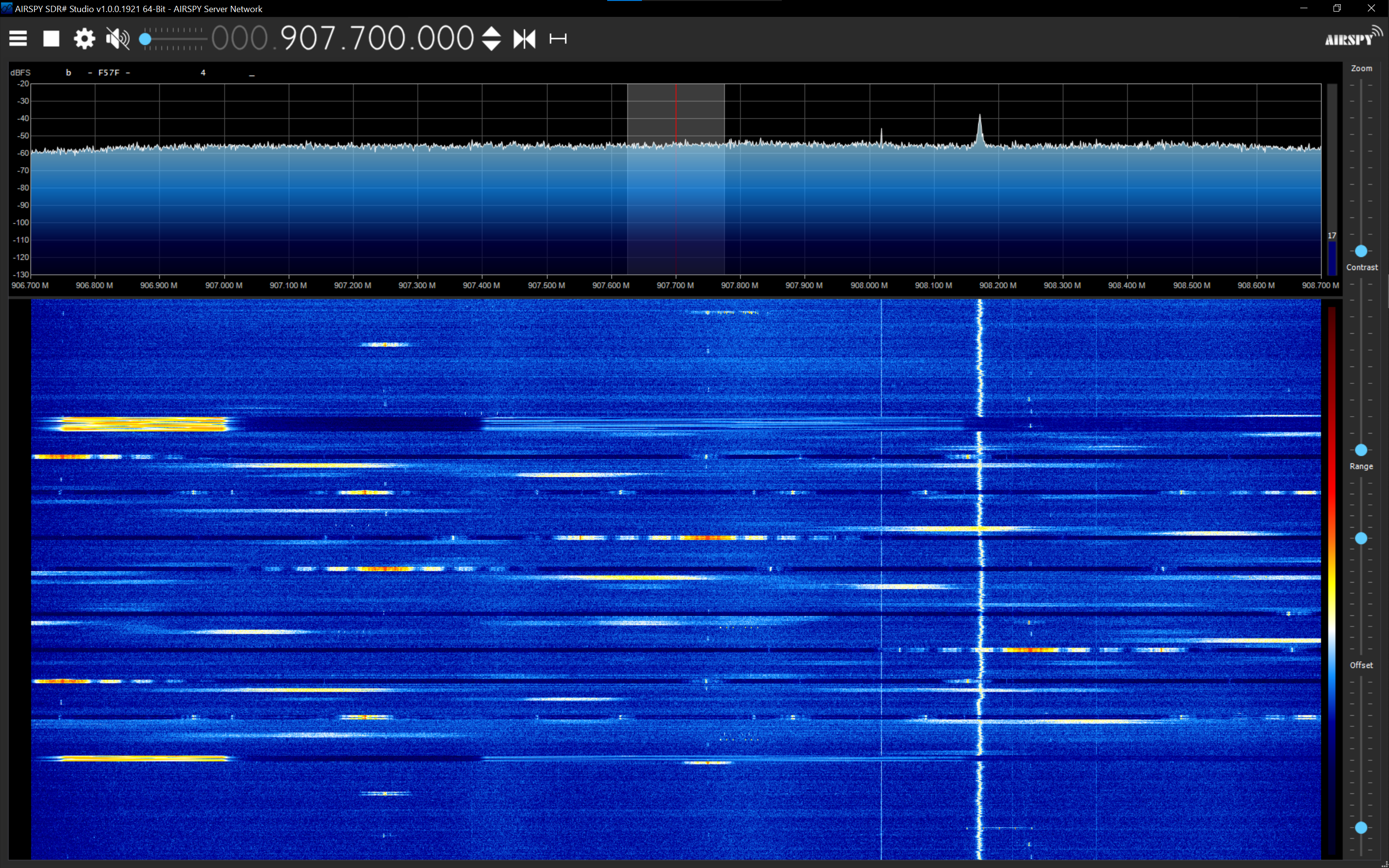
But the biggest problem they encountered was interference from other devices on the ISM band. In a dense urban environment like Philadelphia such interference is essentially unavoidable, but they found that Meshtastic operating at 500 kHz was especially susceptible to the electromagnetic din of the city. From their investigations, they theorize that the narrower bandwidth used by Meshtastic’s default mode was better able to slip through some of the interference, while the wider 500 kHz mode was more likely to collide with other transmissions.
Welcome to the Wild Wild Mesh
Given its poor performance at 250 kHz in an urban environment and the growing concern that anything less than 500 kHz could draw the ire of the Federal Communications Commission, Philly Mesh caused a considerable wave in the community earlier this month when they announced they would be switching to MeshCore.
While MeshCore was also impacted by interference at the FCC-compliant 500 kHz, during their testing Philly Mesh found that its protocol seemed to handle the situation more gracefully. The announcement also explained that they hadn’t given up on Meshtastic entirely, and that future installations may run both. But at least for the time being, it was determined that MeshCore offered them the best chance of creating a reliable mesh network in Philadelphia — a goal which superseded any loyalty they may have felt to one particular project.
 This decision completely shifts the balance of the mesh community in Philadelphia and the surrounding area. Not only will users running older Meshtastic radios set to 250 kHz be unable to communicate with newer installations operating at 500 kHz, but both groups would also be separated from radios that were being switched over to MeshCore — which themselves may also be operating at various bandwidths depending on how they were configured.
One large network which could be accessed by anyone using Meshtastic’s default configuration has now been broken into several factions. In theory everyone could simply start over from scratch and move over to the same configuration, but the potent combination of tribalism and apathy is all but guaranteed to keep many users in their respective niche, kicking off what’s essentially a LoRa turf war.
It’s too early to tell what will become of Philadelphia’s mesh aspirations. There’s little reason to question their analysis of the situation on the ground, and it could very well be that using a custom MeshCore configuration is the best way for them to achieve their stated goals. But it’s still a painful transition, and you can be sure that other large mesh networks in the Northeast and beyond will be keeping an eye on the situation as they consider their own futures.
Featured image: “Meshtastic T-Beam” by [Chiffre01]












Interesting. What about other area in the world, say Europe?
Regarding the radio rules, the takeaway is: Don’t rely on the manufacturers to know or care about your local laws, you’re the one doing the broadcasting and they just sell you the kit.
Everyone is going to have to deal with the interference and network density issues no matter where you are because these protocols weren’t intended for mass urban usage.
And Canada (which uses the NA band of 915) ?
ISM band duty cycle limitations at any appreciable range gimp most LoRa applications. See ETSI EN 300 220 regulation. For SF12 on the primary bands, you effectively get about 500 bytes per hour throughput because you’re only allowed on the air for 36 seconds (1% duty cycle).
It’s also so slow that for many IoT applications it’s a better budget for your power use to use a cellular radio, because on Cat M you can connect to the network and send our data, and go back to sleep in 10-20 seconds, for what may take minutes with LoRa. The cellular connection also cuts out the middle man because you’re on the internet instead of sending data through a gateway.
The ‘regulation’ is 2017/1483/EU.
The test standard is ETSI EN 300 220-1
(FWIW, they both are about to be updated.)
Signed, your friendly neighborhood pedantic jerk
Thank you.
It’s actually ecc recommendation 70-03 that is really interesting….
73
There is no 915 MHz ISM band outside ITU region 2. In Europe, these frequencies are primarily used for mobile communications at least since the ETACS era.
The European equivalent ISM band is 868 MHz, between 863–870 MHz.
Also the “old” 433-434 MHz ISM band.
Was 433 ever available in Europe?! I always thought it was used for other stuff (think analog TV, which is now being moved to broadband type services?).
This band is so tightly regulated that one can’t call it an ISM band. Also it isn’t listed as such in EU and national laws.
Its not an ISM band its a mobile and partly military band that can be used by short range devices under strict conditions. Europe has no ISM band in the 900 MHz range, thats only region 2.
915-921 is not completely harmonised as SRD band in Europe either, both Germany and Netherlands dont allow anything there except military communications. 918-921 is exclusively for railway communications in Europe.
This bad is not in europe
Australia’s Low Interference Potential Device (LIPD) regulations have a limit of 1W EIRP and 25mW per 3kHz of occupied bandwidth (Table 8, Row 6 / Clause 43: https://www.legislation.gov.au/F2025L01047/asmade/text)
So the mesh in Sydney and surrounds has moved to 125kHz / SF9/ CR5 (aka “Australia Mid”), being the bandwidth required to operate at 1W EIRP without breaking the power spectral density limit. Victoria still operates at 62.5kHz, but they’re arguing about moving to 125kHz.
125kHz also fits between LoRaWAN channels used here, so we operate just inside 915MHz to avoid the first LoRaWAN channel and get as far as possible away from mobile phone noise above 930MHz.
In Europe, the EU 868 MHz spectrum constraints need to be taken into account, particularly the duty-cycle and spectrum-access requirements. This becomes a significant scalability constraint for large sensor deployments when bidirectional communication or ACKs are required, because every downlink/response also consumes additional radio airtime.
As a result, a design with 1,000+ sensors cannot simply assume unlimited bidirectional traffic. At scale, the available airtime, packet size, reporting frequency, ACK rate, and applicable duty-cycle limits all need to be engineered carefully. For applications requiring frequent ACKs or two-way communication, this can materially limit scalability in EU868 unless an appropriate spectrum-access mechanism and architecture are used.
I’m a commenter on that thread, and I kinda noped-out of the community because everyone just wanted to stick their heads in the sand about being compliant. I also wrote a blog post about whether you can use the LoRaWAN chips with meshcode (it’s a little out of date, because I think someone has been able to get it working at least in part), and in that post I bring up the fundamental difference of LoRaWAN (which is FCC compliant) and Meshcore/Meshtastic. That is to say that LoRaWAN actually does frequency hopping with end devices.
I know meshtastic thinks it’s an advantage to be able to be truly peer-to-peer, but as the Philly mesh experiment shows, in practice meshtastic just doesn’t work well.
I had proposed, and I truly believe, that it’s possible to build a mesh that is as easy to deploy as meshcore/meshtastic, but is also FCC compliant. But, members in the community either don’t care, or don’t believe that it’s not compliant.
Yeh Meshcore doesn’t work much better in Los Angeles either (Meshtsastic is unusable) – Too many repeaters. The utopian fallacy that “more repeaters make it more robust” is counterproductive and has trashed the whole thing. You see lots of nodes and traffic but you can’t reliably communicate with any of them. The other demented notion users have is that it has to be as ubiquitous and work everywhere like cell coverage. Also nope, not as it is now. I wouldn’t be sad to see the entire thing disappear in its current form.
Wow, totally inaccurate. Meshcore has a reach from Santa Barbara to San Diego in SoCal. It is way better than MT for sure. I communicate daily with little issue. Maybe you need a better antenna?
This. I used to design ISM band radios for a living and have avoided these projects and movements because people don’t understand or care to follow the FCC rules. Throwing a flag on the field just gets ignored.
Its not about whose better or works better…meshtastic works 100 times better where i live (lest populated) the fact that everyone act as a repeater makes it work. However, in more densely populated cities that just congests the air waves and meshcore hands down is the way to go. They’re both great and excell in areas where the other fails.
This has the appearance of similar issues that appeared in the Quadcopter/Drone community before the the hard regulation came down from the FAA here in the US – It would be a good Idea to take note! Last thing we want is the FCC to come down hard and BAN these kinds of things all together, which, given the way the Federal Government reacted to the Drone situation, could very easily happen to these radio technologies. Hopefully the community will take this seriously, because I would be disappointed to see this becoming a regulatory mess like Flying Quads/Drones and RC airplanes has become.
I’d say that Brendan Carr is far too busy committing crimes to care about the ISM band, but due to the fact that a lot of ICE rapid response teams use the mesh, I could see them coming down hard. But, the encryption is such a joke on the mesh that I could also see them letting it fly and scraping the data to use against activists.
For decades the RC flying community played nice and FAA had no reason to worry about them.
Sadly multicopters became affordable and very easy to fly. Any asshole could fly them and use them to invade privacy of others (or cause harm in different ways). Hobby airplanes had to be either banned or tightly regulated.
Same thing with (electric) scooters. Around 2016 I wanted to build myself a large, steel scooter thing fitted with a Honda GX160 engine. Back then it would be just an interesting technical curiosity, a display of DIY metalworking skills. Having built it myself I would probably ride it responsibly, not to endanger myself or anyone else. The project was shelved because at the time I didn’t have enough funds to do it right.
Around 2018 Bird, Lime and other public e-scooters became a thing. Suddenly any drunk teen could ride them and have a laugh terrorizing pedestrians to make a great TikTok video. Few years later and the Chinese started selling e-scooters fitted with large battery packs and BLDC motors so powerful, that any obese antisocial teen can easily reach speeds of over 50 km/h while on a sidewalk.
Just like with RC planes , the “wild west” era of personal transportation is now over. We’re in a period of bans and harsh regulations due to assholes misusing a new technology. My gasoline-powered scooter thing project makes no sense anymore as I wouldn’t be able to ride it anywhere :(
On the other hand, in this particular case I’m somewhat glad the procrastination won. Nowdays, literally every day there’s a new media report of how someone was riding an electric scooter, had an accident and suffered a debilitating injury. Turns out those things are unstable and very dangerous even when wearing a full-face helmet. I guess I’ll just stick to cycling and driving a car. Tens of thousands kilometers on both and I’m still fine.
I would say, when RC planes were the preserve of the rich, it was far more likely to find an asshole at the sticks. With the general public, it’s more about the general incompetence than a fundamental disregard for your fellow human being.
“when RC planes were the preserve of the rich”? Hmm… That kind of statement makes me think you were never a part of the RC community.
I had a small RC rig back as a teen, before Star Wars. As a rule, RC flyers, drivers, and boaters have generally always been responsible. To be sure, there are always morons and idiots, but they weren’t common–or dangerous–due to the effort needed to get the whole thing going. Now, anybody can get a quadcopter and start flying–and THAT is the source of the stupidity that ruined RC flying for the rest of us.
There’s a difference between an asshole and a moron. The asshole doesn’t care about other people or their property and safety – they only care about their own. The moron or idiot simply doesn’t think before they do.
The idea that RC flyers were all “responsible” before is discounting the fact that assholes only act responsibly when it’s their own ass on the line. If the gear is cheap and replaceable, and the risk of getting caught and punished is low enough, they don’t care.
A moron doesn’t think, an a-hole doesn’t care. They only act responsibly when there’s a risk of punishment or loss to themselves – like when their hobby costs enough money and time that you don’t want to crash your RC plane into someone else’s house.
Having worked SAR for boaters….no there are tons of idiots
Exactly. But I don’t see this as a problem – stupid people doing stupid things, and then complain when the government jumps in and tightens the regulations. This is what they deserve anyway. “The dry and wet burn together”, you know.
The FAA and FCC have radically different agendas. The FAA needed to keep airspace safe for all users and developed regulations that pretty much satisfied everyone. They’ve always used a ‘light touch’ approach to regulation — they make the rules, they don’t try to enforce them directly for the most part (the community is expected to police itself) but if you’re found breaking them after, say, an incident expect them to come down on you like a ton of bricks.
The FCC, especially under Brendon Carr, has taken on a very different role. Its using its regulatory authority to regulate commerce in favor of established interests. So it now prohibits importing of Chinese made drones, ostensibly for ‘national security’ but in practice to give his sponsors a helping hand to cope with crushing competition, and it does this by refusing FCC certification even to valid, established, radio equipment. He’s now proposing to extend this ban to R/C in general. Technologies like LoRa have the problem that they undermine what is effectively a communications monopoly by cellular interests so naturally you’ll expect the rules to be changed to mae the technology less useful. The FCC has strayed a long way from its original purpose of spectrum management by sharing among users, its become overly politicized, being now a blatant shill for pay for play business interests when its not acting as a media censor.
FCC rules are written the way they are for legitimate reasons. We have only so much bandwidth in the ISM bands and we all have to share it. The rules have been basically the same for many years. It is up to the users to comply or risk them being taken away from everyone.
The assertion that it is the cellphone companies leveraging the FCC to kill off projects like this is ridiculous. There are several legitimate businesses selling ISM equipment for communication that compete with cell services. The difference is they have professionals making sure they conform to the rules.
Actually, with regard to the present Administration and in particular the FCC head I wouldn’t just assume ‘legitimate reasons’. The FCC has instituted a ban on the importation and sale of new drones by flat out refusing to certify any new products. As you may know certifying radio equipment for sale is an involved process so manufacturers sell certified modules that go into a product (its why you can use a Raspberry Pi Pico in anything without having to individually certify each product — the Nano’s certified so whatever its used in is implicitly certified). Mr. Carr is now trying to extend this to ISM based R/C equipment in general. Obviously the spokespeople will waffle on about ‘interference’ and even ‘national security’, its their job, but people with a bit of real technical knowledge know better.
The reason why these rules will be changed is to degrade LoRa for informal messaging. Its just got too big for its boots. The best solution for people who want to continue using it would be to get an amateur radio license — the Technician class license is easy to get, there are lots of resources to help you get it and a fairly powerful lobbying group to make sure it continues to be usable.
Once upon a time they did, but if you think it is still like that, you are misinformed at this point. It like most government has been infested with private and political lobbying for personal gain. Long gone are the days we can trust them to effectively manage the spectrum in a way that is equitable for the American people as a whole.
Seems early real world testing should have caught a lot of this.
Yes, but more than testing the communities seem to have skimped on finding somebody who understood the regulations governing the ISM bands.
And saying “let’s ask the FCC!” isn’t a viable option: the government approach relies on finding (and paying for) an expert at the planning stage who is prepared to but his professional reputation on the line, and only getting involved if he’s wrong which ends up painful for everybody.
There actually was real world testing. We knew about the noise issue long ago, before even making the pull request to make the change here:
https://github.com/meshtastic/firmware/issues/8214
As it was based on settings here in Alberta (yycmesh.com). That’s why we are running at 902.x and suggested the preset name be different because of how it hashes it as part of the calculation of the channel 0 frequency.
It was also based on the assumption that the very high default CR of 8 could be adjusted with a variable Code Rate feature to balance speed and packet reliability.
Love how law abiding people are in many parts of the world. If i want to use LoRa it usually means I’m using SF12, 62.5KHz channel. Air time with the data I’m sending is in seconds per packet.
Sorry not sorry. I mean I’m hardly harming anyone with 20dBm of TX power…
It’s unlikely anyone’s ever going to catch you. The regulations are more about what kind of products you can sell rather than what you can use.
Right up until you romp on someone’s medical monitor using 10dbm
I’d blame the victim. Who puts anything important on an ISM band?
I = industrial
S = scientific
M = medical
The ISM band isn’t for individuals to use casually. It is set aside for the use domains listed in the acronym. Secondary use is HAM. Public use is tertiary and is explicitly contingent on not interfering with primary or secondary use. (Likewise, HAMs may not interfere with primary use.)
So go ahead and blame the victim. If you are using the ISM band illegally and cause a medical device to malfunction, causing a patient to die, you are guilty of manslaughter, in addition to FCC rule violations. If you get up in court and blame the hospital, the jury will convict you without question and recommend the maximum sentence.
There’s a reason HAM licenses are required for higher power and range use. If unlicensed users are routinely breaking the law in potentially deadly or destructive ways, the correct FCC response would be to remove unlicensed usage permissions entirely, track down and arrest anyone still using them without a license, and require everyone doing non-primary use to prove they understand the law by getting a HAM license. (And us HAMs will gladly help them catch illegal users.)
This is no skin off my back, as I am HAM licensed, but blowing off the laws and regulations enforced by the FCC is just begging to lose your privileges to use the ISM band and even risks committing serious felonies.
I believe that permitting restricted unlicensed use is a net good. So I’d rather not see that disappear. However, if unlicensed users won’t follow the regulations, the only option for public safety is to withdraw that permission. So don’t screw it up for everyone else! All it takes is one death or one industrial accident caused by a reckless unlicensed user to ruin it for everyone.
The rules on the ISM band is that your device must except and accept interference, so if someone builds a medical device that that goes bonkers because it can’t deal with other emissions, the fault is on them.
typo: except – expect.
Of course if you’re blasting enough EMI on the ISM band that it’s physically interfering with some medical device and not just blocking its radio, then that’s another issue entirely.
https://en.wikipedia.org/wiki/ISM_radio_band
Let’s tone things down a bit. I don’t think anyone is seriously talking about anything that would realistically interfere with anyone’s medical equipment. Do you really foresee a whole lot of LoRa mesh users homebrewing killowatt amplifiers for this?
Unless maybe grandpa escaped his hospital room, climbed the tree or whatever that someone placed their 1-watt Rak board in and hugged it tightly against his pacemaker bearing chest. And even then I really doubt it would do much.
I’m a ham too. (it’s not an acronym, no need yelling it) But I prefer to use these networks under part-15, not part-97. I’ve long thought that a mesh network that unlicensed people can use and that allows encryption (more for identity proving than secrecy but whatever) would be a really good thing to have. If my outdoor weather sensor can double as a neighborhood repeater for such a network… awesome!
If I switched my nodes over to use part-97 permissions.. I’d be contributing to a shorter range beta-version of what APRS already mastered decades ago. Why bother?
We are way too dependent on big corps for all our communications. (a condition which the FCC has certainly embraced) And no, I don’t want encryption in amateur radio, the bands would be over-filled immediately by a handful of us using it as a long-range personal WiFi about 1/2 a day after that law changed!
I’ve also long thought there should be public license-free broadcast band where the rule is keep all transmissions within the band, don’t expose passers-by to unhealthy RF levels, and not much else. I don’t think that one is ever going to happen but now with internet streaming… I guess we don’t really need it to either.
Dude, The stipulation for accepting interference is based on people complying with the rules. If you are not in compliance and you are interfering you are the party at fault.
Even if people are complying with the rules, there may still be enough interference from many devices to effectively block the entire channel you’re trying to use, and ISM band devices are just supposed to deal with it.
Beyond that, you’re talking about EMI that affects the rest of the device’s electronics directly, and that issue is beyond compliance to the regulation. That would be someone doing something clearly illegal anyhow.
And on the point of medical devices not being EMI hardened against direct interference from the radio band they’re operating on would just be incompetent design, because the device’s own radio is the closest and most intense source of such interference by a huge factor.
Radio signals drop off in the square of distance. If the device fails because some non-compliant device is transmitting a few watts nearby, even just a couple feet away, it would have to be so sensitive to EMI that it would malfunction instantly by turning on its own radio.
Why is there a minimum bandwidth restriction? I can see placing a max so as not to hog the entire channel, but what disadvantages or interference occurs with a narrowband?
Because that’s how you restrict the non-licensed ISM performance (mostly range). Spreading the transmitter energy over wider frequency range reduces the communication effectiveness, as also does widening the receiver input bandwidth.
Widening the transmitting bandwidth without increasing overall power (restricted ERP) dilutes the transmitted energy over the bandwidth. Meanwhile, widening the received bandwidth increases the amount of noise you pick up.
The effect of both is that the signal you’re measuring becomes weaker and the apparent background noise becomes stronger.
But it’s not just about limiting your performance. The point is that by diluting the transmission energy over a wider band, it creates less interference for other devices. It’s like whispering instead of whistling – the overall energy might be the same, but the hissing whisper disappears into the background at a closer distance.
PSD reduction.
Yeah, it’s not actually “minimum bandwidth” at all, it’s power spectral density – they’ve just defined it as “a signal (at the maximum permitted total power) has to be spread across at least 500kHz” to ensure that the power at any specific frequency is below the limit. If your signal is quieter than the maximum allowed then the minimum bandwidth is proportionally narrower.
Thanks; TIL. Probably shouldn’t have slept through my EE class.
That’s not correct. Against thermal noise, which is uniform (white), spectral spreading is power neutral. The relevant term in the Shannon equation is Eb/N0 – the received energy in joules (watt-seconds) per bit divided by the noise power density (watts/Hz); bandwidth doesn’t enter into it. Interference is another story. Most radio communications systems minimize it by assigning frequency channels and time slots so signals at one time and frequency can’t affect others at different times and frequencies. Spread spectrum is for situations where that kind of prior coordination is impractical, so ideally it spreads interference so widely that it falls below the noise that’s already there. That’s the theory, anyway.
The way LoRa and similar technologies work is by sending an up/down chirp that spans multiple frequencies. The point of the modulation is that by monitoring a wide bandwidth for a particular pattern over time, you dodge interference at any particular frequency. With the ISM frequency being open to all, you have to deal with interference, and this spread spectrum approach is one way to bust your way through the general noise.
The wider the band, the more likely you are to dodge interference at any individual frequency – but there’s also a limit to how much power you’re allowed to transmit overall – so if you spread the band too wide you’re diluting the energy at any given frequency making it harder to detect.
Transmitting with limited power over a wider band, you create less interference for other devices that might be using any specific frequency, while your transmission becomes harder to detect over the general noise floor. In other words, it’s a tradeoff between how much interference you’re allowed to cause to others, versus how easy it is to detect and demodulate your signal.
If you know the spread signal you’re looking for, the wider bandwidth doesn’t hurt at all; the receiver de-spreads the signal back to its original bandwidth (which depends on data rate). But if you’re NOT looking for a particular signal, then the wider it is spread the less likely it is to bother you. Ideally it’s weaker than the thermal noise you already have to deal with, in which case there’s no interference at all. The problem comes when an unwanted transmitter is so close to you that it appears well above the noise despite the spreading.
Even without a lot of local interference… at twice the bandwidth won’t a lot of range be lost? How much?
Has anybody checked if a similar problem exists with openMANET based on 900 MHz Wifi Halow?
WIFI halow is 1-16mhz wide it wont be impacted… but that said going from 62.5 kHz to 500khz wide is going to absolutely murder the sensitivity on these things.
Yep, FCC paving the way for LTE CAT NB1 for the carriers :).
That’s not even remotely the case unless they’ve developed time travel technology and not told anyone else about it.
These ISM rules date back to the 80s, and the FCC isn’t cracking down on Meshtastic/MeshCore/Lora (at least not presently) nor have they made any action whatsoever.
This whole situation is the result of the projects themselves realizing they’ve technically been in violation of those ISM rules the whole time and bringing things into compliance. That’s it.
While I have no love for the current head honchos at the FCC, and am well aware they have their own agendas, there’s no agenda here.
Hey Tom, thanks for the great article!
This reminds me of some years ago, the 27 MHz CB community – hey, we found something that seems free, let’s abuse it to death! It’s illegal? Couldn’t care less, not my problem… I think even today trucks are using QRO CB radios, with harmonics spreading 10s of MHz up.
This is the danger of incompetent people touching equipment (which they have no business to touch) which can cause issues at long ranges and there’s always a trigger-happy government agency ready to over-regulate to death.
My personal stance on this – go and get an amateur license. The learning part of it is really important, so you become an educated and responsible spectrum user, not causing harm to yourself and others, in any way.
The 27 MHz band is itself an ISM frequency, thanks to being a higher harmonic to lower ISM frequencies and military radars etc.
The ISM frequencies are generally, but not always, aligned to a harmonic series so that the interference from lower bands align roughly with the higher bands, and they all spill over on one another. It’s exactly because amateur, experimental, and military equipment operating on these bands cannot be expected to output very clean signals…
Ahem. Where I live, it’s the duty of the radio amateur to monitor his/her transmissions and make sure they’re clean.
No matter if the transmitter is homebrew or commercial.
This dates back to the earliest days of wireless communications, when many of the other services didn’t exist yet.
The reasons for many ham bands to be on multiple wavelenghts also was due to the experimental character of amateur radio.
In order to study propagation on shortwave, the ionosphere and so on.
For experimentation and research this truely mattered. Still does, maybe.
100% – gaining an amateur license means you’ve proved that you know the rules and have the skills and obligation to follow them.
Similarly, having a drivers license doesn’t give you the freedom to drive an unsafe vehicle or break the speed limit.
Yes
To be more accurate, many of the ISM frequencies originate from industrial RF heating applications where you need such high power that filtering out all the harmonics becomes difficult if not impossible.
Early microwave heaters operated in the 900 MHz range, from which we get 868 and 915 MHz ISM bands, then 2.45 Ghz and the 5 GHz band. Lower bands around 6 MHz, 13 MHz, 27 MHz, and 40-60 MHz were used for near-field RF welding and heating. 27.12 MHz was used for plastic welding, or for things like pressing laminated wood and setting the glue in between the layers. That’s the “industrial” in “ISM”.
All those applications never went away. I’ve been to a factory where they press plywood and particle boards using high-voltage dielectric heating at radio frequencies. Even if it’s not an intentional radio transmitter, when you’re running kilowatts of RF energy, some will leak out. We were instructed to leave our cell phones and credit cards in the dressing area.
“…cannot be expected to output very clean signals.”
Our national spectrum regulator has very specific expectations codified in a regulation document with exact values for frequencies, EIRP and harmonic content, and you’re totally expected to follow it by the letter, otherwise you can expect the typical actions – loss of license (if you have one), confiscation of property, civil and/or criminal charges depending on the situation.
Perhaps the right phrase is “could not be expected”. The ISM frequencies began to take shape right after WW2 which was in the vacuum tube era. Existing legacy equipment, especially military and experimental gear, weren’t following regulations that didn’t yet exist.
But if what you’re saying is correct, then the FCC is basically misleading people. Because these devices are FCC certified, aren’t they? And FCC certification is specifically meant to be able to give devices into the hands of incompetent people without running the chance of them causing issues. Right? If not, then why go through all that trouble of certification?
(Yes, I know that another role of the FCC is to be a political tool to help favor local manufacturers over foreign manufacturers. Let’s not go there, even though I just did :P)
Most of these devices have a Part 15 equipment authorization from the FCC. They ship with firmware and settings that were tested in an authorized lab. The problem is hobbyists buy these devices, wipe the original firmware, and install their own (meshtastic or meshcore), and change the settings to whatever the regional default is.
Perhaps the FCC could go after the manufacturers for not preventing this “foreseeable misuse” of their devices, but these devices are also development boards, so locking them down too much would hinder that use.
FCC did do something similar a few years ago when some Ham bozos in San Diego took some UBNT M3 3.4GHz gear (hams HAD access to that band until AT&T backed a truckload of money up to the FCC door and bought it out from under us, even though the ARRL was warned back in 2011 it would happen without help promoting its use, the ARRL Board just sat on their straight keys twiddling their bugs), loaded their own crappy mesh firmware without realizing the stock firmware listened first to avoid other users, put them up and clobbered USN’s aircraft radar there. The Navy bitched to the FCC, and the FCC put out a mandate that all routers/AP’s now must be locked down to the mfg’s code, limiting OpenWRT/Tomato, etc use. A few idiots ruined it for everyone.
That’s what someone who is interested in amateur radio is about, but not what getting a license will lead you through. I hold a General license based on my single EE class in undergrad decades ago. I reviewed the Tech questions the evening before the exam* to pass by rote memorization; I tested at General because they offered; I worked out the problems longhand or made engineering guesses (I also tested and failed Advanced at the same sitting). I only got licensed so I could use an OTS GPS tracking device for a high powered rocketry. I’ve yet to learn anything else.
you could argue that this is a good reason to not have dropped the Code portion of the test…but I’d likely have learned CW while still gathering zero RF knowledge.
Yes, this has been a thought of mine for some time. Unlicensed radio use has had this trouble brewing for a while. When there is a handful of users things hum along and nobody cares but to scale things up regulation becomes important. And we currently have frameworks like the amateur service. People seem to want the freedom but not the responsibility.
If the FCC regulations are ambiguous why doesn’t someone in the community ask the FCC for a ruling on interpretation?
Because they generally don’t say yay or nay unless it immediately benefits some corporate/industrial actor. They like to keep you in the loose noose until it’s time to hang. That’s called “regulatory capture”.
It’s not about regulatory capture, although of course they are captured – it’s because the FCC’s job is to manage the spectrum and settle disputes between users. They’re a court, not the police. They won’t proactively give you the ok to do anything, and they don’t care if you’re shouting out in the sticks where no one else can hear you. But if someone decides to yell into a megaphone next to someone else’s bedroom (metaphorically) that’s when they’ll make a decision.
Because all the FCC will say is “hire a professional who knows how to interpret the standard. After that, if you get it wrong we’ll sue you, and your recourse will be to sue that professional for negligence.”
I emailed ISED/IC a question, they responded quoting the regulations. They did not interpret them at all to the question I asked.
Instead of making a mistake they just simply won’t clarify.
There’s really no ambiguity here. Semtech has published application notes on how to ensure your LoRa device conforms to these regulations. The meshtastic team has said publicly that their Semtech advisors told them the presets were illegal (source: https://www.reddit.com/r/meshtastic/comments/1wcyg6z/comment/p92isoc/). Most of the folks against changing the presets have moved on to other arguments now like “Sure it’s illegal, but the FCC hasn’t fined anyone yet, so why bother?”
After the great garden-wallification of the early internet, I don’t think they want to let any other wild west free networks sprout up. Everything has to be another iteration of cable TV from now on.
I played with Meshtastic and cited some of these concerns (as well as other issues)… years ago. I was considered a “troublemaker” and after an initial burst of support when I entered the hobby, could no longer get any kind of support. I dropped my radio into a waste basket and moved on. You will get zero support from the Mess-tastic community if you try to point out anything that flies in the face of their marketing and cashflow. “If you make a donation, you will get better support.” – direct quote from one of the moderators at the time.
That’s just the open source business model at work. You don’t pay for the application, you pay for support to actually use it. It’s actually refreshing to see somebody so honest and open about it.
Yea, perhaps that’s poorly phrased. Maybe folks would better understand “We’re not friends and family. If you pay (to support) my time, you’ll receive it.” That’s how most things work, even when the payment’s in kind or in aid of a mutual goal.
Although reading through this I’m mildly surprised there weren’t licensed operators somewhere in that mix of people developing. Most of the general radio folks I know wouldn’t run afoul of this if I’m reading it correctly. A project like that seems the sort of thing a steering committee meeting up in person is designed for.
Apropos of nothing more than my own experience that sounds like a small group of software people without enough support to field appropriate inquiries.
It’s a bit two-faced. Some people who really subscribe to the “open source” ideology treat it as a commune where everyone is invited, while for others it’s just a token gesture to say you’re in if you work for us and out if you don’t. In my observation, the latter is more prevalent and most developers don’t care what anyone outside of their group does with the stuff. Why would they?
Lora radio modules are type approved in the USA. Their potential for interfering with other users of the regional ISM allocation has been determined minimal at ALL possible settings. Absent a major issue with another user of the allocation, FCC has neither money nor incentive to enforce the current wording of the regulation. The regulation is demonstrably obsolete as the modulation method did not exist at the time of rule making. Another branch of the government (SEMTECH) was developing it. It is de facto legal IFF you are using the module approved for your region.
The practical and politically correct response is simply to document mesh performance and the ambient RF environment over time. Demonstrate with data that the regulation is wrong.
A small number of SDRs spread around Philly streaming the entire ISM band to disk synced to network performance metrics will provide clear proof and data for several first rank theses and dissertations. They need to be phase matched via GPSDO but the cost to build such a data archive is very low.
In short, prove NB performance is superior. Test performance with all the proposed alternate schemes across Philly concurrently while recording the ambient RF. FCC will have little choice but to approve best practice.
OK you can leave your day job, and take up comedy full time.
Not how any of this works.
This is just completely false. You can look up the Part 15 equipment authorizations yourself. They were all tested and approved at > 500 kHz.
Has anyone investigated why that was the case? On the face of it the physics are the same, so is Meshcore trying harder or more frequently? I know there has been some debate about opt-in duty cycles and whatnot. Would be good to get an expert’s view.
Meshtastic / LoRa are out in the wild. Very difficult to restrict it now. Perhaps by way of indifference, impossibility of enforcement… low power free-for-all band… legal complexity… FCC needs to modernize Part 15.247 to reflect reality (LoRa-Chirp Spread Spectrum).
The legal purists are raising noise about nuances and outdated FCC rules. How to prosecute an “illegal” transmission that is made with FCC certified hardware as DTS AND with narrower bands than what DTS rule 15.247(a)(2) allow?
Run this FCC issue with your favorite AI. Summarized the following (which I’ve cut and pasted, and challenged AI for mistakes and hallucinations… or edited for clarity…. AI was double-speaking sometimes). I went through a few iterations… not straightforward.
The split in §15.247 is:
§15.247(a)(1) → Frequency hopping systems (FHSS)
Hop count, dwell time, 20 dB BW limits (≤ 500 kHz), etc.
§15.247(a)(2) → Digitally modulated systems (DTS)
Minimum 6 dB BW ≥ 500 kHz.
The distinction is hopping vs non‑hopping, not spread vs non‑spread.
LoRa radio modules are certified as DTS, and the CSS modulation is granted an exception from the 500 kHz minimum because it is recognized as spread‑spectrum…. Narrow bandwidth allowed due to CSS spreading gain. Operates legally under §15.247 at DTS power levels.
Probably under industry lobbying, FCC found a home for certifying LoRa modules that would preserve the technology benefit to long range, low bit rate. This is why LoRa at 62.5 kHz or 250 kHz is legal because FCC itself granted an exception to the DTS minimum bandwidth requirement and FCC allows labs to certify as such.
More technical detail is in FCC radio module certifications that use SX127x/SX128x and Semtech’s application note “AN1200.26: LoRa and FCC Part 15.247: Measurement Guidance” is the smoking gun. It explicitly describes how LoRa is evaluated under FCC Part 15.247 as a digital transmission system (DTS/Hybrid). The emission designators are all under 500kHz BW (like 250K0D7D).
Do you have an example of an FCC filing for a precertified module? Does it contain an explicit waiver?
FCC certification is not permission to use it however you please. If your device is not being used in compliance with regulations, certification is irrelevant. All certification does is protect the manufacturer from lawsuits if the user does not adhere to regulations. (It is also required to sell RF products for non-experimental use.)
Normally the FCC does not send out enforcement if no problems are reported. That does not make it safe to violate the rules though. If you interfere with primary or secondary (HAM) ISM users, and they report you, the FCC will hunt you down, which will be easy, since you are sending out and easily identified non-compliant signal. And us HAMs will happily help the FCC, to protect our own privileges. (Where I live, the FCC sends out regular reports on reported violations and who got arrested and/or sued. The list is hundreds long every year, for a region with a fairly small population. Most reports are made by HAMs, and many arrests are made with help from HAMs to identify the source.)
As far as the AI claims go, have you ever heard of hallucination? The AI isn’t going to the FCC regulations and reading them. It’s searching the Internet and then averaging the relevant information with equal weight regardless of source. One guy on Reddit speculating that the FCC made a formal exception, or even suggesting that it should, has equal weight to the law in the eyes of the AI. Lot’s of people online making that claim (like you) or speculation can easily cause the AI to claim the opposite of what is true. If you haven’t read it from the original source, you’d be an idiot to risk your freedom based on what the AI says. Depending on what you end up interfering with, you could end up with a felony conviction for violating FCC rules. (Damage or injury caused by such violations are legally your fault and are prosecutable in criminal court. If your LoRA device being operated outside of regulatory requirements causes a medical device to malfunction and a patient dies, that’s manslaughter.)
LoRa is a huge part of what I work on at the day job. I have run two sub-1 GHz devices of my own design through FCC certs. One employs frequency hopping spread spectrum (FHSS). One operates with fixed channels. Both needed to satisfy the 500 kHz 6dB OBW requirement in 15.247.
I’d noticed that the 500 kHz OBW requirement was violated when looking at some Meshtastic presets. Was wondering if someone would notice.
Maybe YOU’RE the one to explain why there needs to be a minimum bandwidth. It seems counterintuitive, except that by limiting available “channels” it will limit total traffic and maybe thereby the attractiveness of the band.
A lot of people here are worried the FCC wants to take the ISM band and reallocate it for telecom. This is absurd. The ISM band is not a free public use band. It is a reserved band for industrial, science, and medical use. The FCC permits limited non-primary use. HAM use is secondary, and unlicensed use is tertiary, because it’s easy to listen in and avoid interfering with primary users…unless you are recklessly transmitting with LoRA devices blind, in illegal modes. The 900Mhz ISM band is where and what it is for many reasons, historical, technical, and legal. The FCC cannot reallocate it without a Congressional bill leaving certain international treaties and redesignating it for another purpose. And even if all of this happened, harmonic interference from other ISM and military bands would severely limit its telecom value. There is no risk of this whatsoever.
If you insist on trying to get involved in legal and political discussion on this topic, please learn what the law is and why. In fact, go get your HAM license. It’s not that hard, and learning the laws and regulations are part of it, and then you’ll know how to do this stuff legally, and you’ll know the consequences of breaking these laws and regulations, which can be quite severe. Also, a HAM license will allow you to transmit in different modes with higher power, so long as you do it responsibly. It’s win/win!
“The FCC cannot reallocate it without a Congressional bill leaving certain international treaties and redesignating it for another purpose.”
Per the Constitution you are correct.
But the FCC is appointed by the executive branch.
Have you not been paying attention at all for the last 10 years?
The Constitution is not being followed anymore.
ISM bands all have propagation issues. Things like maximum absorption of transmitted energy from water molecules, etc… (The same reasons microwave ovens use 915MHz and 2.4GHz). There is no real threat of big business taking the ISM bands.
That said not following the rules set down doesn’t mean the fcc won’t take it away from unlicensed use.
This is a common misconception. Water is not particularly resonant at 915 or 2450 MHz. You don’t start to see water resonances until you’re up around 24 GHz. Yes, water heats in a microwave but simply because it’s a polar molecule that gets tossed around by the oscillating electric field. But there’s nothing magic about 2450 MHz.
ZtP said:
“Per the Constitution you are correct.
But the FCC is appointed by the executive branch.
Have you not been paying attention at all for the last 10 years?
The Constitution is not being followed anymore.”
Can you clarify, please, what magical event occurred in “the last ten years?”
I’m pretty sure the undermining of the Constitution goes back at least as far as 1934 when “shall not be infringed” was effectively amended with “… unless Big Brother decides otherwise.”
Actually… You could go as far back as the income tax in 1861… which was eventually overturned on Constitutional grounds.
Ironically we passed the 13th amendment banning slavery and “involuntary servitude”, only to later modify that policy with the 16th amendment. The latter laid the groundwork for our government to extract 106 days of slave labor, from every American taxpayer, in 2026.
Your sense that something’s broken is justified. Blowing a TDS dog whistle won’t fix it.
Well that explains why my node has zilch traffic on the mesh and very few peers after I updated it on a whim a few weeks ago lol.
Ok…
IMOP… And definitely NOT qualified legal advice…
What SHOULD happen:
• We all switch to a legal bandwidth.
• IF this results in a significant loss of range or reliability we petition the FCC to change the rules
• IF there aren’t a bunch of documented cases of the current bandwidth mesh networks causing interference then the FCC grants the change
• IF the FCC grants the change we all switch back
And of course.. in other countries.. if the same rule issue exists then the same sequence of events occurs, just sub the relevant agency in place of the FCC
What WILL happen:
• Nothing. And no one will be harmed. And no one will care. And everyone will eventually forget the whole issue.
Starkey Labs petitioned the FCC to change the rules in 2011/2012: https://www.fcc.gov/document/starkey-laboratoriess-inc-waiverrulemaking
The FCC’s response: lol no
I wouldn’t hold my breath any rule changes. Starkey’s reason for asking for the change was to make better hearing aids. If the FCC doesn’t find that persuasive, I doubt “hobbyist mesh net” is going to impress them.
Valid. Yet “Hobbyist Emergency Comms” experimentation might hold a lot more punch. Might.
IF a tree falls in the forest and there is no one around to hear it… did it make a sound?
IF you drive 5 MPH over the speed limit and the enforcement action starts at 10MPH over, should you care?
If 80% vote with their right foot and drive 5 MPH over the speed limit, should the posted limit be changed?
How do you perceive those that are OCD about the speed limit, drive exactly as posted (give or take their speedometer accuracy) and see everyone else as scofflaws?
Politics, bias and abstract process of creating or enforcing laws!
So, how many enforcement actions have there been because of this? Usually FCC enforcement is complaints based, so the main risk is some sad ham decides to play lora police.
Ignore the fcc. There are so many commercial devices that use lora for its long range. This interpretation of fcc rules breaks all that. Someone at the fcc is just pissy
So quit being one of those idiots bringing up a subject that the FCC currently doesn’t give a shit about..
The kroenisiots that keep bringing this overly posted topic will be the ones that will get the FCCs attention.
Again, shut up about the subject
Continue on the default Presets.
Silently do some 500BW tests to get the best preset for when the day comes .
Why doesn’t the community request rulemaking to amend the regulation? While I haven’t seen an explanation as to why a MINIMUM bandwidth is necessary, things seem to be working well as they are.
This is what happens when you care about regulations in the first place. Play by the rules and you get shafted anyways. Lesson learned, I hope.
Only for USA. Not for the rest of the world.
Seems easily readable.
Like here in VK in ITU3, it’s a dual use band for us too, although our class regs are a little better written than that word salad.
Here, You can either run in RLAN mode; spread spectrum – which here lets you use 1W EIRP but demands you use 20 hops or more.
Or, here, you can use other digital modulation techniques at a maximum 250mW EIRP as long as your transmission envelope is shaped to be under (pretty much but not close) “6db of signal 500Khz off your centre frequency”.
That FCC version of the same sort of idea is shockingly written though.
User liability is fairly low compared to manufacturer liability, especially in USA. If the FCC does decide to crack down, (a big if), they will go after the manufacturers selling hardware first, especially those that are in USA. If a dev kit is sold, that falls under an exemption for a homebrew product, but a finished made product, preloaded with non FCC compliant settings or allowing for non FCC compliant settings, deviating from the FCCID of the module used in that sold product, ouch to manufacturers. Whether foreign companies care or not is interesting, but USA based ones should absolutely re-evaluate how they decide to handle the risk. We at LowMesh are changing a few default settings now, so at least when a product is sold and shipped, or new firmware is used on our web flasher, at least the defaults are set for “compliant settings”.
With that said, I have been reading on great idea’s to go around the 500khz issue. 1 of my favorite ones that is actually doable, though it does increase the current draw and we lose RX Duty Cycle is switching to FHSS/Hybrid mode. Example: 125KHz BW, SF7 datarate, lets say 3 separate channels, a long enough pre-amble you would be able to switch your RX center frequency to all 3 channels within the length of the pre-amble to catch a message.
“Hobbyist Emergency Comms”
Grab your AR and your Mesh radio and SAVE THE WORLD….. Oh wait—
Thats ham radio…. :)))
This reminds me of the recent switch of Meshcore in the Netherlands from SF8 to SF7, as I understand it this was mostly to address the issue of congestion in the most densely populated parts(not something I noticed in my area).
The transition didn’t go very smooth, there have been a couple of months that both spreading factors had a more limited reach. I think most cities switched over quite quickly, rural areas came a bit later. But right now it seems like pretty much everyone has transitioned their hardware and it all works pretty well. Most people I’ve seen in the discussions on Meshcore want to at least have their main nodes run on the most commonly used settings and frequencies.
So although it’s not ideal to have to change these settings, ultimately it’ll spread out anyway because everyone participating wants to have access to the biggest reach.
One thing remains true since the 1990s, if you talk to non EEs or people who never worked with spread spectrum technology or total amateurs (never used an equation past ohms law types), they ALWAYS pound the table and demand the processing gain of increased bandwidth is a negative number and I don’t understand how they think that way. You talk to any EE who work(ed) in CDMA or DSSS communications links and they understand wider bandwidth gives a huge positive processing gain. They aren’t implementing this spreading nonsense for the LOLs its because it provides a huge BER/SNR improvement. A wider SS signal is harder to make, harder to amplify, harder to filter amps and preamps, harder to work with in general, but it always gives better performance. It doesn’t matter how many CDMA cell phones you wave in front of amateurs (also amateur radio operators) they always insist that just because the world works that way doesn’t mean its true. It’s been aggravating since at least the 1990s in ham radio. “I don’t care if it works and there’s been world wide deployment of SS systems, I still say processing gain is negative”. The RF equivalent of internet trolls, I guess.
Another topic people refuse to discuss is ISM bands are trash heaps of the spectrum. This is where you put your medical diathermy machines, your RF plastic curing ovens, your home microwave ovens, its kind of a dump. You’re never going to get good performance but at least its unlicensed. The FCC doesn’t care about your 0.1 watt transmitter because the cancer ward down the road has a 10 KW skin cancer diathermy treatment machine or the local factory has a 5 KW thermosetting resin diathermy machine.
Another topic people refuse to discuss is the FCC regs were made in an analog era. If you’re using a DDS, even if it tunes in 1 hz increments, a DDS synth or a complete RF system in a python script (gnuradio) can only generate FSS (admittely at near infinitely small steps LOL) which has to be under 0.5 MHz or “unspecified digital” which has to be over 0.5 Mhz and FCC regs are (intentionally?) vague. I would opine that any use of MODERN digital synthesis where you’re using software to pretend you’re analog is illegal under 15.247 as “emulated analog hopping” has to be under 500 KHz and “digital techniques” have to be over 500 KHz and its going to be hard to satisfy both regulations. If you used a crystal oscillator and some diode bridge IQ modulators that would legally be wideband digital but everyone does it in digital which makes it inherently FSS even if the steps are so close together it looks analog like old fashioned DSSS
I would further propose that traditionally the FCC spec’f BW limits to allow band sharing between discrete single freq use (like 1980s remote microphones, I guess) and wideband spread spectrum. Since we’ve proven IRL that wide band spread spectrum provides adequate spectrum sharing “in practice” then by the usual FCC “intent of the law” we can keep doing what we’re doing. But those regs were written in like 1970 and are hopelessly out of date with modern practice yet try to regulate modern practice leading to failure.