
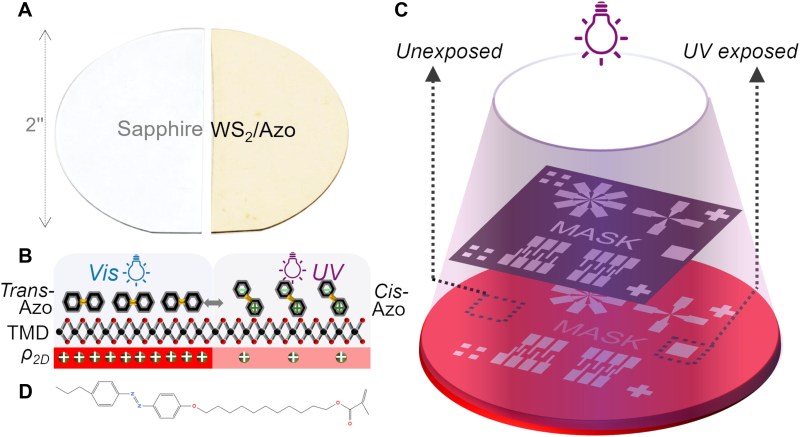
Generally semiconductor devices like transistors have fixed properties, but using an azobenzene (Azo) compound it’s possible to optically alter these properties by exposing them to UV light. This is demonstrated in a recent paper by [Jaehoon Ji] et al., as published in Science Advances, with accompanying coverage by Princeton University.
Building on previous research on e.g. flakes of MoS2 with photochromic Azo molecules, a functional semiconductor device was created. This uses a transition metal dichalcogenide (TMD) monolayer combined with the Azo compound, with the latter altering the electrical and optical properties of the structure.
In both n- and p-type FET semiconductors it was demonstrated using visible and UV light that this can alter the carrier densities in the material, effectively altering the FET’s behavior.
While this is of course just a proof of concept, it does show that by using (Azo) molecules that can respond to certain electromagnetic radiation frequencies, electric fields, temperature, etc. semiconductor devices can be created whose behavior dynamically changes with these factors. This could potentially provide new ways to make programmable circuits and sensors.












Wonderful. Call me when the next-gen 555 based on that tech is available on Mouser.
Was always wondering if there would be a FET that can flip on or off one of the sides, ie, act as FET in “relaxed” state and act as NPN or PNP transistor in one of the “energized” states.
Obviously, I could just wire two complementary NPN and PNP transistors together to form pseudo-FET and see for myself; though, I was thinking more inlines of “optoisolator with two LEDs, one – for firing up the NPN side and disabling the PNP side, second one – for doing the reverse, while no LED lit up would keep the gate working as ordinary FET”.
I can see few occasions where such thing would be of use, and when coupled with few op amps driving the LEDs can rearrange itself into positive or negative phase response depending on the control signal.