DIY Algae Biodiesel Is Harder Than You Think

There’s one thing [Silent H] wants you to know before you watch his video about making biodiesel, embedded below: he started this project before he’d even heard of the Strait of Hormuz. No, he’s just independent-minded and wanted to try making his own fuel when diesel was– in retrospect– cheap as chips. That’s probably a good thing, because while [Silent] gets his pint of fuel at the end of the video, it’s not from algae; it’s from a backup crop of sunflowers.

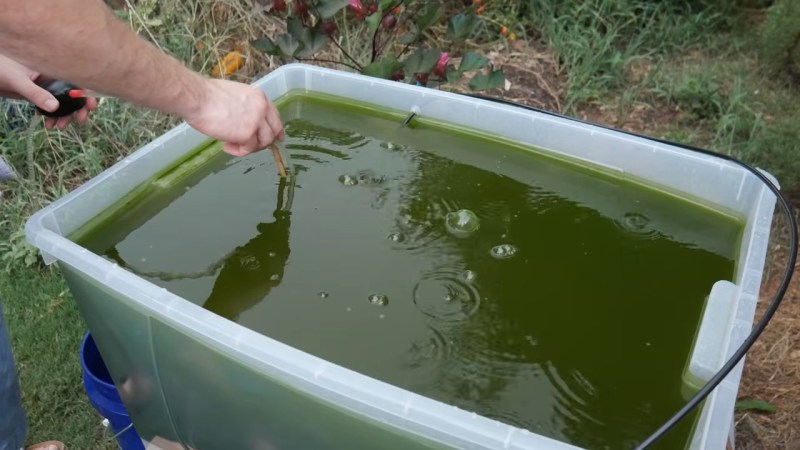
As it turns out, he picked what was the perfect algae and the absolute worst algae for making biodiesel from: Chlorella Vulgaris. It’s perfect because it’s easy to grow, and easy to extract from the growth medium, as it sinks when it is ‘ripe’, and has a very high oil content. Of course [Silent] didn’t want to toss algae cakes into a steam powered canoe, he wanted diesel fuel for his vehicle. That’s where the project broke down: Chlorella Vulgaris cells are exceptionally tough, and if you can’t rupture the cell wall, you can’t can’t get out any appreciable oil. A few grams by solvent extraction is all he manages before switching to more tractable feedstock.

That feedstock is sunflowers, which give up their oil through the application of violent pressure. That is to say, he crushes the seeds in an oil press. Oil acquired, he goes on to transesterfy the stuff, extracting glycerine to produce biodiesel– a process ripe for hacking that you’d think we’d cover more often.

We have covered the algae growth side of things before, but that algae seemed to be destined for other uses than fuel.

Continue reading “DIY Algae Biodiesel Is Harder Than You Think” →
Biodiesel Equipment Hacks

biodiesel_hacks

[Oldman] took on a biodiesel project for some friends a few years ago. A fully operational processing rig was never achieved, but he did document some of the successful hacks he came up during the project.

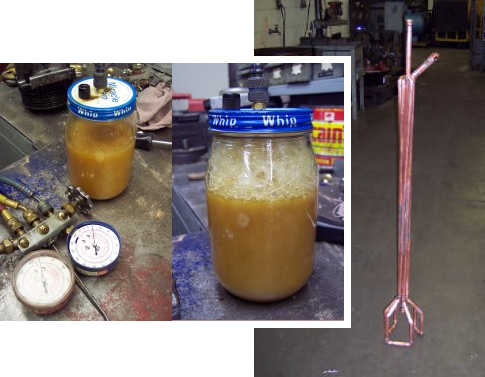
The idea is to reclaim the waste oil from restaurants and burn it in your modified racing motorcycle or other mode of transportation. That makes it sound easy, but have you ever seen what happens to bacon fat after it cools? Granted, we’re talking oil from vegetable sources but the same type of coagulation presents itself. Pumping it through a processing rig becomes especially tough in the winter, and that’s why [Oldman] came up with the heated pump head on the right. It’s got three connections; two are part of a loop of copper tubing, allowing 150 degree water to be circulated to liquefy the grease. The third connection sucks up the melted oil. You also need to regulate the water content of the fuel. The inset images of a salad dressing jar are his test runs with applying vacuum to dehydrate the fuel. He learned that it needs to be heated slightly to reduce foaming. He had planned to scale up this concept to apply vacuum to fuel stored in propane tanks.

Sustainability Hacks: Bio-diesel Motorcycle Speed Record

Sometimes you don’t need a lot of horsepower to win a speed record. In a fluke of no one else competing in the alt fuel class,  [John]’s biodiesel motorcycle set a new land speed record at the LTA event last summer.

[John]’s bike is a junkyard 1978 Kawasaki KZ400. The stock engine was replaced with a Chinese knock off of a Yanmar air-cooled diesel motor. The fuel is regular old vegetable oil. From the looks of the exhaust, we’re assuming [John]’s garage has a rich french fry smell to it.

Compared to highway speeds, [John]’s runs for a land speed record are a little absurd – a nice bonus when you’re the only driver in your class. The first pass of 42 mph was a little disappointing, so [John] removed the fender, tail light and brakes. After all the unnecessary weight was removed, the top speed – and new record – was 56.5 mph.

Converting a diesel car to run on french fry oil is great and a lot better for the environment than burning liquefied dinosaurs. In any event, a green motorcycle is a lot better than 2000 pounds of automobile moving less than 200 pounds of person. Check out a few of [John]’s land speed runs after the break.

Continue reading “Sustainability Hacks: Bio-diesel Motorcycle Speed Record” →