
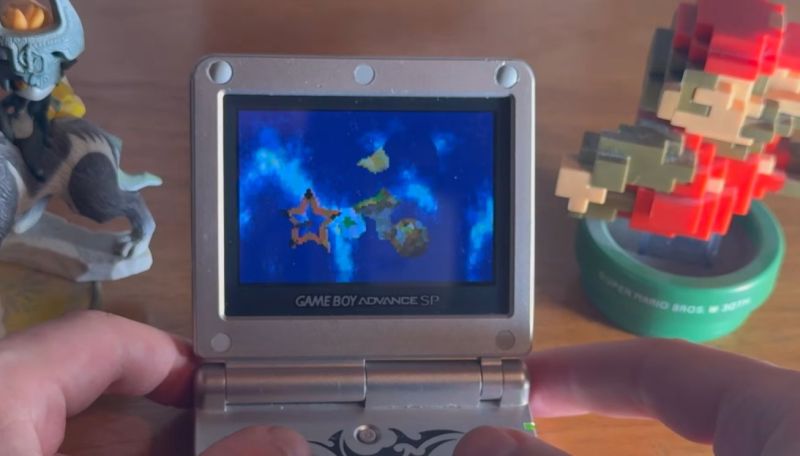
Joining the ranks of fresh backported Nintendo games is Super Mario Galaxy for the Nintendo Game Boy Advance (GBA), courtesy of [Tobias Friedly], AKA [Tobi]. In a recent video he announces the release of this game, along with the release of the source code of the engine and all the game’s code in a GitHub project.
Naturally none of the original Wii game’s assets are provided to appease Nintendo’s vicious lawyers, so you’re expected to bring your own super-legally acquired ISO image or equivalent to fill in these blanks when you build your ROM for the GBA.
This is a mostly complete port, even integrating the star pointer despite the GBA’s limited number of controls compared to the Wii. In some situations it’s opted to have star bits automatically collected to work around this limitation, which is probably a quality-of-life improvement that many SMG players will appreciate.
For the game’s logic a lot of code was borrowed from the recently decompiled version of the original game, which saved a lot of time even if the GBA’s hardware is no match for the Wii’s. From the gameplay in the video it definitely looks like a playable version of the game, with an acceptable frame rate that looks to be worth a try.












This is amazing! I was an early adopter of the GBA when it was new.
Because the GameBoy Advance was a spiritual successor to the Super Nintendo.
The games (ports/remakes of SNES titles), the pixel art and the shape of the console (SNES pad).
To a child of the 16-Bit era, these things were a positive change from the blocky N64 days and a time being somewhat PlayStation-ized (mid-late 90s).
The only thing I didn’t like was lack of backlight and the lack of GameBoy Colour’s irDA port (or just infrared port, as it didn’t use the irDA protocol likely; GBA prototypes still had IR) .
That wireless port had some potential and was fun to tinker with.
When GBA was new, PCs and Macs back then still had infrared ports, too.
On PCs, it mainly were notebooks that had them preinstalled
(though PC motherboards had IR headers and an infrared setting in CMOS Setup).
They were our proto-Bluetooth, basically.
That being said, USB irDA “adapters” were still available years after Bluetooth was introduced.
You’re right that the GBC infrared port wasn’t an irDA port, because its hardware was about as ridiculously simple as it possibly could have been. You could write to a specific address to toggle the transmit LED on and off, or read from it to get a single bit indicating whether the receiver was detecting anything. So basically everything had to be implemented in software.
It surely could have been programmed to use the irDA protocol (in its low-speed serial version) but as far as I know, nobody ever did. Pretty much every game or series that supported IR used its own custom (and sometimes very bizarre) protocol.
.. and yeah, it was too bad that the GBA didn’t carry over this feature. I assume it was just a cost-saving decision.