
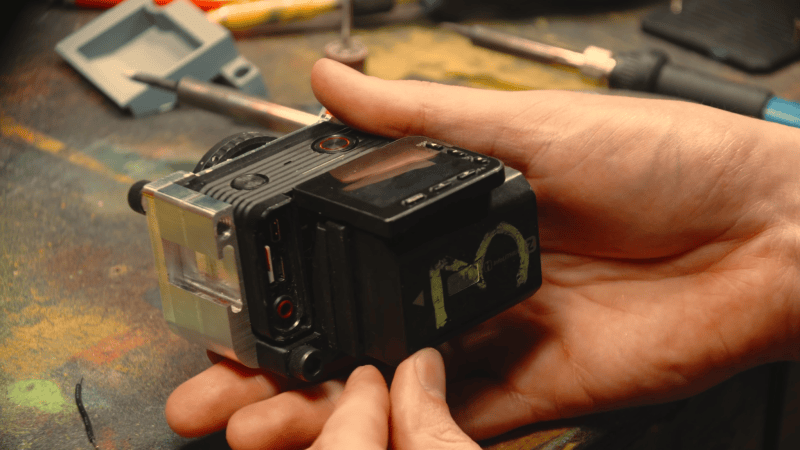
[Evan Monsma], the prolific experimenter with cameras, found himself with an issue: he had a small Sony action camera with good performance in every respect but battery life, which was as low as twenty minutes. This was too short for practical everyday use, so [Evan] built an external adapter to add a larger battery and a few other features.
In fairness to the camera’s designers, it wasn’t really meant for consumer use; it was meant as more of a stunt camera, where endurance is less of a concern than size and weight. [Evan] wanted to use it for more general situations, hence the new battery. He first attached a small CNC-machined aluminium half-cage, which provided mounting points for additional hardware, including a screw-mount for a neutral-density filter.
[Evan] next designed, 3D-printed, and attached a mount and battery clip for a larger Sony camera battery; the mount also held a voltage converter to step the battery’s 7.2 V down to the original battery’s 3.7 V. A USB power adapter slotted into the battery compartment and broke out the power leads to the converter. Unfortunately, short battery life isn’t the camera’s only issue; it also eventually overheats with continuous use, which kept [Evan] from running a real battery-life test. He is, however, confident that it will last long enough for practical use.
We’ve seen a similar action camera mod before, as well as a mod to allow the use of third-party batteries in a vendor-locked camera. For larger cameras, we’ve even seen a hot-swappable battery pack.
Thanks to [Luis Mercado] for the tip!











Some cameras had detachable flash units.
Perhaps the camera could have a very small internal power source that could be recharged once the flash is re-attached.
Perhaps this main battery would also have other optics…FLIR, night-vision, large lenses, etc.
The camera is now just a camera…that you can place in a drone.
Speaking of detachable flash units, some of the most surreal photographs I have seen are crime scene photos.
The shutter left open, and the forensic photographer walks around a corpse and activates the flash intermittently….something known as painting a scene with light.
The result is a body that almost seems to glow…with no shadows.
More unnerving are the camera artifacts.
Since the photographer moves while the corpse doesn’t—he doesn’t stay still long enough to be in the photograph himself–but his individual flashes ARE burned into the film.
The result is a picture of a body that seems surrounded by ball lightning-like orbs.
But I digress.
It took me a while but I understand that the camera is still while the flash is moving with the photographer is that right? I’d be curious to see example of such picture, do you have link to some of them (non graphic/bloody if possible)?
A video here:
https://m.youtube.com/watch?v=6VXdtiyAM38&ra=m
https://www.forensicsciencesimplified.org/photo/principles.html
https://www.crime-scene-investigator.net/nighttime.html
Art
https://www.ucpress.edu/books/painting-with-light-2/paper
OK. Definitely a hack.