
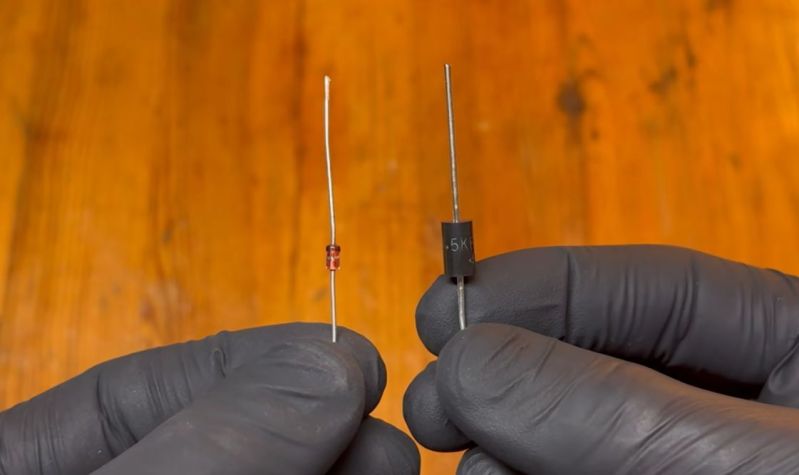
Sometimes the naming of parts in electronics can contribute to confusion about what they are good for, with the topic of Zener diodes in the context of fast surges like those from electrostatic discharge (ESD) being a good example. In a recent video by [BTT Lab] this particular question regarding Zener suitability for suppressing ESD is addressed, as compared to transient-voltage-suppression (TVS) diodes.
The main argument against using Zener diodes for ESD and similar surge suppression is that they react too slowly, which obviously gives said surge time to cause some real damage. This is where a special form of avalanche effect-based diodes called TVS diodes are recommended, as their response time is in the picoseconds rather than nanoseconds or slower as for Zener diodes.
Although this is technically true, as also pointed out in the video, a Zener diode also uses the avalanche effect, with the diode starting off conducting in the reverse direction using the Zener effect before transitioning to the much faster avalanche effect. The transition point is hereby determined by how heavily the p-n junction is doped, making effectively all Zener diodes also avalanche diodes.
TVS diodes consequently are basically Zener diodes that are optimized for a very early transition to said avalanche effect. They are also generally larger than typical Zener diodes as they generate a lot of internal thermal energy while in reverse conducting mode, which has to be contained and shed without causing permanent damage.
The short version is thus that diodes marked as ‘TVS’ are the best choice for surge protection, while those marked as ‘Zener’ are best used for voltage clamping, reference voltages and all other typical Zener diode things.












Please be kind and respectful to help make the comments section excellent. (Comment Policy)