Letting People On The Internet Control Your Dating Experience

charismacheck

Like Cyrano giving advice to Christian from underneath Roxanne’s balcony, now you too can can advise young suitors trying to win the heart of the object of their affection.

[Lauren] had the idea of using objective, third-party observers checking in on her dating activities and giving advice as to what she should do next. Yes, she’s streaming her dates over the Internet and asking for advice from Mechanical Turk workers.

The idea behind this project isn’t that [Lauren] isn’t looking for advice from her own Cyrano, but rather to open up new, previously unexpected possibilities. Turk workers will watch the stream while [Lauren] presents them with options telling her to smile more, laugh, change the subject, or ask a question. [Lauren] receives these results as a text message, where she’ll comply with the Internet’s wishes and hope her date doesn’t go horribly awry.

It’s an interesting project to say the least, but we’ve got to wonder about the quality of the advice given from her online advisers. Turk workers do take their jobs more seriously than random people on the Internet, so barring an invasion from /b/, [Lauren]’s night might just go alright.

Really, Really Geeky Wedding Invitations

invitation

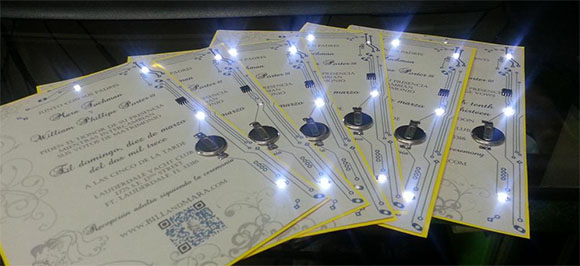
Being real, ultimate geeks, [Bill] and [Mara] didn’t want to settle for plain, paper-based wedding invitations. No, they wanted something cooler, and came up with their own DIY electronic wedding invitations.

Since they would be making the invitations themselves, [Bill] and [Mara] needed a simple circuit that could be easily mass produced. They turned to the classic microcontroller-powered blinking LED circuit powered by an ATtiny13.

The first order of business was producing 50 printed circuit boards for each of the invitations. For this, [Bill] picked up an Xerox Phaser laser printer off of ebay and a few sheets of copper-clad kapton film. The etch resist was printed directly onto the kapton film and etched in a bath of ferric chloride, effectively making a flexible PCB.

These circuit boards were soldered up and laminated between the printed invitation and the card stock cutter with the help of a Silhouette Cameo paper cutter. After the cards were assembled, the battery was wired up and the cards shipped out.

The microcontroller inside the card was programmed to be asleep most of the time, waking up only every few seconds to check a light sensor to determine if the card was opened or not. If the microcontroller sensed the card was open, the lights began blinking, making it one of the most memorable wedding invitations [Bill] and [Mara]’s guests will ever receive.

You can check out a demo of the invitations after the break.

Continue reading “Really, Really Geeky Wedding Invitations”

Controlling A Raspberry Pi With Real Life Redstone

minepi

We’ve seen computers built in Minecraft out of redstone, the game’s version of electricity, circuits, and digital logic. We’ve even seen a few redstone contraptions controlling real-world devices. [Angus]’ build, though, takes things to a whole new level. He’s created a bridge between Minecraft circuits and their real life counterparts using a Raspberry Pi.

[Angus]’ build relies on a mod for Minecraft servers running as a Bukkit plugin. Blocks powered by redstone are labeled with an in-game sign, and messages regarding the state of a block are passed over the network using the MQTT protocol.

The hardware side of the build is a Raspberry Pi with a PiFace expansion board. With this setup, [Angus] can control LEDs on the PiFace by toggling Minecraft levers, or light up redstone lamps using the PiFace’s buttons.

If you’d like to try this out for yourself, you can grab the Bukkit plugin over on [Angus]’s git. Check out the video of the real life redstone in action after the break.

Continue reading “Controlling A Raspberry Pi With Real Life Redstone”

Finding The Cheapest Board House

The prices for custom made circuit boards has never been cheaper, but surprisingly we’ve never seen a comparison of prices between the major board houses. [Brad] took the time to dig in to the price of 10 boards manufactured by Seeed Studios, OHS Park, and BatchPCB. He made some pretty graphs and also answered the question of where you can get your circuits made cheaply.

[Brad] got the prices for boards up to 20 cm x 20 cm from Seeed Studio’s Fusion PCB service, OSH Park, and BatchPCB. These results were graphed with Octave and showed some rather surprising results.

For boards over 20 cm2, the cheapest option is Seeed Studios. In fact, the price difference between Seeed and the other board houses for the maximum sized board is impressive; a 400 cm2 board from Seeed costs $150, while the same board from OSH Park is close to $1000.

Of course most boards are much smaller, so the bottom line is  for boards less than 20 cm2, your best bet is to go with OHS Park. If you don’t care when your boards arrive, or you need more than 10 or so, Seeed is the way to go. As far as the quality of the boards go, OSH Park is up there at the top as well.

Genetic Algorithms Become Programmers Themselves

AI

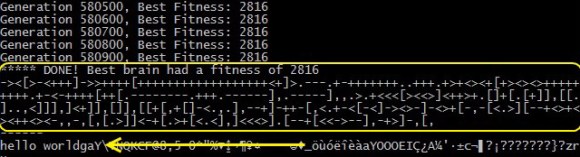
[Kory] has been experimenting with genetic algorithms. Normally we’d expect his experiments to deal with tuning the variables in a control system or something, but he’s doing something much cooler. [Kory] is using genetic algorithms to write computer programs, and in the process bringing us one step closer to the Singularity.

The first experiments with genetic algorithms generating applications did so in BASIC, C, and other human-readable languages. While these programs nearly worked, there were far too many limitations on what could be produced with a GA. A simpler language was needed, and after turning to assembly for a hot second, [Kory] ended up using brainfuck, an extremely minimal but still Turing-complete language.

The use of brainfuck for creating programs from a genetic algorithm may seem a bit strange, but there’s a method to [Kory]’s madness. It’s relatively simple to write an interpreter the GA’s fitness function can look into and come up with a score of which programs should breed and which should die. Also, the simplicity of brainfuck means a computer doesn’t have to learn much syntax and grammar at all.

Right now, [Kory]’s computer that can program itself only does so by creating simple ‘hello world’ programs. It should be possible, though, for this AI to create programs that take user input and generate an output, whatever that may be. Once [Kory] is able to have the computer generate its own fitness functions, though, the sky is the limit and the Singularity will be fast approaching.

Building A Velocity Sensitive Keyboard

keys

Cheap toy pianos don’t usually have MIDI, and getting a velocity-sensitive keyboard from something out of the toy aisle at Walmart is nearly out of the question. If you’re willing to tear one of these toy pianos apart and build your own control electronics, though, the sky is the limit, as [JenShen] shows us with his home built velocity sensitive keyboard.

Usually, velocity-sensitive keyboards have two buttons underneath each key. By having a microcontroller measure the time difference between when each button is pressed, it’s possible to sense how fast each key was pressed. [JenShen] took the idea of a velocity-sensitive keyboard in another direction and instead used a force sensitive resistor strip, cut up into many pieces to provide velocity and aftertouch data.

[JenShen]’s keyboard adds these resistive buttons to the button matrix he already made. The result is a very inexpensive velocity sensitive keyboard with aftertouch, an impressive feat for an Arduino and only a few components.

You can check out the keyboard in action after the break.

Continue reading “Building A Velocity Sensitive Keyboard”

This Man Will Take Your Picture While Macing You

pepper

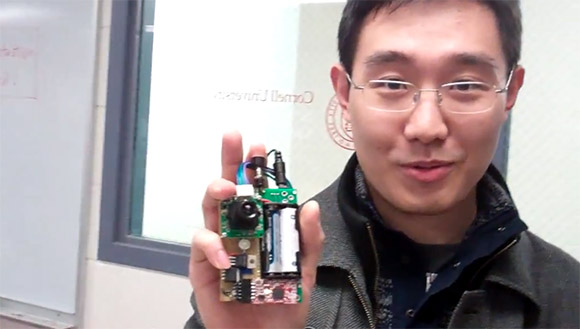
Odds are you don’t have a photographic memory, so if you ever have to mace someone, you probably won’t remember exactly what your attacker looks like. Compound that with talking to the police and looking at a few dozen mug shots, and it’s highly unlikely you’ll ever be able to identify the person you maced. This was the problem [John], [Cordelia], and [Adrian] chose to solve for [Bruce Land]’s microcontroller course at Cornell this semester.

The device they created, PepGuard, adds a microcontroller and a serial JPEG camera to a canister of pepper spray. When the button on top is pressed, the microcontroller flashes a LED, takes a picture with a camera, and sends that picture to a phone over a Bluetooth connection.

PepGuard is always connected to the user’s phone via Bluetooth, and this allows for some interesting possibilities. With their Android app, the team can set up the phone to call emergency services when the device is activated.

You can check out the demo of the device after the break, or read the team’s report here.

Continue reading “This Man Will Take Your Picture While Macing You”