DIY Solder Stencils From Soda Cans

smd_stencil_done_w

Even if you’ve overcome your fear diddling about with tiny SMD components, applying solder paste – especially if you’re populating more than one board at a time – is still a chore. The pros use very expensive laser cut stainless steel solder paste stencils, something still a bit out of reach to the casual hobbyist. [Felix] solved this problem by making his own solder paste stencils very cheaply using empty soda cans.

The process begins just like any other home etching tutorial by lightly sanding the un-bent aluminum can and applying the etch resist via the toner transfer method. Etching is done with off-the-shelf HCl and hydrogen peroxide, resulting in an amazingly clean stencil comparable in quality with a professional stencil.

Sure, going through a dozen-step process to make a solder paste stencil may not be as convienent as [Cnlohr]’s toothpick and tweezers method, but [Felix]’ method is just about up to par with extraordinarily expensive laser cut stainless steel stencils. Not bad for something that came from the recycling bin.

Making High Concentrations Of Hydrogen Peroxide At Home

Hydrogen peroxide – the same stuff you can pick up from a drug store or beauty supply store – is one of those very interesting chemicals that belongs on every maker’s cabinet. At concentrations of about 30%, it’s perfect for etching PCB boards, and at even higher concentrations – about 70% – it can be used as rocket fuel. Unfortunately for the home hacker, it’s very difficult and expensive to obtain peroxide in concentrations above 3% or so. That’s alright with [Charlie], though, because he’s come up with a way to concentrate peroxide and measure the concentration once he’s done.

There are a few YouTube videos of kitchen chemists concentrating peroxide by heating it on a stove to just under 100°C. Because hydrogen peroxide boils at 150°C, they’re simply boiling off the water and increasing the concentration of peroxide. This is a qualitative method, and you’ll never know what concentration you’re getting. [Charlie] rigged up a small-scale with a pipette to measure the weight of his concentrated peroxide per unit of volume, giving him the density of his concoction and thus the concentration.

We have to note that concentrated peroxide is dangerous stuff, but the results of [Charlie]’s lab work aren’t much more dangerous than what hair stylists work with every day. If you’re going for high-test peroxide, good job, that’s awesome, but do be aware of the risks.

Ammo Box PSU

PAB-PSU-1

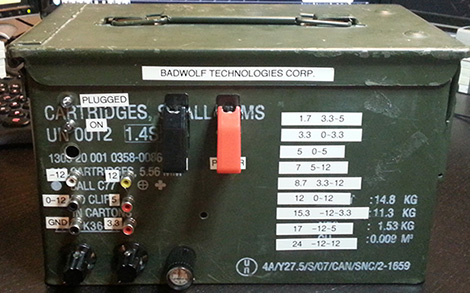
Sometimes you need a power supply that can be thrown into the back of a car and taken into the field. [BadWolf] didn’t want to take his bench supply, so he whipped up this very portable power supply made from a computer PSU. To ruggedize his build a little, he put it in a 50 caliber ammo can making it more than able to handle the roughest field work.

While not a proper adjustable power supply, this ammo can is more than capable of delivering a whole lot of current in a number of different voltages. There are a few bells and whistles – a ‘plugged in’ and ‘on’ light, as well as a few very cool looking toggle switches that are sure to arouse the suspicions of unsuspecting bystanders.

[BadWolf] kept all the safety features built-in to the computer PSU, so this ammo box power supply is still protected from short circuits, and over-current, making it much safer than its appearance belies. It’s also a great example of what can be done if you don’t have a proper bench supply, so we’ve got to tip our hat to [BadWolf] for that.

BladeRF, Your Next Software Defined Radio

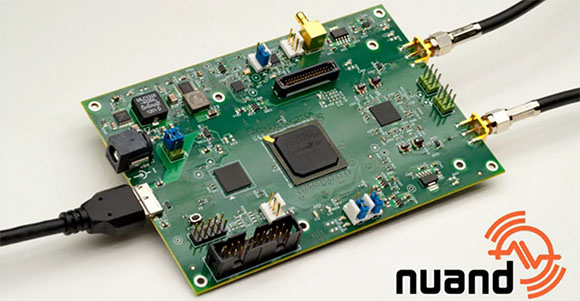
By now you might have a bit weary of your small and inexpensive TV tuner dongle software defined radio. Yes, using a USB TV dongle is a great introduction to SDR, but it has limited bandwidth, limited frequency range, and can’t transmit. Enter the bladeRF, the SDR that makes up for all the shortcomings of a USB dongle, and also serves as a great wireless development platform.

The bladeRF is able to receive and transmit on any frequency between 300 MHz and 3.8 GHz. This, along with a powerful FPGA, ARM CPU, and very good ADCs and DACs makes it possible to build your own software defined WiFi adapter, Bluetooth module, ZigBee radio, GPS receiver, or GSM and 4G LTE modem.

It’s an impressive bit of kit, but it doesn’t exactly come cheap; the bladeRF is available on the Kickstarter for $400. The folks behind the bladeRF seem to be doing things right, though, and are using their Kickstarter windfall for all the right things like a USB vendor ID.

There’s a video of two bladeRFs being used as a full duplex modem. You can check that out after the break.

Continue reading “BladeRF, Your Next Software Defined Radio”

Barometer Tells You To Take Your Bike Or The Train

bike

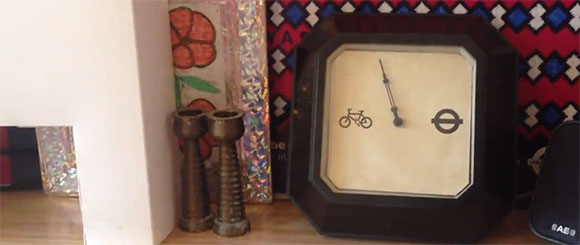
Before beginning his day, [Richard] needs to decide whether he should ride his bike to work or take the London tube. All the information to make that decision is available on the Internet – the current weather report, and the status of the subway lines and stations he’d be taking. The problem, though, is all these pieces of information are spread out in multiple places. [Richard]’s solution to this was to make a bicycle barometer that pulls data from these places and makes the decision to ride a bike or the tube for him.

[Richard]’s barometer is built around a nanode and an old clock he found at a flea market. The nanode queries the UK’s weather bureau and the London underground’s line and station status. All the variables under consideration are weighted; if it’s snowing, the output is much more likely to decide on the tube than if there was a slight drizzle.

It’s a really cool build that certainly makes a great use of the publicly accessible APIs made available by the London underground. You can check out a video of the barometer after the break.

Continue reading “Barometer Tells You To Take Your Bike Or The Train”

Getting Rid Of Telemarketers With A Banana Phone

Banana

The Federal Trade Commission really doesn’t like robocalls and other telephone solicitors selling you vinyl siding or home security upgrades. The FTC is even offering $50,000 to anyone who can do away with these robocalling telemarketers, and [Alex] looks like he might just claim the prize. He developed The Banana Phone, a device that eliminates those pesky telemarketers.

The basic idea of the Banana Phone is requiring callers to enter a four-digit pass code (played via text to speech over a relevant song to prevent a bot from getting through) before connecting them to the main line. Once a caller has been verified as human, their number is added to a white list so they won’t have to listen to [Raffi] every time they call.

The Banana Phone uses off-the-shelf parts  including a Raspberry Pi and a phone/Ethernet adapter with the total build cost under $100. You can check out a demo of the Banana Phone in action after the break starting at about 2:25.

Continue reading “Getting Rid Of Telemarketers With A Banana Phone”

Turning The Belkin WeMo Into A Deathtrap

The Belkin WeMo is a small, WiFi connected outlet controlled by a mobile device that adds Internet control to a desk lamp, coffee maker, or, if you’re feeling daring, your home server. It’s an interesting device, but of course there are a few security implications of having your electric kettle connected to the Internet. [Daniel] was able to get root on his Belkin WeMo and with full control of his Internet-connected outlet was able to turn it into a deathtrap.

[Daniel] says his exploit could be developed into a virus that will scan for WeMo devices. Once these Internet-connected devices are found, it’s easy to turn these devices on and off really fast; something not too dangerous for a desk lamp, but potentially lethal if it’s plugged into a space heater.

In the video after the break, you can see [Daniel] exploiting the WeMo with a flaw in its UPnP implementation. There’s footage of his terminal hacking and of his desk lamp being turned on and off really fast, something that could be very dangerous for higher current devices.

Continue reading “Turning The Belkin WeMo Into A Deathtrap”