3D Printed Arc Reactor Replica

3d-printed-arc-reactor-replica

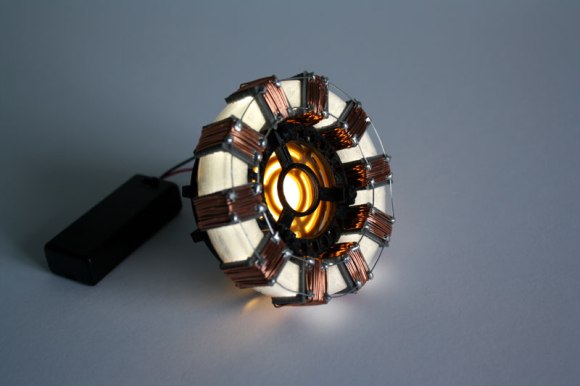
[James] just keeps cranking on the idea of the perfect arc reactor replica. This time around he’s made most of the parts using a 3D printer. His write-up covers the basics of the build, but he also used this opportunity to make some tutorial videos on designing the parts using Autodesk 123D.

This is definitely an improvement on his last prop, which was built out of dollar store parts. When designing the components he tried to be as true to the original movie design as possible, while keeping in mind the limitations of using a home 3D printer; he printed them on a Lolzbot AO-101.

The videos below give you a good idea of what it’s like to model parts using 123D. The tool set is pretty simple compared to something like Blender 3D. But [James] uses them in such a way that the components get complex fairly quickly. The second video includes some footage of the parts being printed, as well as the assembly process that adds wrapped wire for looks, and LEDs for illumination.
Continue reading “3D Printed Arc Reactor Replica”

Building An Accurate Equal Arm Balance

microscale

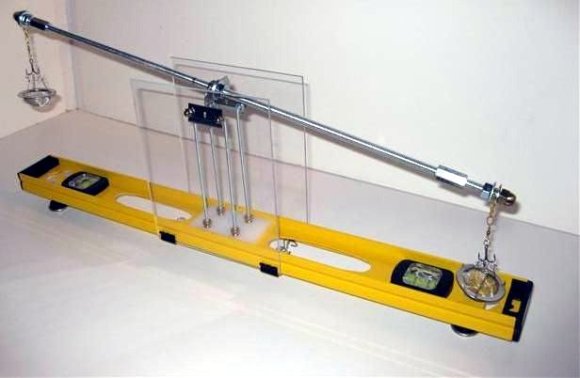
This interesting take on weights and measures uses a two foot long level as the base for a diy equal arm balance. The balance is the oldest method used for measuring mass. That’s because you don’t even need a reference weight for it to work as long as you are measuring ingredients that are proportional to each other in whole numbers.

The key to accuracy with these scales is to reduce friction at the fulcrum. In this case the fulcrum is made of two upturned razor blades on the base, with a single razor blade resting perpendicular to those on the arm. But because gravity is doing the equalization, the base must be as level as possible. Adjustable feet were added to the base so that it can be leveled on two axes. When the tower at the center was built (using threaded rod) a disc level was used to fine-tune the mounting angle of the two razor blades. The finishing touches include a coupling nut on each end for fine-tuning the balance, and the halves of a tea ball strainer as the weighing vessels.


AquaTop: A Gaming Touch Display That Looks Like Demon Possessed Water

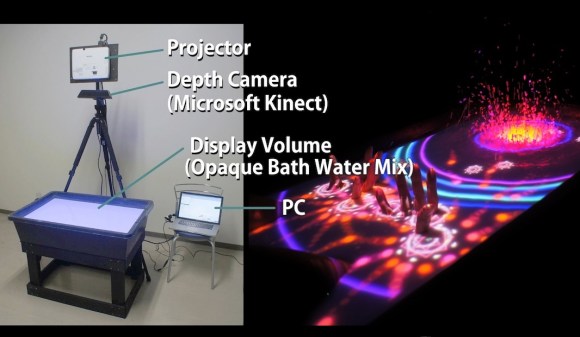
AquaTop_touch_displayAre you ready to make a utility sink sized pool of water the location of your next living room game console? This demonstration is appealing, but maybe not ready for widespread adoption. AquaTop is an interactive display that combines water, a projector, and a depth camera.
The water has bath salts added to it which turn it a milky white. This does double duty, making it a reasonably reflective surface for the projector, and hiding your hands when below the surface. The video below shows several different games being played. But the most compelling demonstration involves individual finger tracking when your digits break the surface of the water (show on the right above).

There is also a novel feedback system. The researchers hacked some speakers so they could be submerged in the tank, adding a large speaker with LEDs on it in the same manner. When fed a 50 Hz signal they make the surface of the pool dance.

Continue reading “AquaTop: A Gaming Touch Display That Looks Like Demon Possessed Water”

Preserve Your Garden Bounty With A Solar Food Drier

solar-food-drier

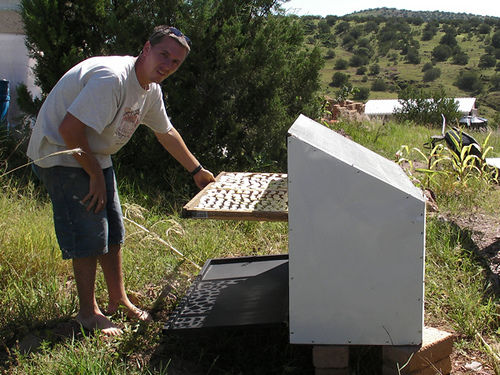
The [VelaCreations] family lives off the grid, getting the electricity that they actually use from solar and wind power. When they started looking for ways to preserve the fruit and vegetables now coming into harvest the electricity consumption and cost of a food dehydrator made them balk. What they do have plenty of at this time of year is sun and heat, so they built their own solar food drier.

The frame is made of welded square tube. They mention that you will have to alter it if you don’t have welding tools, but building your own MOT welder is just one more fun project to take on. The frame has wood rails to hold the trays of food. It is enclosed with translucent polycarbonate sheets. There is a vent in the top as well as the bottom. As the heat from the sun builds inside, it flows upward, sucking fresh air in the bottom. This carries away moisture from the food and can be regulated by adjusting the size of the bottom vent.

Motorized Skateboard Controlled By Hand Gestures

hand-gesture-skateboard

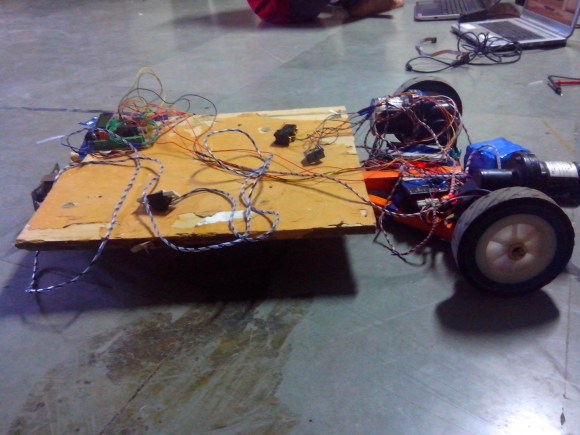
This rough-looking contraption is a hand gesture controlled skateboard which [Aditya] built using parts on hand. So far the sensor for hand gestures is connected by a control wire, but he hopes to transition to an RF unit at some point in the future.

Having access to a couple of high torque brushless motors is what turned him onto the project. He hit up a couple of Mechanical Engineer friends of his to help assemble the chassis and then started on the electronics side of things. A breakout board for an ATmega16 is mounted on the corner of the deck. It monitors an accelerometer which acts as steering as well as throttle. The accelerometer had been abused in a previous project so he had to add an extra switch to bolster his available inputs. We were glad to hear that he also included a kill switch, since putting the control of those motors in the hands of a damaged accelerometer is a bit sketchy.

We remember seeing a similar trike design a few years back. That one powered a single rear wheel while this one powers two wheels and uses a caster for the third.

One Pixel Video Game Rises From RGB Button Hardware

rgb-button-one-pixel-video-game

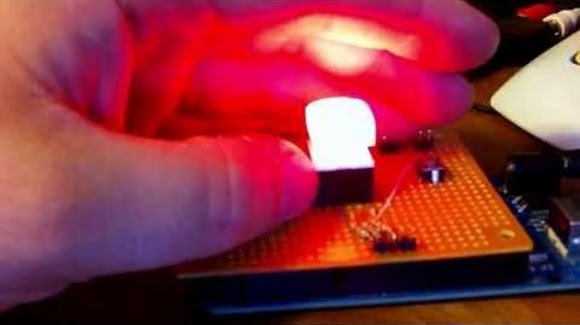
This project was completely component driven. [Christopher] and [Robert] wanted to try out buttons with an RGB backlight option. They found the one shown above, which looks fantastic. It should since it costs over twenty bucks in single units. What they came up with is a one pixel video game that works like a color matching version of Simon Says. The button will show you the target color for just a moment. The player then holds the button as it fades through colors. Releasing it at the right instant will produce a green flash, a wrong shade results in a red flash.

They went with an Arduino Mega for the project as that was within easy reach. A hunk of protoboard is used as a shield, it includes the button itself, connected through some current limiting resistors to the pins that drive the LED. There is also a tactile switch which actuates the AVR’s reset pin.

When trying to get the LED to fade through the full range of colors [Christopher] was hit with a common problem. Since our eyes don’t detect changes in low and high intensity light the same way, you can’t use linear changes in PWM and get a smooth result. He fixed this by using Gaussian curves to set the intensity levels.

Continue reading “One Pixel Video Game Rises From RGB Button Hardware”

HHO Generator Makes Bubbles That Go Boom

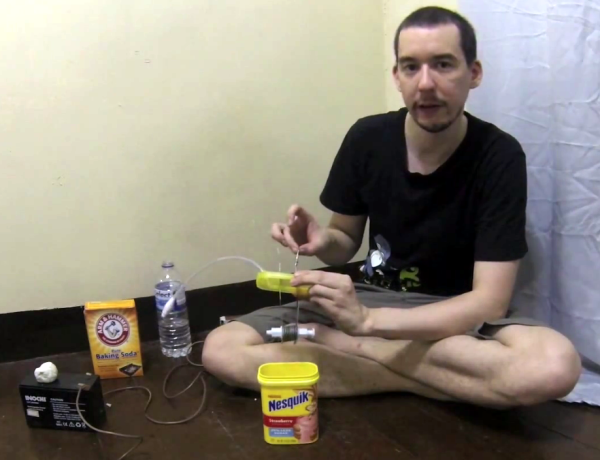
Here’s [Phil] showing off the components he used to make an HHO generator. The device uses household items to generate hydrogen and oxygen from water using electrolysis.

He’s using a plastic Nesquik container as the vessel for his experiment. Inside is water doped with a bit of baking soda. The lid plays host to the majority of components. There are electrodes which stick through the lid of the container. To help boost the productivity of the generator these electrodes have several metal washers suspended between. It’s importnat to avoid a short circuit so they’re mounted with the plastic bolt from a toilet seat, and isolated using hot glue. A plastic tube used collects the gasses. You can tweak the ratio of what’s being collected by reversing the polarity of the battery.

It’s interesting to see soap bubbles lit on fire in the demo video. But there are more serious uses for this concept. People have been working on making it feasible to power cars from the hydrogen generated this way. We’ve also seen a plastic bottle rocket powered from an HHO generator, and there’s always the thought of building your own miniature dirigible.

Continue reading “HHO Generator Makes Bubbles That Go Boom”