PhatIO Uses File System To Control External Hardware

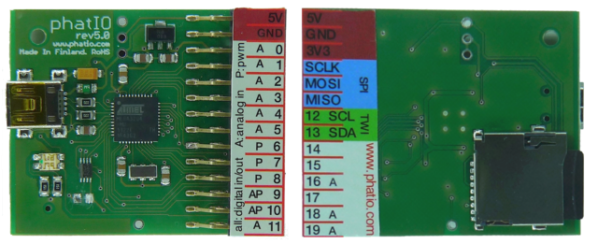
[Andrew Smallbone] wrote in with a link to his latest open source project. This is phatIO, a USB I/O device that uses a mass storage file system for control. The idea is that any operating system can manipulate files on a USB storage device. This enumerates as mass storage, and any alterations you make to its file system will result in pin manipulation on the I/O header.

We’ve long been Linux advocates and enjoy the fact that everything on a *nix system is a file. This simply extends the idea across multiple platforms. [Andrew’s] guide for the hardware gives an overview of how the system is structured. The top ‘io’ directory contains sub-directories called mode, pins, status, and a few others. Inside the directories are files for each pin. Writing to these files has much the same effect as writing to a data direction register, port register, or reading a pin register on a microcontroller.

The board is not yet in production and the github link to his hardware files gives us a 404 error. But there is code available for several software demos. After the break we’ve included video of the phatIO driving a Larson scanner.

Continue reading “PhatIO Uses File System To Control External Hardware”

Science Fair Project Sorts Recyclables

This crew of high schoolers built a sorting robot for the Smart Young Mindz challenge. We got pretty excited when hearing that it sorts plastic by its recycling code, but unfortunately this isn’t quite what it’s made out to be. The device uses an RFID code on each product to figure out where it goes. Their thinking is that at some point every product sold will have an embedded tag in it. For now this will not revolutionize the recycling industry, but the build is still impressive. We’re sure they learned a ton from all of the mechanical engineering that went into the project.

You can see the three laundry baskets that serve as the sorting bins. The white box above the bin on the right is the hopper in which a plastic container is placed. The box can then revolve around a central axis to position itself over the correct basket. The floor of the box is then retracted, dropping the refuse in the bin. Check out the video after the break for the satisfying cry of the servo motors at work.

We like seeing recycling robots, but so far most of what we’ve seen are aluminum can crushers.

Continue reading “Science Fair Project Sorts Recyclables”

Burglar Suspected Of Using Arduino-Onity Hack To Rob Hotel Rooms

Can anyone argue against this being the least-secure hotel room lock on the market? Regular readers will recognize it as an Onity key card lock. A few months back a glaring flaw in the security was exposed that allows these locks to be opened electronically in less than a second. So we are not surprised to hear that a series of hotel room robberies in Houston are suspected to have been performed using this technique.

The image above is from a demonstration video we saw back in October. That hack used an Arduino-compatible chip inside of a dry erase marker as an end-run around the lock’s electronics. It reinforced the warning sound by [Cody Brocious] when he presented the exploit at this year’s Blackhat conference. The barrel jack on the outside of the door lock doubles as a 1-wire communications port and that is how an attacker can gain access. Investigators can find no other means of entry for these thefts.

We applaud one of the victims in this story. At the end of the article she is asked if the information about the Onity flaw should have been kept secret. She said that if there’s a vulnerability that’s not being fixed people have a right to know about it. Bravo [Janet Wolf]!

[Thanks Andrew]

Hacking BodyBugg Fitness Sensors To Get Around Subscription Fee

This arm cuff is a sensor package which logs data whenever you’re wearing it. It records accelerometer data, skin temperature, and galvanic skin response. That data can then be analyzed to arrive at figures like calories burned. But… The company behind the device seems to have included a way to keep the cash flowing. Once you buy it you can read the data off of the device using a Java program they supply. But you can’t erase the data from the device unless you subscribe to their online service. Once it fills up, it’s useless. [Doug] wasn’t happy with this gotcha, so he reverse engineered the technique used to clear the BodyBugg’s memory.

There had been a few previous attempts at reverse engineering the device but that groundwork didn’t really help [Doug] on his quest. He ended up disassembling the Java classes from the original program. This helped him figure out how to initialize communications. Once there he was happy to find that the device will tell you how to use it. If you issue an invalid command it will respond with a list of all valid commands. Everything you need to get up and running can be found in his github repo.

100 Meter Spring Reverb Makes Us Hear Satanic Voices

Spring reverb is something we’re used to hearing about when it comes to guitar amplifiers. It’s a coil spring stretched the length of the amp’s housing. One end is fed the guitar signal, with a pickup at the other to capture the output. But this spring reverb is on a much grander scale. [Jochem van Grieken] strung up 100 meters of coiled steel wire in a long hallway and the results sound a little bit evil.

A simple piezo element is used as a pickup to amplify the sound coming off of the spring. Above [Jochem] is using what looks like a jeweler’s saw to make some sound on the 3.5mm wire. It’s this portion of the video that sounds demonic to us. In the second half of the demonstration he strikes the wire with a ruler to produce the pew-pew effect from many a sci-fi movie.

This isn’t his first experiment with the concept, it’s just his largest. Also found after the break are a pair of links to his other installations.

Continue reading “100 Meter Spring Reverb Makes Us Hear Satanic Voices”

MOD Player For The Stellaris Launchpad

[Ronen K.] wrote in to tell us about the MOD playing Stellaris Launchpad project he recently completed. A MOD is a sound file for the computers of days long gone. But you’ll certainly recognize the sound of the 8-bit goodness that is coming out of this device.

To understand how a MOD file stores samples you might want to glance at the Wikipedia page. There are a ton of these files out there, but this implementation is meant for files with only four channels. For now the only external hardware used is an audio jack which needs a ground connection and a PWM signal on each of the two audio channels. [Ronen] is storing the files in flash memory rather than using an SD card or other external storage. This leaves 213k of space for up to six files that can be selected by the user buttons which cycle forward or backward through the list. See this demonstrated after the break.

The project ports existing code from an STM32 application. Since that is also an ARM microcontroller there’s not a ton of work that needed to be done. But he did have to write all of the PWM functionality for this chip. This PWM tutorial turned out to be very helpful during that process.

Continue reading “MOD Player For The Stellaris Launchpad”

Internet Radio Occupies An 80-year-old Radio Case

[Florian Amrhein] made use of some old hardware to build his own internet radio in a 1930’s radio case.

The original hardware is a tube-amplified radio which he picked up on eBay. There’s tons of room in there once he removed the original electronics and that’s a good thing because he crammed a lot of new parts into the build. The main one being an old laptop he had on hand. It’s got a 10″ screen which is too large for the opening, but that ended up being okay. He coded an interface with C and SDL which give him a visual representation of his favorite online streams. The knob to the right moves the red line when turned and causes the Debian box to change to the new stream using the Music Player Daemon. Two potentiometers control the tuning and volume, and there is also a rotary encoder which is not yet in use. All three are connected to the laptop via an Arduino.

Check out the finished product in the video after the break. It sounds quite good thanks to the small automotive speaker and amplifier also crammed into the old case.

If you don’t have a laptop lying around to use in a project like this consider a microcontroller and character LCD based system.

Continue reading “Internet Radio Occupies An 80-year-old Radio Case”