RGB Upgrade For Ikea Single Color Fiber Optic Lamp

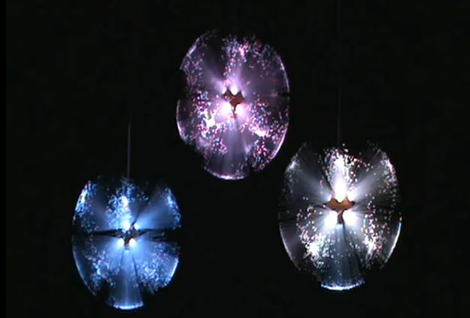
Five bucks will buy you a STRÅLA lamp from Ikea. It’s a battery operated hanging lamp that pipes the light out through multiple branches of fiber optic bundles. But you’ll only get white out of this, which is pretty boring. [Boris] decided to swap out the stock LED for an RGB unit and drive it with an Arduino.

The lamp nucleus is just a couple of pieces of plastic which can be popped apart to reveal the shard of PCB hosting one LED. The body of that diode is flat on the top, and [Boris] filed down his replacement to match the form factor. There are only two conductors in the wire that runs between that PCB and the battery pack, so he replaced them with four conductors (R,G,B, and GND). His prototype uses the Arduino’s PWM capabilities to control the colors, but [Boris] recommends transitioning to a simple chip like a PIC 12F675 or one of the smaller ATtiny microcontrollers after you’ve got the bugs worked out.

See how this turned out in the clip after the break.

Continue reading “RGB Upgrade For Ikea Single Color Fiber Optic Lamp”
20 Kilovolts Replaces Push Pins On This Bulletin Board

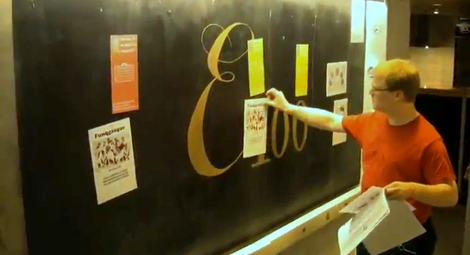
Electrical Engineers don’t need push pins. That’s because they know how to control electrons! [Sven] put his knowledge of these subatomic particles to use when building his high voltage bulletin board. It uses a set of vertically strung wires to keep paper pinned against the board. The wires have high voltage at low current travelling through them. They’re in front of the board, but not touching it, and the board is serving as a ground plane. In this way an electrostatic charge pushes (or should that be pulls?) against the paper to keep each sheet right where he places it.

In the video after the break [Sven] gives us a tour of the hardware at work here. It starts with a 12V psu which feeds a buck converter. The regulated feed is patched into a high voltage supply which was designed as a CCFL driver. Finally, a voltage doubler is used to reach the final voltage, measuring about 20 kV per wire.

Don’t worry, [Sven] says the bare wire is “almost completely safe” because of the low current being conducted.

Continue reading “20 Kilovolts Replaces Push Pins On This Bulletin Board”

Jarvis Opens The Door At P-Space

It seems like every Hackerspace should have some type of kludged together access system on their entry door. [Vasilis] wrote in to share the system called Jarvis that controls access to P-Space, a Hackerspace in Patras, Greece. It’s an RFID-based system that offers a few nice features.

They already have a server running the webpage, so basing their entry system off of a computer was an easy option. You can get in one of two ways; by presenting your valid RFID tag to a reader at the front door, or by ringing the bell and having a member inside press the Big Button of Doom (BBoD) which is a wireless controller.

The BBoD has an Xbee module inside which lets it send an unlock command back to the computer. The remote is powered by two AA batteries, and since it’s never on unless the button is pressed the team estimates these batteries should last around one year.

There’s even a feedback system. The computer posts the last few events to the webpage. So you can go online and see when the BBoD was used, or who’s tag has recently unlocked the entrance to tell if your friends are there.

RGB Laser Projector Is A Jaw-dropping Build

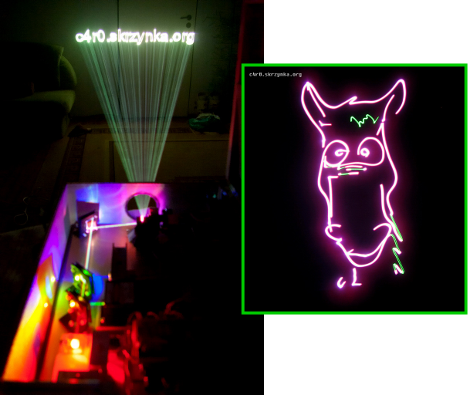
We can think of no better way to describe this laser projector project than Epic. [C4r0] is a student at Gdansk University of Technology and he’s been working on this projector for at least a couple of years. It uses several different laser diodes pulled out of DVD burners, Blu-Ray drives, and entertainment equipment (the green diode is from a disco laser).

In order to direct the beams he built a series of brackets that hold dichroic filters which reflect some wavelengths of light while allowing others to pass straight through. Each diode also needs a driver, most of which he built from scratch. And once the hardware has been designed and tested, what does one do with it? If you’re [C4r0] you build it into a money case with professional-looking results.

Don’t miss the video demo after the break. And make sure you have a rag ready to wipe up the drool before you look at his forum post linked above.

Continue reading “RGB Laser Projector Is A Jaw-dropping Build”

Pikachu Is Coming For You (especially On Carpet)

If you look closely, you’ll see that Pikachu isn’t sporting a pair of funky throwing stars, but is actually suspended between there. Our furry friend is just putting a happy face on this carpet roving robot called the Carpet Monkey V5. It’s been in the works for years, and this is just one more stop in the prototyping process as the development of version 6 is already under way.

The project is a testament to what can be accomplished using all of the design tools at your disposal. The motive mechanism was conceived as a cross between the qualities of legs and the ease of using wheels. Each of the appendages are covered with strategically placed points meant to grab onto carpet, and allow the ‘wheel’ to grip objects as the machine vaults over them. You can see that each has a spring mechanism to further facilitate gripping with each turn of the axle. This seems to go far beyond what usually comes out of hobby robotics, and we think that’s a great thing!

After the break there’s a video showing how all the parts of these grippers are assembled. See the bot cruising around the room at about 3 minutes in.

Continue reading “Pikachu Is Coming For You (especially On Carpet)”

Candy Chucker – Weapon, Or Advanced Halloween Delivery System?

Now we know why kids in this neighborhood wear plastic Halloween masks instead of just painting their faces. They’re trying to protect themselves from the onslaught of hard candy spewing out the front of this candy chucking pumpkin.

The mechanism operates very much like a baseball or football throwing device. Now that we think of it, it’s also the same concept as the chicken launcher. There is a feed shoot that drops the projectile into the grips of two spinning chuckers. Those chuckers are built out of a couple of fans, with layers of fabric to account for different sizes and shapes of candy.

The video after the break shows some test firing. We love the sickening ‘whap!’ that the Werther’s Original (or whatever crappy Halloween offering they’re using) makes when it slams into the wall of the room.

This thing’s just begging to be mounted on a parade float, don’t you think?

Continue reading “Candy Chucker – Weapon, Or Advanced Halloween Delivery System?”

Single-column Rubens’ Tube

Here’s a fiery project which [Patrick] calls his Pyro Jam Can. It’s the simplest Rubens’ Tube build that we can think of. For the uninformed, a Rubens’ tube uses flammable gas to reveal wave forms passing through the supply vessel. In the past we’ve seen projects with multiple columns, which very clearly show a standing wave. But this version lacks the resolution for that, so the wave is seen as a modulated flame height.

You can see the propane feed tube coming into the can from the right. This keeps the gas flowing steadily, but a diaphram on the bottom of the can made of a latex balloon allows for modulations in flame height by pushing the gas through the aperture a bit faster than it is flowing. A speaker in the base bounces sound waves off of the diaphragm for the effect seen in the video clip after the break.

We wonder if the can will ever heat up enough to melt the balloon on the other end?

Continue reading “Single-column Rubens’ Tube”