How We Got The Scanning Electron Microscope

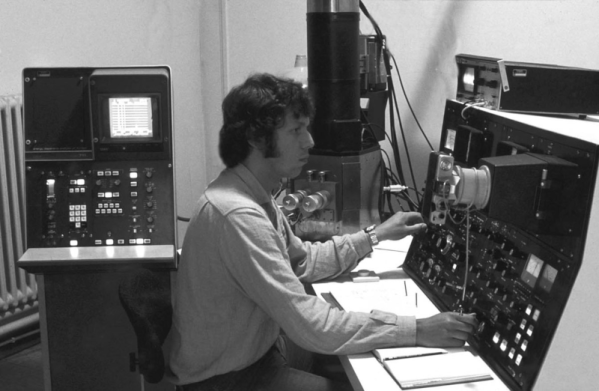
According to [Asianometry], no one believed in the scanning electron microscope. No one, that is, except [Charles Oatley].The video below tells the whole story.

The Cambridge graduate built radios during World War II and then joined Cambridge as a lecturer once the conflict was over. [Hans Busch] demonstrated using magnets to move electron beams, which suggested the possibility of creating a lens, and it was an obvious thought to make a microscope that uses electrons.

After all, electrons can have smaller wavelength than light, so a microscope using electrons could — in theory — image at a higher resolution. [Max Knoll] and [Ernst Ruska], in fact, developed the transmission electron microscope or TEM.

Continue reading “How We Got The Scanning Electron Microscope”

Mitre Wants The Feds To Play In Its Sandbox

If you haven’t worked with the US government, you might not know Mitre, a non-profit government research organization. Formed in 1958 by the U.S. Air Force as a company to guide the SAGE computer, they are often research experts who oversee government contracts or evaluate proposals. Now they are building a $20 millon “AI Sandbox” for the Federal government to build AI prototypes.

Partnered with NVidia, the sandbox will use an NVidia GDX SuperPOD system capable of an exaFLOP of 8-bit AI computation. Mitre reports this will increase their compute power for AI by two orders of magnitude.

Continue reading “Mitre Wants The Feds To Play In Its Sandbox”

Z80s From The ’80s Had Futuristic Design

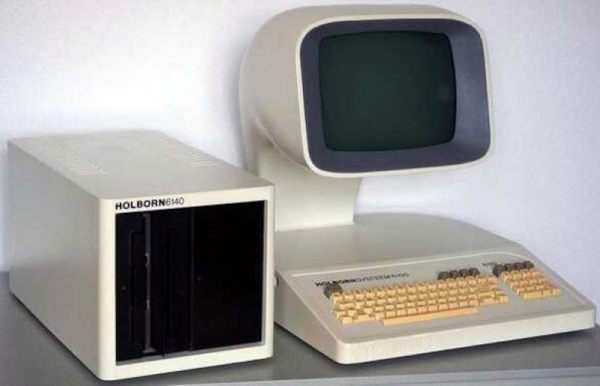
Ever heard of a Dutch company called Holborn (literally, born in Holland)? We hadn’t either, but [Bryan Lunduke] showed us these computers from the early 1980s, and we wondered if they might have appeared in some science fiction movies. They definitely look like something from a 1970s movie space station.

The company started out tiny and only lasted a few years. The Holborn 9100 looked like a minicomputer and, honestly, other than the terminal, looks more like an air conditioner or refrigerator. While it was a Z-80 system, it was clearly aimed at business. The processor ran at 3.5 MHz, there was 72K of RAM that could expand to 220 K — a whopping amount for the early ’80s. They also could accept loads of 8-inch floppies. It even had a light pen, which seems exotic today but was actually fairly common back then.

Continue reading “Z80s From The ’80s Had Futuristic Design”

Peering Inside The Tang FPGA

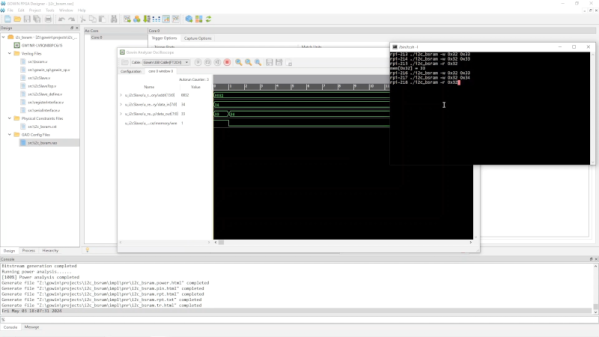
[Grug] has been working with the Tang Nano 9K FPGA board. He wanted to use the Gowin Analysis Oscilloscope (GAO) to build an internal monitor into the device for probing internal points. The problem is that the documentation is a bit lacking, so he made a video showing how to make it work to help us all out.

The idea for this isn’t unique, although for some vendors, getting this capability requires you to buy a license or the free versions are limited. We were disappointed, as was [Greg], that he had to run Windows to get the software to work.

Continue reading “Peering Inside The Tang FPGA”

Non Contact Scope Probe Costs Nearly Nothing

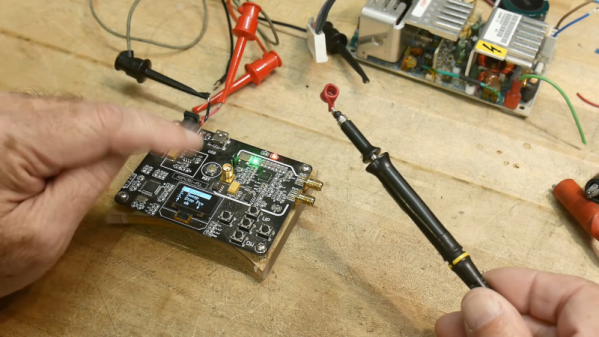
[IMSAI Guy] wants you to build a non-contact scope probe. The cost? Assuming you have a bit of wire and a regular scope probe, it won’t cost you anything. Why do you want such a thing? You can see what he does with it in the video below.

The probe is really just a coil with little slip-over coils that grab it. You can stick it on and remove it just as easily, so you don’t have to sacrifice the probe for normal use. It won’t give you high-accuracy readings, but if you want to sniff around a circuit without directly connecting to it, it will do the trick. If you are too lazy to make a coil, you can even clip a ground lead to the probe tip, although that won’t work quite as well.

Continue reading “Non Contact Scope Probe Costs Nearly Nothing”

Retrogadgets: The Ageia PhysX Card

Old computers meant for big jobs often had an external unit to crunch data in specific ways. A computer doing weather prediction, for example, might have an SIMD (single instruction multiple data) vector unit that could multiply a bunch of numbers by a constant in one swoop. These days, there are many computers crunching physics equations so you can play your favorite high-end computer game. Instead of vector processors, we have video cards. These cards have many processing units that can execute “kernels” or small programs on large groups of data at once.

Awkward Years

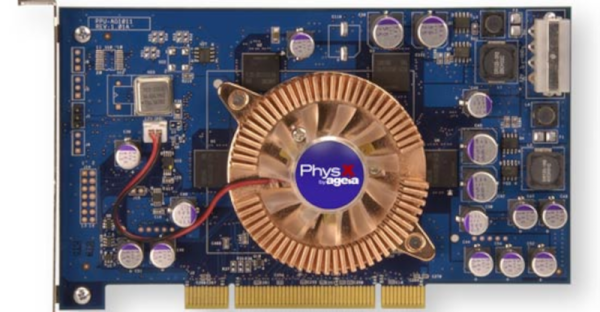
However, there was that awkward in-between stage when personal computers needed fast physics simulation, but it wasn’t feasible to put array processing and video graphics on the same board. Around 2006, a company called Ageia produced the PhysX card, which promised to give PCs the ability to do sophisticated physics simulations without relying on a video card.

Keep in mind that when this was built, multi-core CPUs were an expensive oddity and games were struggling to manage everything they needed to with limited memory and compute resources. The PhysX card was a “PPU” or Physics Processor Unit and used the PCI bus. Like many companies, Ageia made the chips and expected other companies — notably Asus — to make the actual board you’d plug into your computer.

Continue reading “Retrogadgets: The Ageia PhysX Card”

Spend An Hour In The Virtual Radio Museum

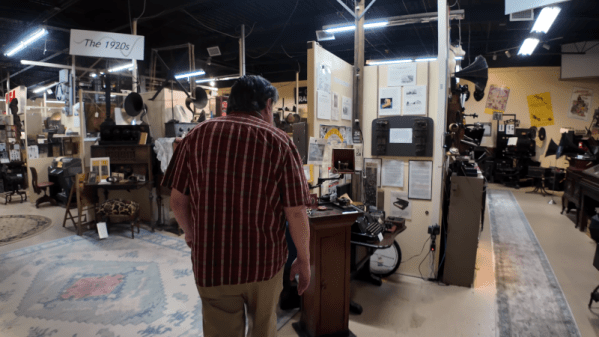
You have an hour to kill, and you like old communication technology. If you happen to be in Windsor, Connecticut, you could nip over to the Vintage Radio and Communication Museum. If you aren’t in Windsor, you could watch [WG7D’s] video tour, which you can see below.

The museum is a volunteer organization and is mostly about radio, although we did spy some old cameras if you like that sort of thing. There was also a beautiful player piano that — no kidding — now runs from a vacuum cleaner.

Continue reading “Spend An Hour In The Virtual Radio Museum”