
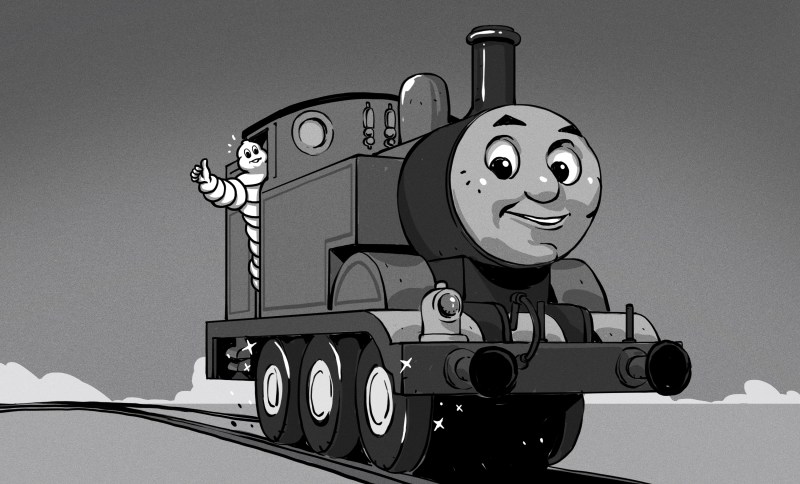
The train was one of the game-changing inventions that defined the Industrial Age. No more would humanity rely on tempestuous animals to haul goods and passengers great distances across the land. Fire and steam came along to rapidly increase the speed of travel and transformed the very fabric of society itself.
To this day, the vast majority of train networks rely on the same basic principle—heavy locomotives and carriages running steel wheels on steel tracks. Yet, there is a curious alternative twist on this concept that sees trains of carriages riding on tires instead. But what would possess anyone to build a rubber tired train?
Where The Rubber Meets The Rail
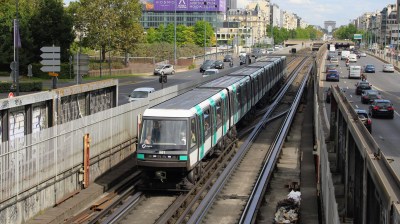
The first practical rubber-tired train system came about in the wake of World War II. The Paris metro had been poorly maintained during the German occupation, and was in dire need of repair or replacement. The state-owned public transport operator RATP and tire supplier Michelin came to the table, developing a concept wherein vehicles running on pneumatic tires would ride on a flat steel or concrete “rollway.” The vehicles would also have backup steel wheels that run against a steel rail for safety, keeping the train upright in the case of a tire blowout. Guidance would be provided by extra rubber tires mounted to the wheel bogies on a vertical axis, running against a vertical guideway built into the track, in a manner not dissimilar from later O-Bahn systems.
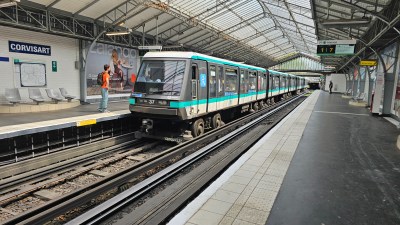
By the 1950s, when the concept was being seriously developed, steel-wheeled railways had been around for well over a century. They were the norm for good reason, but running rubber-tired trains did offer some advantages. The pliable tires would soak up vibrations, which was both good for passenger comfort as well as also virtually eliminating high-pitched squealing noises that are common on steel railways.
The rubber tires, running on concrete or steel surfaces, also offered greatly improved grip. This allowed the rubber-tired metro trains in Paris to climb much greater grades with ease, compared to traditional steel-wheeled railcars. It also aided in early automation efforts on the Paris Metro, as the higher grip level made it easier to ensure locomotives stopped at the right position when entering stations. Rail wear is also greatly reduced compared to steel-on-steel systems.
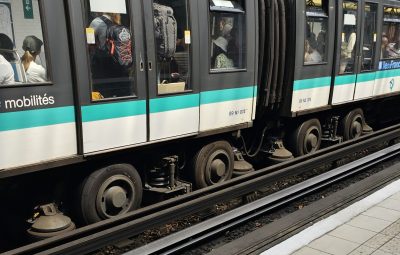
Of course, rubber tires also came with some drawbacks. Tracks were more expensive to build due to the need to incorporate both rollways and guideways, and commonly a steel rail to supply electricity to the trains. Rubber tires don’t last as long as steel wheels, either, aren’t as robust, and are subject to blowouts when damaged. The flexing of pneumatic rubber tires also makes the trains less energy efficient, and generates more heat in operation, which can be a concern in underground operations. As tires break down, they also create particulate pollution which isn’t great for urban air quality or for the people breathing it in.
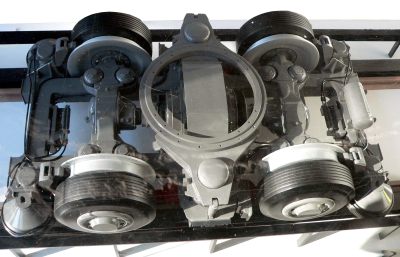
The Paris Metro found the oddball concept to be of great use, particularly given some of the higher grades faced in certain parts of the network. In time, lines 1, 4, 6, 11, and 14 would all be retooled to the Michelin-designed system with rubber-tired railcars running on 1,435 mm rollways. Various airport routes would later adopt rubber tired services, too, as well as the Toulouse, Lille, Lyon, and Marseille metros as well.
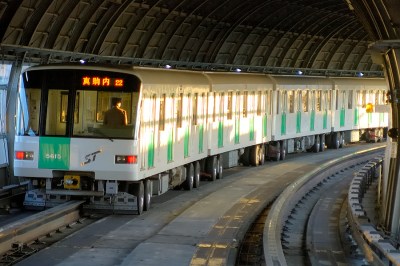
The system was not just limited to France, either. Mexico City found a rubber-tired metro to be the perfect transport solution, as the reduced vibrations were a massive boon given the area’s unstable soils. Other famous examples include the Montreal Metro in Canada, and lines 1, 2, and 5 of the Santiago Metro in Chile. Many other smaller-scale examples can be found around the world, often serving airport routes or shorter-distance lines.
Rubber-tired metros are unlikely to ever fully overtake more traditional steel-wheeled trains in popularity. There are more drawbacks than positives for most typical operations, particularly when it comes to maintenance and ongoing costs. Nevertheless, they have their place, particularly where grip is at a premium, grades are steep, or there is a keen desire to avoid excessive noise and vibration to keep the peace or avoid disturbing the subsurface. These rail-like curios stand out as a weird surprise treat for any railfan visiting Paris, or any of the other similar systems that can be found around the world.











Honorary mentions for Morgan town’s Personal Rapid transit system, Not quite a car not quite a train all 70’s , On rails for rubber wheels with full 70’s glory
Next.
Steel rubbers.
The trick is making them very thin.
Yes. https://en.wikipedia.org/wiki/Railway_tire
Parts of the London Underground mount the track on rubber to reduce vibrations in nearby buildings.
Also the Docklands Light Railway uses rubber-tyred cars.
The earlier system were Michelines:
https://fr.wikipedia.org/wiki/Micheline_(transport)
(This is the French Article, which is much more detailed than the English one)
The DLR does not use rubber-tired cars.
Basically every railyard on the continent will have a ‘Yard Car’, a rubber-wheeled rail power unit used for moving short trains of cars around the yard for staging, moving cars in and out of loadout, etc.
Conventional locomotives create traction simply from their massive weight. A yard car still has steel idler wheels to keep it on the track, but also a set of driven rubber traction wheels.
Unimog makes road-rail trucks that are very popular in Europe for small yards or maintenance work on regular train lines.
The Atlanta airport uses rubber tire trains.
It would be interesting to hear if this has been used for longer or freight applications. I’m guessing no.
Same for Phoenix. With no engine and following a guide rail on an elevated road, it always irks me to refer to it as a train so it lives as a tram in my head 🤣
The metro in Santiago de Chile uses rubber tires as well. Good comfort.
What about rubber braking wheels? Lowered for emergency stops. Trains can take a mile to stop.
It’s an interesting idea but wouldn’t a train that takes a mile to stop be so massive it would just eat up the breaking tires without knowing the difference?
Nope. On most modern freight trains, every axle is braked, so it wouldn’t be more than 10 tons per wheel, that’s not extraordinary. But then it would still be on steel rails, unless you want to make a concrte track all the way which is very expensive. However, trains rarely have to emergency brake, except for at level crossings, a fault in the safety systems is extremely rare.
Also, the mechanics of this system is very complex. Eddy current brakes (which are already fitted to most EMU/DMU passenger trains) offer far more effective braking power.
I imagine that if it isn’t already, heat dissipation would quickly become the governing factor here? Convert x MJ of kinetic energy into heat within a given volume of tyre, and temperatures would probably skyrocket given the low specific heat capacity and thermal conductivity, leading to very short tyre life? Though for emergency-only applications, that perhaps doesn’t matter.
Also, of course, the matter of braking hard enough to simply tear the tracks off their ties – I’m not sure how easy or difficult this is, but trains are known for being quite heavy…
I think to me the interesting concept here would be eddy-current braking – already used, afaik, on some rollercoasters and possibly some “real” trains as well – since you can direct the heat predominantly into the rail, which is an inherently self-refreshing supply.
Disclaimer: all entirely speculative, by no means an expert
If you tear the tracks off, you don’t have any guidance left — you want to avoid that. The resulting braking effect isn’t that high either, but it has been done (for a different kind of slowing down, though): https://en.wikipedia.org/wiki/Railroad_plough
You can use eddy currents, but everything on the track side must be hardened to survive the induced voltages. The heat capacity of the rail is only self-refreshing for a small number of brakes at the beginning of the train, after that you have to deal with the heat expansion forces in the rails. This has been done in ICE3: https://en.wikipedia.org/wiki/File:Wirbelstrombremse_aktiv.jpg (not to be confused with the track brake (https://de.wikipedia.org/wiki/Magnetschienenbremse with more pictures than the english version), which just uses magnets to pull the brake elements onto the track). The latter suffers from scraping lots of dust from the track, which then confuses axle counters, so the use is limited to emergency braking.
just grab it by magnet to track, ebrake is about brake, nothing else is relevant, you wanna stop, now. thats it.
Wet rubber/steel is worse than wet steel/steel, you’d rather need a rack railway for that. Then you want to keep the forces along the train at bay, which limits the acceleration (negative sign for braking). If the acceleration is too low to avoid an accident, you have severe issues to solve beforehand. Railway security is a nice, deep rabbit hole, btw.
When I saw the title l, I thought it was going to be about Australian road trains
https://en.wikipedia.org/wiki/Road_train
clemont-ferrand has a rubber tired tram with a central steering slit in the road.
I discovered the rubber tyred train while commuting from Frankfurt Airport terminal 3 to terminal 1 two days ago.
Clermont-Ferrand is also Michelin home city and they created the “Micheline” around 1930 (pre-WW2 then) a rubber train that the autor seems to have missed in this history of rubber trains.
https://en.wikipedia.org/wiki/Micheline_(railcar)
Where gradient is the issue, there is the next step in friction… Funicular railways.
Notable examples at Scarborough and Snowden.
Came for the 12v lego trains.
Disappointed.
Rubber tired Subways? I.E. a Bus in a hole.
One downside worth mentioning: these metros in Paris on rubber tires are ear-splitting when changing speed (braking or accelerating). It’s just a long, horrible screeching sound—especially when you’re at the station.
In fact, the normal, steel-wheeled ones are the ear-splitting ones, especially in curves. The rubber tired ones only squeal at switches (where they run on the steel wheels). However, they have a deep roar when accellerating ant they are more noisy on straight track.
There was a time when Pullman used paper wheels, for a quieter and smoother ride: https://en.wikipedia.org/wiki/Paper_car_wheel
Montreal metro is also on rubber.
Most mono rail systems use rubber pneumatic tires for traction and guidance. In my opinion if it’s on rubber it’s a bus.
Could’ve sworn I saw trains on rubber tires as a kid in Paris once. Now it’s confirmed I wasn’t misremembering them.
Steel wheels are not only needed in case of flat tires, but especially on track switches that are normal steel track switches, where there are no side rails to help the train to stay on its track.
One line from the Lausanne (CH) subway has been converted from rack to rubber tires since it offered enough traction and it was probably easier and cheaper to upgrade.
There’s also the ancestor or rubber-tires subways: https://en.wikipedia.org/wiki/Micheline_(railcar)
Those odd things were based on trucks and later custom built. They had narrow tires sitting on regular rails, as well as steel flanges to help it stay on the track. Since rubber tires struggled to carry the weight of a train, it needed many of them, with examples of light trains needing 12 axles when the steel equivalent would only have 4 axles
The guided bus system in Cambridge turned out a total fiasco though.
I’m convinced that there’s a conspiracy. There are a handful of “guided busways” around the world, like the o-bahn linked in the article. They only ever seem to get a mention when a proper light rail is proposed for a region, and then all the grumpy people who hate efficient public transport point to the o-bahn and say “hurr durr why are the taxpayers on the hook for light rail when we should have a cheaper o-bahn” as if they actually care about efficient public transport or would use it in either case.
Most monorails run on rubber – though not necessarily pneumatic – tires.
The problem is the wear and maintenance, especially on “metro” systems that see constant use and little non-op downtime.
First, the author compares “steel wheels to tires.” However, the part of the steel wheels that makes contact with the rail is still called the tire. (Not “tyre.”)
Second, it has been found that everywhere in the world, even in the most remote places, the most significant “pollutant,” found in frightening quantities, is tiny rubber balls from rubber vehicle tires. Apparently they’re in the air, everywhere, in significant quantities.
We need to address that, before we think up new ways to grind down more rubber tires, don’t ya think?
😱 🤪
I guess the utility pickup trucks the railroads in US use for maintenance, with retractable steel guide wheels that use their regular rubber road tires to grip the rails for drive don’t count huh? :)