A Tube, The Wooden Kind

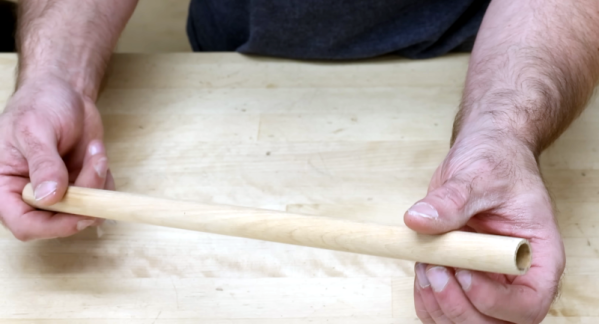
While we aren’t heavy-duty woodworkers, we occasionally make some sawdust as part of a project, and we admire people who know how to make wood and do what they want. We were surprised when [Newton Makes] showed a wooden dowel that was quite long and was mostly hollow. The wall was thin, the hole was perfectly centered, and he claimed he did not use a drill to produce it. Check it out in the video below and see what you think.

We don’t want to spoil the surprise, but we can tell you that making something that long with a drill or even a drill press would be very difficult. The problem is that drills have runout — the bits are usually not totally centered, so the bit doesn’t spin like you think it does. Instead, it spins and rotates around a small circle.
Continue reading “A Tube, The Wooden Kind”

Inside Project Delilah

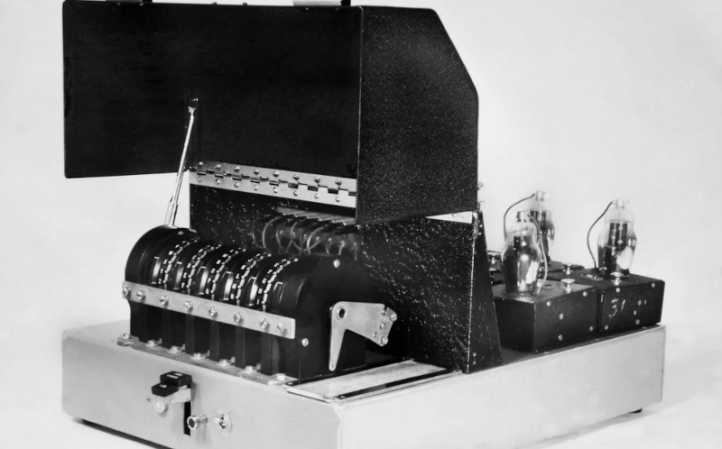
The invention of the computer is a tricky thing to pinpoint. There were some early attempts that were not well known and some early attempts that were deliberately secret. [Alan Turing]’s efforts with Colossus were top secret for years, and while that work built on earlier efforts in Poland, [Turing] has as much claim to be the father of computers as anyone. But [Jack Copland] points out in a recent post that the famous computer scientist was also involved in another secret project: Delilah.

While [Turing] is best known for his work breaking ciphers at Bletchley Park, he also put time in on a second project about ten miles away in a secret electronics lab at Hanslope Park. There he worked with an assistant, [Donald Bayley] on Delilah — a portable system for encrypting voice transmissions.

Continue reading “Inside Project Delilah”

Telling Time Used To Be A Ball

If you watch the New Year’s festivities from New York, you know that they mark midnight with the dropping of a big, gaudy ball. You might assume this was just an arbitrary gimmick, but it turns out dropping balls has a place in the history of timekeeping, especially for ships at sea. The New York ball doesn’t work precisely the same, but it was clearly inspired by an ancient method of indicating the time.

Apparently, even the ancient Greeks used ball dropping to indicate time. But the modern ball got its start with [Captain Robert Wauchope], who installed one at Portsmouth, England, in 1829. The Royal Observatory in Greenwich got one in 1833, which you can see working in the video below.

Continue reading “Telling Time Used To Be A Ball”

BLE Rain Gauge Sips Water And Batteries

It isn’t that hard to make an electronic rain gauge if you have a steady source of power or you don’t mind changing batteries often. But [Matthew Ford] offers a third option: a simple device with a Bluetooth Low Energy (BLE) module that can get a few years of a pair of AA batteries.

The approach has several advantages. Batteries make the device self-contained, and changing them infrequently is an obvious win. In addition, the BLE allows the device to be wireless and send data directly to an Android device. Thanks to a WH-SP-RG rain gauge, there’s not much to that part. The smart part is an nRF52832 module and some minor parts. The phone side uses an off-the-shelf Android app.

In a project like this, it is critical to have timers that really put the CPU to sleep. [Matthew] had to modify the Arduino libraries to allow the lp_timer objects to make it to an hour. Without the modifications, the timer can only reach 8.5 minutes. Sure, you could stack them, but that means taking a power hit multiple times an hour which would affect battery life.

Not the most complex project, but more complexity would mean lower battery life, so — as they say — less is more. We couldn’t help but think that with rechargeable batteries and a small solar panel, this could last a very long time.

LoRa, of course, is another choice. You can make 3D print a tipping bucket device, too.

Giving A Proprietary Power Supply The Boot

You’ve probably noticed that everywhere you go — the doctor’s office, hotels, or retail shops, there are tiny PCs everywhere. These small PCs often show up on the surplus market for a very good price, but they aren’t quite full-blown PCs. They usually have little option for expansion and are made to be cheap and small. That means many of them have custom and anemic power supplies. We aren’t sure if [bm_00] needed a regular power supply to handle a graphics card or if the original power supply died, but either way, the HP small-form-factor box needed a new power supply. It took some clever work to be able to use a normal power supply in the little box.

At first, we thought this wouldn’t be much of a story. The motherboard surely took all the regular pins, so it would just be a matter of making an adapter, right? Apparently not. The computers run totally on 12V and the motherboard handles things like turning the computer on and off. The computer also was trying to run the power supply’s fan which needed some work arounds.

Continue reading “Giving A Proprietary Power Supply The Boot”

Casio Calculator Gets New Keyboard

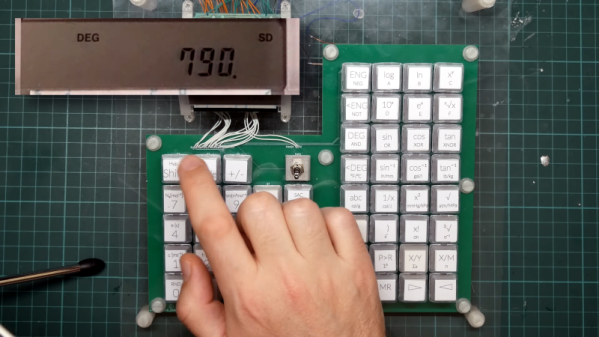
What do you do with a circa 1985 Casio FX-451 calculator with a bad keyboard? Well, if you are [Poking Technology], you transplant the inside of the calculator to a new custom keyboard. There are two videos that cover the process in detail, which you can watch below.

The calculator has a unique design. It looks like a simple calculator in a wallet. But the wallet opens to reveal an extended keyboard with all the scientific features onboard. Unsurprisingly, the membrane keys didn’t survive over four decades. Disassembling the unit was a challenge. Soldering wires to the keyboard lines was further complicated by the fact that some of the lines are on the back of the PCB and pass through to the top under the main IC.

The new keyboard is quite a bit larger than the original, making this more of a desk calculator, but that also means you can use high-quality keys. We’d love to see a 3D printed case to wrap it all up, but the bare PCB look has its charms, too.

If you can’t understand how [Poking] can love a calculator so much, you probably never owned an HP-41C, either. Of course, our retro calculator dreams also include Star Trek.

Continue reading “Casio Calculator Gets New Keyboard”

A History Of Copper Pours

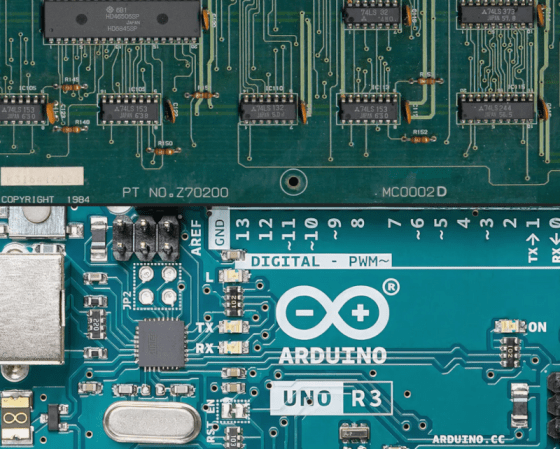
If you compare a modern PCB with a typical 1980s PCB, you might notice — like [lcamtuf] did — that newer boards tend to have large areas of copper known as pours instead of empty space between traces. If you’ve ever wondered why this is, [lcamtuf] explains.

The answer isn’t as simple as you might think. In some cases, it is just because the designer is either copying the style of a different board or the design software makes it easy to do. However, the reason it caught on in the first place is a combination of high-speed circuitry and FCC RF emissions standards. But why do pours help with unintentional emissions and high-speed signals?

Continue reading “A History Of Copper Pours”