All talk and schedule information is available on the conference webpage, but here are the things you don’t want to miss (all times are Pacific time zone):
10:10 am | Keynote: Keith Thorne
5:25 pm | Keynote: Jeremy Fielding
6:25 pm | Hackaday Prize Ceremony
7:35pm | After party live set from DJ Jackalope — watch on Twitch, socialize on Discord
If you’re reading this post while the bits are still fresh, you’ve got about four hours until day two of Hackaday Remoticon 2021. You can feel the electricity in the air, right? We’ve got an absolutely stellar line-up this year: every talk is gonna be a good talk.
Friday was great fun, and you can still still rewind Friday’s live stream if you hurry. Otherwise, at 11:00 AM PST, we’ll start up day two with a keynote talk by Keith Thorne, who’s going to take us through all of the work, and hacks, that made the LIGO experiment the most sensitive instrument mankind has ever made. Bookending the talks, just before the Hackaday Prize announcement and after-party DJ Jackalope Live Set, Jeremy Fielding is going to be walking through everything about his robotic arm and what you need to know about anything that moves.
Watch some great talks, and then hang out with the presenters afterwards over on our Discord server. What more do you want on a Saturday?
We really don’t want you to miss out on anything, but in case you come late to the talks, you can rewind the live stream to catch up. After it’s all done, we’ll slice and dice up the talks so you can find them later. But if you miss out on the discussions, the chance to ask our speakers questions, and the pervasive Jolly Wrencher ambiance, you’ve just missed out. Join us live if you possibly can! We’d love to see you.
This article is part of the Hackaday.com newsletter, delivered every seven days for each of the last 200+ weeks. It also includes our favorite articles from the last seven days that you can see on the web version of the newsletter.
Want this type of article to hit your inbox every Friday morning? You should sign up!
All talk and schedule information is available on the conference webpage, but here are the things you don’t want to miss (all times are Pacific time zone):
With just a few days to go before the kickoff of the 2021 Hackaday Remoticon, we’re still working furiously behind the scenes to pack as much content as possible into the two day virtual event. In fact, there’s so much going on that we thought you’d appreciate getting a bit of a head start as far as planning your own personal course through the weekend goes. The event might be free, but that’s no reason not to squeeze as much out of it as you can.
Chat It Up on Discord
To begin with, you’re really going to want to join the official Hackaday Remoticon Discord server. We know some subset of the Hackaday readership would rather we used Matrix, or IRC, or maybe carefully modulated smoke signals; but at the end of the day, Discord has bubbled to the top as the defacto choice for this kind of thing. Give it a shot, you might actually like it.
The Discord server isn’t just a place for like-minded hackers to hang out and discuss the musical stylings of DJ Jackalope during the Saturday afterparty. It’s also how attendees can ask questions at the end of each presenter’s talk, as we’ll be turning off YouTube chat to keep things centralized. Even if you don’t plan on communicating with others (though you really should), the Discord server has an interactive schedule of events which will let you sign up to be notified when the talks you’ve selected are about to start, and we’ll be dropping important announcements and links in there as the event goes on.
Friday Bring-a-Hack on Gather Town
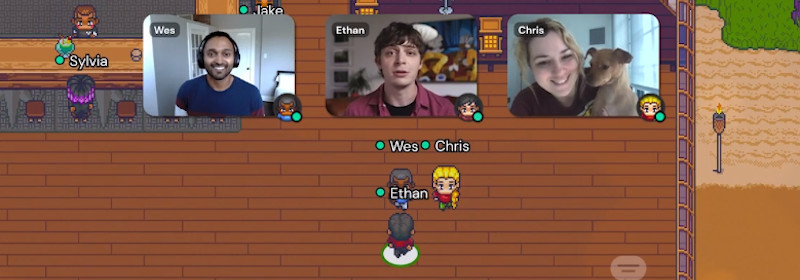
Like this, but with soldering irons.
Friday night ends with a Bring-a-Hack where attendees can show off whatever they’ve been working on using Gather. It’s a video chat platform inside a virtual 2D world that looks a bit like Legend of Zelda.
Using this virtual environment, you can easily drop into an ongoing video stream simply by walking up to the presenter. Once you’ve seen enough, just walk over to the next little cluster of users. The point is to recreate the experience of stopping by a crowded after party where everyone brought some hardware project along with them to get spark conversations. Space will be limited, with ticket holders and people in Discord getting the first dibs, so keep an eye on your inbox for information about how to join.
Of course this is not the only Friday evening activity. A few weeks ago we announced that Lewin Day will be hosting Hacker Trivia, giving our beloved commenters the chance to show off your unimpeachable knowledge of technology and Hackaday history. The Friday talk stream will dump immediately into trivia, but here’s the dedicated link if you want to set a reminder for yourself.
Try It, You’ll Like It!
It’s difficult, perhaps even impossible, to truly recreate the experience of going to an in-person hacker con. But with interactive events and the latest and greatest communication software, we’re hoping the 2021 Remoticon can get pretty close. All the pieces are in place, the only thing we need now is to have a whole bunch of excited hackers to join in and have a good time. Think you can help us out?
Remoticon is almost here, but by Saturday night it’ll be gone! The best sendoff we can think of is with a party, and DJ Jackalope is playing a live set to make that happen.
DJ Jackalope [Photo credit: Eli Omen Photography]We’ve been lucky to have live music from DJ Jackalope at numberous Hackaday Superconferences immediately after the Hackaday Prize ceremony. This year she reached out and suggested we continue the tradition, offering up her Twitch stream as the audio/video platform.
Everyone can enjoy the music, and still socialize via the Remoticon Discord server (invites will be sent out on Wednesday). Her set is scheduled to begin at 7:35 pm Pacific time on Saturday, November 20th.
But really you should plan to show up on the Remoticon live stream for Jeremy Fielding’s keynote at 5:25 pm followed by the Hackaday Prize ceremony at 6:25 pm — if not for the entire day. You can see why we need to cap the evening with a party!
All speaker and schedule info is available on the Remoticon website. Be sure to grab a free ticket; we’ll remind you about the live stream links, and that’s also how you’ll get access to Friday night’s Bring-a-hack. It bums us out that we can’t be together in person this year, but we’re going to do everything possible to enjoy each others’ company — come be a part that!
In the before-times, back when we could have in-person Hackaday Supercons, there was always the problem of the badge. Making a few hundred small electronic thingies, for a smart but broad range of hackers, is tricky. We always want it to do something all on its own, but also ideally to allow enough free range that the motivated badge hacker can make it into something exquisite. Add in the fact that some attendees are hardware types and some are software types, and toss in a price constraint too. Oh, and it has to look good. Tough problem.
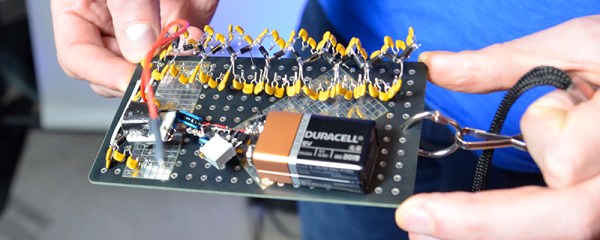
Here’s one extreme solution: the badge at the first Supercon. Faced with essentially zero budget and a tight time constraint, the Hackaday team punted — and produced a prototype board, but had tons of parts on hand for everyone to draw from. And the Hackaday crowd delivered. This was the badge that demonstrates what happens if you leave everything open.
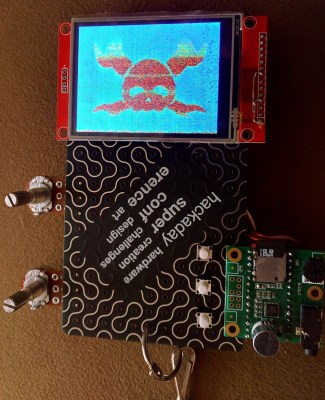
Contrast with the 2018 Belgrade and Supercon badges, which were essentially the same except for color. Here, the hardware interface was limited to a 9-pin header, but the badge itself was a fully functional microcomputer, complete with keyboard and screen. Most of the hacks were written in the native BASIC, though a few hearty souls played around with the alternative CP/M system. This was our most software badge.
And finally, even before the global supply crisis, even a tight-knit conference like ours could stock-out the world’s supply of a given component. The untold story of the 2016 Belgrade badge is that Voja Antonic bought out the world’s supply of Kingbright 8×8 common-cathode LED matrixes, and had to redesign the board in the last minute to incorporate the common-anode parts too. (Or was it vice-versa?) Lesson learned, the 2016 Supercon badge traded out the LED modules for discrete LEDs. Not gonna stock out on red LEDs.
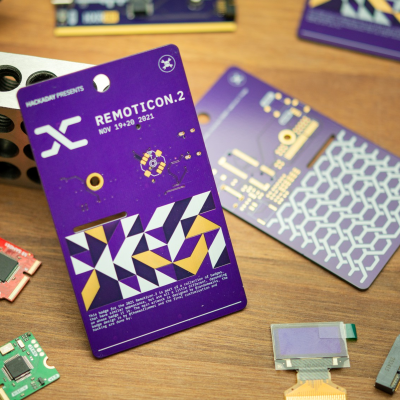
So that’s a long-winded introduction to Thomas Flummer’s unofficial Remoticon 2 badges. With the parts crisis and a virtual conference, you’re on your own to source the badge. Splitting the freedom vs. in-built functionality problem like Samson, he’s got two boards — one a breadboard and the other fully populated. And like all his badges, they both look great. If you manage to get one made by Remoticon next week, be sure to show it off in the Bring-a-Hack. And if you don’t get it in time, bring it by in person to the 2022 Supercon!
This article is part of the Hackaday.com newsletter, delivered every seven days for each of the last 200+ weeks. It also includes our favorite articles from the last seven days that you can see on the web version of the newsletter.
Want this type of article to hit your inbox every Friday morning? You should sign up!
As an itinerant Hackaday writer I am privileged to meet the people who make up our community as I travel the continent in search of the coolest gatherings. This weekend I’ve made the trek to the east of the Netherlands for the ETH0 hacker camp, in a camping hostel set in wooded countryside. Sit down, connect to the network, grab a Club-Mate, and I’m ready to go!
Forget the CTF, Connecting To WiFi Is The Real Challenge!
There no doubt comes a point in every traveling hacker’s life when a small annoyance becomes a major one and a rant boils up from within, and perhaps it’s ETH0’s misfortune that it’s at their event that something has finally boiled over. I’m speaking of course about wireless networks.
While on the road I connect to a lot of them, the normal commercial hotspots, hackerspaces, and of course at hacker camps. Connecting to a wireless network is a simple experience, with a level of security provided by WPA2 and access credentials being a password. Find the SSID, bang in the password, and you’re in. I’m as securely connected as I reasonably can be, and can get on with whatever I need to do. At hacker camps though, for some reason it never seems to be so simple.
Instead of a simple password field you are presented with a complex dialogue with a load of fields that make little sense, and someone breezily saying “Just enter hacker and hacker!” doesn’t cut it when that simply doesn’t work. When you have to publish an app just so that attendees can hook up their phones to a network, perhaps it’s time to take another look . Continue reading “So. What’s Up With All These Crazy Event Networks Then?”→


 Friday was great fun, and you can still still rewind



 Here’s one extreme solution: the badge at the first Supercon. Faced with essentially zero budget and a tight time constraint, the Hackaday team punted — and produced a prototype board, but had tons of parts on hand for everyone to draw from. And