Update: Realtime 3D For You Too!

[Kyle McDonald] has kept himself busy working on 3D scanning in realtime. He’s posted a writeup that takes us through the concepts, tools, and assembly of a DIY 3d scanning camera. You should remember a preview of this method posted earlier this month, but now it’s time to build your own. You’ll need a camera, a projector, and some open source software to process the image data. Using these simple tools, [Kyle] turned out much better video than before. Take a look after the break to see his results from scanning at 60 fps using a PS3 Eye. The trick to this setup is getting the correct synchronization between the projector and the camera, something that could be improved with a bit of extra hacking.

Does [Kyle’s] name sound familiar? It should, he’s got a long history of quality hacks that we’ve featured over the years. If you’re looking to use a scanner as a multitouch, add some music to tea time, or play with your skittles his work will give you a shove in the right direction.

Continue reading “Update: Realtime 3D For You Too!”

Panoramic Scanner Camera

[Photodesaster] put together a panoramic digital camera using a scanner and some miscellaneous parts. You may remember seeing something like this about six months ago and originally about five years back. The parts used here work together nicely. The sensor board from the scanner is mounted to a metal plate along with a 50mm lens. The plate is mounted to a hard drive platter that is turned via belts connected to the original scanner motor. This way, when you tell the computer to scan an image, the lens is rotated to capture the panorama. The use of an 18V tool battery is a nice portability hack for the scanner circuitry.

Judging from this 71MP image he has achieved some remarkable results.

[Thanks Stefan]

Lightdrawing Robot

Long exposure “light drawing” photography has become pretty popular lately. We see images pop up all the time that look pretty cool. [Nils] wasn’t feeling particularly artistic himself, so he made a robot to do the hard work for him. he can program patterns in, and it will replay them by changing the color of the light on top while it drives around. Though it may lack a little of the fluidity of the hand made images, it can probably make up for it with complexity. This isn’t the first time we’ve seen this style of photography mixed with robotics, though this one seems fairly more flexible. Tune in after the break to see a video of it in action.

Continue reading “Lightdrawing Robot”

Five Updates For The Steadicam

[YB2Normal] has updated his steadicam 5 times! For those that remember the original, it allowed indie film makers to create smooth and steady video. Version 2 implemented a new gimbal based on a throttle linkage in cars. Version 3 allowed the user to easily adjust angles and weights to prevent accidentally knocking the assembly. Version 4 seems to have disappeared. And finally, version 5 updates the gimbal again using a Traxxas U-joint and redistributes the weight. What should come next? We think a handle, holding onto a threaded bolt can’t be good for your hands.

[Thanks Update]

Home Made Panoramic Camera

This one is from way back in 2002, but we didn’t see it till today. This is a hand built panoramic camera. The film is laid out across the back of the case, and when taking a picture, the lens assembly rotates to expose the film. It is a very nice looking design. The brass body is quite reminiscent of the recent one posted here. On the site, you’ll find not only the build log, but a full explanation of all the math behind the design. It is a very interesting read, even if you have no plans on building your own.

[via Make]

Don’t Point That At Me

Some things are made to look steam punk but others are steam punk. This example of the later is a camera made mostly of brass. The body has been soldered together with only a shutter and lens being purchased for the project. There is a viewfinder and separate range finder to determine the proper focus for pictures as this is not a single lens reflex.

It should be obvious by now that this is a film camera. It relies on the photographer to turn the winder until an arrow on the knob lines up with a mark on the body for proper alignment. If you set out to make one of these, perhaps you should also manufacture your own film for it.

[via Dvice]

Capturing That (light Field) Moment

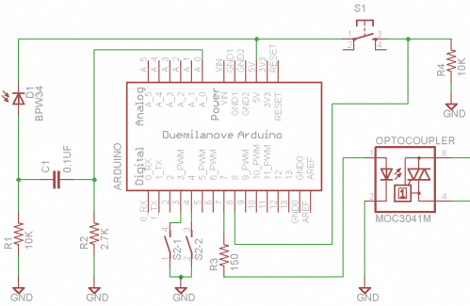
Yes, your eyes do not lie, that is 12 cameras rigged to take a picture at the exact same moment. The idea is a single camera loses data (namely depth) when it takes a 3D image and transposes it onto a 2D medium. FuturePicture somewhat circumvents this loss by taking several pictures with different focus distances. In short, the camera array allows you to focus on multiple items within a scene. The project’s hardware and software have yet to be released (we do know it’s at least Arduino), but they plan to make it entirely open source so everyone can experiment. Of course, we’ll keep you up to date.
[via Make]