Rule Your Furnace With This Network-enabled Thermostat

diy_thermostat

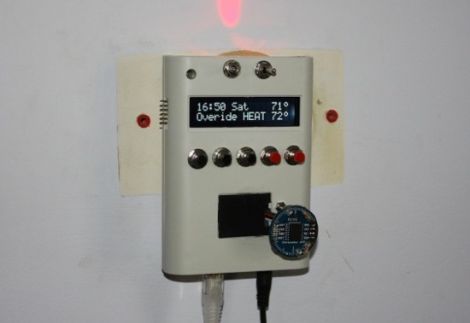
Adafruit forum member [Stephanie] embarked on a mission to replace the thermostat in her home with one that was far more robust and full of electronic goodies.

Her goal was to build a networked thermostat that allowed for 2-way communications between the base station and any other networked device, such as her laptop or iPhone. She wanted to not only be able to monitor her furnace and air conditioning systems remotely, but to control the units from afar as well.

The brains of the thermostat have changed throughout the project, becoming simpler as time went on. It is now controlled with just an ATMega328 mounted to the back of an LCD display with a Wiznet network module where an Adafruit Ethernet shield used to reside. The thermostat shows the current temperature, set temperature, and time on the front mounted LCD, the latter of which is provided by a Chronodot module. It also has an on board LED that can be seen from afar, indicating whether the heat or air conditioning is running,

Right now the thermostat can be controlled at the unit itself, or remotely using a Telnet session. [Stephanie] is currently happy with the setup, but future plans include creating an iPad application to provide a more user-friendly interface.

If you are interested in learning more, or building one yourself, be sure to swing by her blog for a far more in-depth look at the build process.

Cotton Candy Just The Color You Like It

Hit the web to order up your custom-color cotton candy from this machine (translated). A computer monitors a web interface for an incoming order, then pushes commands to an mbed microcontroller which dispenses three different colors of sugar to whip up your custom shade of the cottony delight.

In addition to the sugar dispensing system, the candy maker itself is also a do-it-yourself design. It looks like the most difficult part of this project was getting this component right. They’ve got a collection of videos documenting the multiple attempts on the road to success. Once dispensed, the colored sugars make their way into a spinning metal cylinder where they’re heated by the flame from a butane candle lighter. Eventually the team manages to get cotton candy to form but we can’t help but feel like they’re trying to reinvent the wheel with this one.

[via Make]

aquarium_pump_shutoff

Aquarium Overflow Sensor Saves Your Fish And Your Floors

If you’ve ever had a water leak in your home, you know the sinking feeling that comes over you as you walk through the door to the sound of running water. [Greg] knows this feeling quite well, having returned home to a sopping wet floor and an overflowing reef aquarium on more than one occasion.

Both of the overflows he experienced were due to a clogged drain in his display, but there was little he could do as far as walling off the drain from potential blockages. With all of the delicate creatures living in the tank, the only possible solution that came to mind was monitoring the aquarium’s water level.

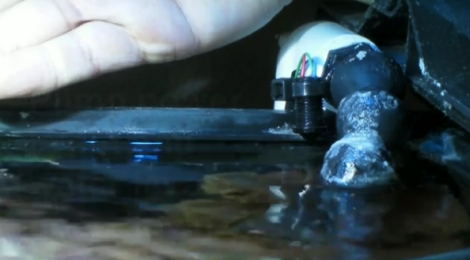
Unfortunately he had no idea how to get this done aside from using probes (which would rust in the salt water) or expensive off the shelf systems. [erich_7719] from the All About Circuits forums helped [Greg] out and designed a circuit for him which would monitor the water level using an IR sensor. The circuit simply shuts off the pump if the water level gets precariously high. As you can see in the video below it works quite well, and as a safety measure, requires a manual restart of the pump once the high water sensor has been tripped.

If you have a need for the same sort of setup, swing by his site for a detailed schematic as well as a bill of materials.

Continue reading “Aquarium Overflow Sensor Saves Your Fish And Your Floors”

Dishwasher Notifier For The Absent-minded

dish_o_tron_6000

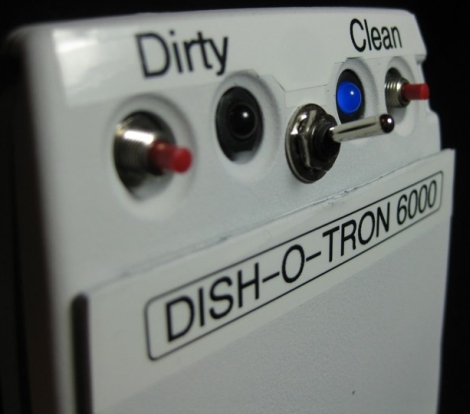
[Quinn] over at BlondiHacks is admittedly pretty absent-minded when it comes to household chores such as emptying the dishwasher. She often can’t remember if the dishes are dirty or ready to be put away, so she decided it was time to devise a mechanism that would help keep her on task. She originally considered a double-sided sign that said “Clean” on one side, “Dirty” on the other, but she chose the fun option and decided to over-engineer the problem instead.

She ultimately focused on two conditions that she needed to monitor: when the dishwasher had been run, and when the dishes have been emptied. To tackle the first condition, she used a thermistor to detect when the door of the dishwasher got hot from the wash cycle. The second wasn’t quite as easy, since she often peeks into the dishwasher to grab a clean dish when needed, unloading the rest later. She eventually settled on using a tilt switch to monitor the angle of the door, assuming that the dishes have been removed if the door was open for over a minute.

[Quinn] reports that her Dish-o-Tron 6000 works well, and she had a good time building it. Sure the whole thing is kind of overkill, but where’s the fun in moderation?

Potentially Explosive Spritz Cookies

Do you recognize the shapes of these spritz cookies? Theoretical physicists and nuclear engineers might. They are representative of a hydrogen atom in several different states. Oh, and they’re delicious. [Windell] over at Evil Mad Scientist Labs cut his own spritz cookie discs in order to bake the hydrogen look-a-likes.

To bring you up to speed: spritz cookies are not rolled out and cut with a cookie cutter – although you could print your own cutters in these shapes if you wanted to. Instead, a cookie press is used to squeeze out dough onto a baking sheet. The press looks like a very wide syringe. The dry dough is packed into a cylinder, and a ratcheting ram presses it toward the business end. A disc with wisely placed slits lets the dough squeeze out into the final shape.

We made some shamrocks for St. Patrick’s Day, but now we’re wondering if we can make our own Hackaday logo cookies. [Windell] grabbed some melamine dinner plates to use as raw material for his custom discs (remember to use food safe material). He then designed the cutouts in Inkscape and headed over to the laser cutter to fabricate the disc. We don’t have a laser cutter but we’d bet you can do a similar, but slower, job with a drill and a lot of filing/sanding.

[via Dangerous Prototypes]

Brainwave-based Assistive Technology In The Home

eeg_smart_house

Amyotrophic lateral sclerosis (ALS) is a debilitating disease that eventually causes the afflicted individual to lose all control of their motor functions, while leaving their mental faculties intact. Those suffering from the illness typically live for only a handful of years before succumbing to the disease. On some occasions however, patients can live for long periods after their original diagnosis, and in those cases assistive technology becomes a key component in their lives.

[Alon Bukai and Ofir Benyamin], students at Ort Hermalin Collage in Israel, have been working hard on creating an EEG-controlled smart house for ALS patients under the guidance of their advisor [Amnon Demri]. The core of their project focuses around controlling everyday household items using brainwaves. They use an Emotiv EPOC EEG headset which monitors the user’s brainwaves when focusing on several large buttons displayed on a computer screen. These buttons are mapped to different functions, ranging from turning lights on and off to changing channels on a cable box. When the user focuses on a particular task, the computer analyzes the headset’s output and relays the command to the proper device.

As of right now, the EEG-controlled home is only a project for their degree program, but we hope that their efforts help spur on further advancements in this field of research.

Continue reading to see a pair of videos demonstrating their EEG-controlled smart house in action.

Continue reading “Brainwave-based Assistive Technology In The Home”

Growling Doorbell Lets You Know Guests Have Arrived

wireless_doorbell_hack

[Sean] was screwing around online looking for nothing in particular when he came across a mailbox hacked to notify the homeowner when the mail had been delivered. Since his mail is delivered via a slot in the door, he had no use for the hack as is, but something similar soon came to mind.

His dog isn’t too keen on visitors, and he figured that he could save himself a bit of grief (and a lot of unnecessary barking) if he were to wire up his doorbell to notify him of guests via his iPhone. He stopped by the local hardware store and picked up a wireless doorbell. It was quickly disassembled and wired up to an Arduino he had set aside for a different project. Tweaking some code he found online, he soon had the doorbell talking with the Arduino and was ready to interface it with his iPhone. He decided that he wanted to deliver notifications to his phone via Growl and found a Perl script online that was close to what he needed. A few tweaks later, and he had a Growling doorbell.

As you can see in the video below, it works, though there seems to be a bit of a delay in the notification. We don’t think that it would be enough to send his visitors packing before he made it to the door, but the lag can likely be reduced with a few small modifications.

As for the post that started this whole thing, we’re pretty sure this is it.

Continue reading “Growling Doorbell Lets You Know Guests Have Arrived”