100 Meter Spring Reverb Makes Us Hear Satanic Voices

Spring reverb is something we’re used to hearing about when it comes to guitar amplifiers. It’s a coil spring stretched the length of the amp’s housing. One end is fed the guitar signal, with a pickup at the other to capture the output. But this spring reverb is on a much grander scale. [Jochem van Grieken] strung up 100 meters of coiled steel wire in a long hallway and the results sound a little bit evil.

A simple piezo element is used as a pickup to amplify the sound coming off of the spring. Above [Jochem] is using what looks like a jeweler’s saw to make some sound on the 3.5mm wire. It’s this portion of the video that sounds demonic to us. In the second half of the demonstration he strikes the wire with a ruler to produce the pew-pew effect from many a sci-fi movie.

This isn’t his first experiment with the concept, it’s just his largest. Also found after the break are a pair of links to his other installations.

Continue reading “100 Meter Spring Reverb Makes Us Hear Satanic Voices”
Turning Toy Pianos Into MIDI Keyboards

Building a MIDI device is always a great microcontroller project, and nearly everyone has an old toy keyboard lying around in the back of a closet or in the basement. [JenShen] decided to take one of these toy keyboards and build a MIDI keyboard.

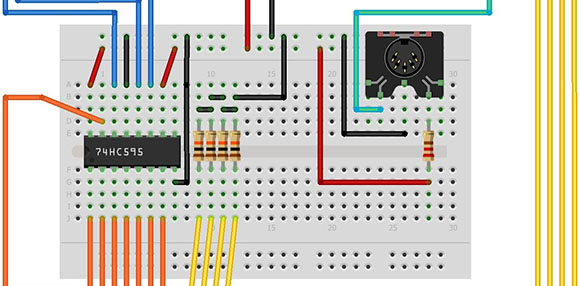
The keyboard [JenShen] used was a simple Casio keyboard with built-in voices. After tearing out the guts of the keyboard, the only thing that remained is the row of push buttons underneath the keys. These buttons were laid out in a row/column matrix, so [JenShen] needed to decode this matrix before sending the result to an Arduino for processing.

A 74HN595 shift register was used to read the 8 rows of buttons underneath the keys, while the rows were tied to different input pins on the ‘duino. This allowed [JenShen] to scan the keyboard matrix with an Arduino and generate MIDI notes and send them to other synths.

In the video after the break, you can check out [JenShen]’s circuit and code that allowed him to turn a toy keyboard into a proper 32-note MIDI keyboard. It’s not velocity sensitive, but he says he’ll show everyone how to accomplish that in a future post.

Continue reading “Turning Toy Pianos Into MIDI Keyboards”

Glockentar: A Guitar + Glockenspiel Mashup

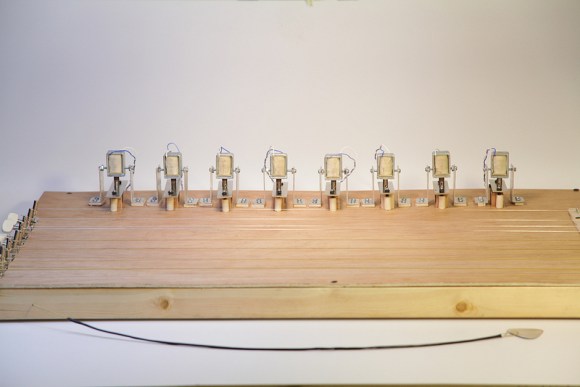
This unique electronic instrument combines a chopped up guitar and a hacked apart glockenspiel with an Arduino. [Aaron]’s Glockentar consists of guitar hardware and glockenspiel keys mounted to a wood body. Solenoids placed above the keys actuate metal rods to play a note.

Under the hood, an Arduino connects the pieces. The conductive pick closes a circuit, which is a digital input into the Arduino. This actuates the corresponding solenoid to play the glockenspiel key, and sends a character to a computer over serial.

On the computer, an openFrameworks based program creates lighting that is projected onto each string. MadMapper is used for projection mapping, which maps the openFrameworks output to each string. Video is passed between applications using the Syphon framework.

[Aaron] has provided a write up that goes into details, including the Arduino and openFrameworks source for the project. There’s also a video overview and demo of the Glockentar after the break.

Continue reading “Glockentar: A Guitar + Glockenspiel Mashup”

MechBass: A Robotic Bass Guitar That Sounds Fantastic

[James] wrote in to show us his honors project for his fourth year at Victoria University of Wellington. He designed and built this robotic bass guitar. You can hear it performing “mass hysteria” by the band Muse after the break. It sounds great, but we’d love to hear it without the full accompaniment.

[James] doesn’t have a site up for the MechBass, so we’ve included details below.

Continue reading “MechBass: A Robotic Bass Guitar That Sounds Fantastic”

Steam-powered Pickup Winder

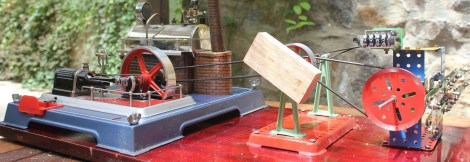
[Valve Child] has been building a few three-string cigar box guitars. Of course he’ll need a few pickups, but three-string guitar pickups aren’t exactly easy to come by. To solve this problem, he’s built a guitar pickup winder powered by a steam engine.

The pickup winder is powered by a Wilesco D20 model steam engine, connected to the actual winding mechanism via a rubber belt. To the right of the bobbin bracket is a mechanism built out of Meccano – Erector sets for us americans – that provides a mechanical counter for the number of wire turns and a wire traverse to keep each layer of wire somewhat even across the width of the bobbin.

Previously, we’ve seen [Valve Child]’s really sweet sounding lap steel build from a log using a hand-wound pickup and a preamp tube as the bridge. It’s questionable if the guitar signal came from this lap steel via the pickup or the microphonic tube, but now [Valve Child] has a really, really good method of improving his pickup production abilities.

Video after the break.

Continue reading “Steam-powered Pickup Winder”

Atari Punk Stick Puts A Synth In A Joystick

[youtube=http://www.youtube.com/watch?v=ngXrTd-8jf4&w=470]

The Atari Punk Console, a tiny synthesizer based on the ubiquitous 555 timer chip, is the first build de rigueur for any budding electronic wizard wanting to build musical devices. With just a handful of caps, resistors, and a pair of pots, the APC is a fabulously fun and easy build made even cooler by [Pat]’s addition of a joystick.

The circuit of the Atari Punk Console consists of a 556 chip – basically two 555s put into the same package – and a pair of potentiometers to control the frequency and output of this very basic synth. Since most joysticks are just two pots arranged on an X-Y mount, [Pat] thought it would be cool to control his APC without twiddling knobs, and instead sweeping a joystick around.

After acquiring an old Microsoft joystick from his local Goodwill, [Pat] wired up his Atari Punk Console to the joystick, using the ‘fire’ button to turn the output on and off. The result is everything between a low machine gun-like tone to a nasal square wave that will hopefully keep pace with your chip-based audiophile friends.

Continue reading “Atari Punk Stick Puts A Synth In A Joystick”

MR-808 Is A Mechanical Version Of The Most Famous Drum Machine

Anyone who has listened to any music from the 80s has heard the percussive effects of the infamous TR-808 drum machine. To the modern ear, it sounds like an antique. Being the most popular drum machine of all time means it must have some redeeming qualities, right?

[Moritz Simon Geist] decided he wanted nothing to do with the wimpy computer-based emulations of a TR-808. Instead, he chose a more mechanical version that puts robots inside a gigantic 808 enclosure to play snares, high hats, cowbells, and drums in time with any MIDI drum track.

[Moritz] calls his build the MR-808 and puts a real-life bass drum, snares, hats, toms, claps, and a ride into a 3.3 x 1.7 meter ( 10.8 x 5.5 foot) case. The sound triggers are handled by Max/Msp communicating with a pair of Arduinos to handle the solenoids and light effects. You can read more about the hardware setup in [Moritz]’ behind the scenes look.

After the break you can see the MR-808 in action, both alone and by providing the percussion for [Moritz]’ band. A very cool build that now cries out for an Arduinofied bassist placed into an overgrown TB-303 enclosure.

Continue reading “MR-808 Is A Mechanical Version Of The Most Famous Drum Machine”