
[youtube=http://www.youtube.com/watch?v=C1WOoPV_7HU&hl=en&fs=1&rel=0&color1=0x3a3a3a&color2=0x999999]
[Jeff] has been playing around with Parallax’s Propeller chip. He’s used it to adapt an NES controller to the to the Commodore 64. In this latest iteration though, he’s added a Memsic 2125 dual axis accelerometer to the end of a whiffle ball bat and used that to provide Wii style controller input. The video above shows his son playing Street Sports Baseball with it.
Peripherals Hacks1579 Articles
Easiest Rock Band To MIDI Setup Yet
[youtube=http://www.youtube.com/watch?v=S6bQaHuFvLw&hl=en&rel=0&color1=0x3a3a3a&color2=0x999999]
We have news for those of you dismissing the new Wii Version of Rock Band. Sure, the lack of DLC is a huge factor, but if you’re looking to use the instruments with MIDI software, [Jordan Balagot] has found what may be the easiest way. Since the Wii instruments are connected via USB, they are easy to connect to a computer. [Balagot] used a program called junXion that is a data routing app for OS X. JunXion can take any USB human interface device and remap the buttons, making it easy to set up the drums as a MIDI input device in an intuitive way. Install junXion, plug in the drums, map the pads, and rock out.
[via Create Digital Music]
3D Glasses For An SGI
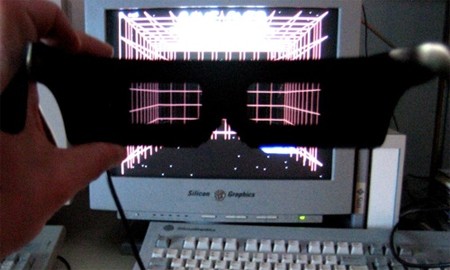
[Mark Hoekstra] is a true SGI enthusiast, and he proves it with these 3D glasses for an SGI. Taking advantage of the SGI’s stereo viewport, [Hoekstra] created a controller for a pair of CrystalEyes glasses that would allow them to be used with the SGI.
[Hoekstra] used the schematic from [M.C.D. Roos]’s similar project, which used old Asus 3D VR glasses. This project can theoretically be done with any LCD-shutter glasses, the only important thing to know is the maximum shutter voltage the glasses will take. [Hoekstra] felt his way through building the board by common sense alone and somehow managed to avoid any shorts. The board only makes three connections to the glasses: an out to the left lens, one to the right, and a ground wire. After building the controller board out of an LM324 chip and a customized segment of perf board, he learned that he needed a monitor capable of displaying a relatively high bit depth at 100Hz, or 50Hz per eye. He tested the glasses with a game called Hacknoid after making a few last minute changes on the board (forgot the ground fuse), and he was soon making himself dizzy with his functioning 3D glasses.
Turn Your Old Hard Drive Into A Sander/grinder

[Jipa] over at MetkuMods put up an original re-use for old hard drives: make em into power tools. The tiny servo motor that drives the spindle doesn’t generate much torque, but once the drive is spinning fast enough, the inertial force of the platter is enough to make it usable for small grinding/sanding projects. The platters are re-stacked directly on top of each other to increase strength – we’d suggest a few dabs of epoxy to make em even stronger. Once stacked, a piece of sand paper is cut to size and held on by the center platter washer. [Via hacknmod]
Wii Fit Balance Board Controls Robot
More Wii Fit Balance Board hacks keep rolling in from Europe. We’re not sure we agree with [Juan Gonzales]’s assertion that the Wii Fit Balance board is the best way to control robots, but we can’t deny how fun it looks. [Gonzales] managed to control a robot of his own design with the balance board, making it turn when he leans to the sides and moving forward and back when he leans in those directions.
The robot, which he calls SkyBot, is fairly impressive in its own right, built from a PIC microcontroller and featuring various infrared sensors and 6 contact sensors. The robot’s OS can be controlled from Windows, OS X, or Linux, but for this project, they used Debian. The balance board interfaces with a laptop connected to SkyBot; custom software (tar.gz file) to make this work was written in python, and is available on [Gonzales]’s robot wiki, as well as instructions on how to build a SkyBot. It is in Spanish, however, so fire up Google Translate and get to work.
[via Balance Board Blog]
PC Interfaced SNES Sound Processor
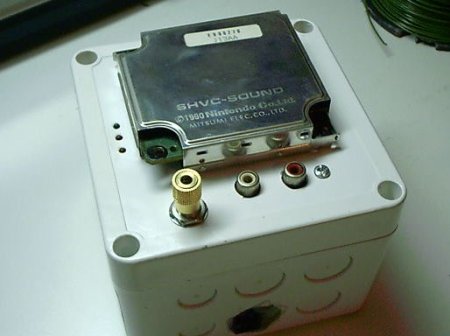
[Silverpill] sent in this interesting Super Nintendo mod. [Raph] interfaced a SNES audio processing unit to his parallel port using a logic gate and a few resistors. The project looks like it probably died off, but the goal was to use a APU to play authentic audio from emulated games. Schematics and code to get the thing working are all available on the site.
Wireless Arcade Stick
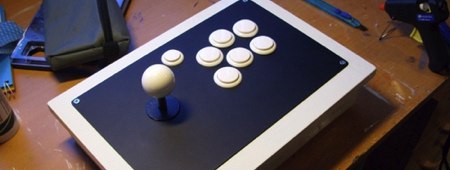
[astralpancakes] wireless arcade stick project looks like a great place to start if you want a simple project. Well constructed arcade sticks can cost $100+, but with all the MAME cabinet builders, the parts have become easy to acquire. The stick has a rigid wooden case with a metal faceplate. All of the component connections are soldered to the pads of a Logitech wireless controller. [astralpancakes] built this specifically to play Street Fighter III: 3rd Strike.









