Building A Magnetic Rotary Encoder

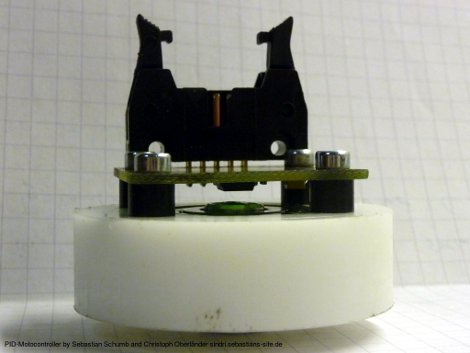
[Long Haired Hacker] has undertaken a high-resolution 3D printer build. He got his hands on some motors to drive the build platform but it doesn’t have a built-in encoder. He knows that optical encoder wheels can have problems due to dirt and grim as well as ambient light so he set out to find a better way of providing feedback to the controller. He ended up building his own magnetic rotary encoder which is shown above.

At the heart of the system is an AS5043 magnetic rotary sensor. The chip, which runs from $6.50-$11, can detect and report the rotation of a magnetic field with great precision. The rotation data can be read out in degrees using SPI, but it sounds like there’s also grey code output on a few pins if that suits your needs a bit better. The magnet which the chip measures is mounted in a sleeve milled to seat inside of a bearing ring.

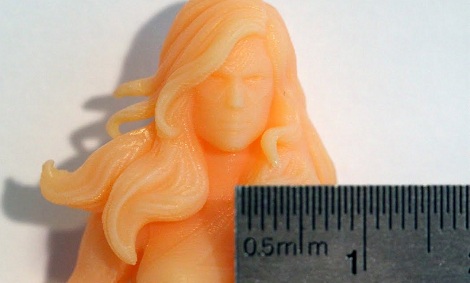
The 3D printing method [Long Haired Hacker] has chosen uses a projector and light-cured resin to achieve the kind of results seen in this other hi-res printer.

Hackaday Links March 8th, 2012

Solder Your Pin headers Straight

straight-header solder

If you’re worried about how to solder your pin headers straight, why not try this simple trick and put them into a breadboard before soldering?

Etiquette for Open Source Projects

soapbox Phillip Torrone

If you use or develop open source projects, it’s worth checking out [Phillip Torrone]’s Unspoken rules of Open Source article. You may not HAVE to do all the things he says, but it’s certainly a good starting point for being ethical with your hacks.

The [GoAmateur] Camera Mount

go-amateur camera mount for bike

If you can’t afford a professional camera mount for your bike, why not make one yourself? As pointed out in the article, normal cameras aren’t really made for this, so do so at your own risk. If this isn’t shoddy enough for you, why not make a mount for your 4 year old dumb-phone (Env2) out of a block of wood?

A 3D Printer BOM

If you’re wondering how much a 3D printer will cost you, or where to source the parts, this Bill of Materials for a Prusa Mendel should help. We would assume this project will be updated as everything is built, so be sure to check back!

MakerBot Assembly Time-Lapse

makerbot time lapse

Along the same lines, if you’re wondering about getting into 3D printing, this time-lapse of the Thing-O-Matic being assembled may give you some insight into what’s involved in getting one functional!

Hackaday Links: February 19, 2012

Industrial control robot band

Remember Animusic, a series of videos featuring computer-generated, highly  implausible instruments? Intel made their own to demo their industrial control tech. From the looks of things, we’re putting money on a bunch of MIDI triggers bolted onto plastic panels; now it’s slightly less impressive and the reason we’re looking at xylophones on eBay right now.

Quadrocopters everywhere

[Jouni] sent in his quadrocopter build that was inspired by the Japanese spherebot we caught earlier this year. [Jouni] used a carbon fiber frame to  prevent the copter from bumping into things. Other things bumping into it are another story entirely.

This is my gun. There are none like it, because I printed it.

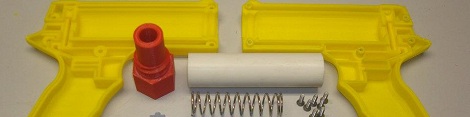
[Landru] printed a Nerf gun on his 3D printer. The only non-printed parts are a few screws, springs and an o-ring. [Landru] promised to put the files up on Thingiverse, but we can’t find them.

Media center auto power on circuit

[Dizzy]’s media server doesn’t have an ‘AC power loss reset’ feature in its BIOS, and he can’t jumpstart the thing by shorting pins on the ATX power socket. He came up with a very clean, minimal solution to starting his server after a power loss. Nice job, [Diz].

Better run, better run, outrun my soldering gun

Alright, circuit board shoes probably aren’t that comfortable, or useful, but we did find a like to the works of [Steven Rodrig], an artist who works in the medium of PCBs. The recycled circuits don’t do anything, and that’s giving us a few ideas on how to improve a digital banana.

Hackaday Links: February 12, 2012

This is why digital picture frames were invented

[Petros] sent in this video of his visualization of Van Gogh’s Starry Night. He did this with openFrameworks and also made a version that reacts to sound. Is anyone else reminded of that one scene in Vincent and the Doctor?

A boat’s a boat, but a mystery box can be anything

[Rick] wanted to build a lock pick training station for the Eugene Maker Space, but he needed a way to make it interesting. What could be better than a mystery box? When you pick the deadbolt, open the box up and you’ll get a prize. Just make sure you put something of yours in the box for the next person.

3D printer prints its own case

Because the 3d printer community isn’t segmented enough, [Sublime] decided to design a new one. Here’s where it gets cool: the Tantillus can print its own case, and can ‘daisy chain’ to another Tantillus so only one set of electronics are needed. Interesting ideas afoot.

A diamond says I love you, but a duct tape rose says I’ll fix that for you

Valentine’s Day is coming up, so if you haven’t already made dinner reservations, you’re probably up the creek. How about making a duct tape rose for that special person in your life. Bonus: a dozen costs $3, and they won’t die in a week.

Using keypads over serial or SPI

[Leniwiec] sent in a tutorial on connecting keypads to a microcontroller with a serial or SPI interface. If you want to build a calculator, this is your chance. We’d use this for an Apollo Guidance Computer, though.

Yet Another 3D Printer

What would you do if you wanted to demonstrate a linear bearing system? If you’re like [Bart] the obvious solution is building a tiny little 3D printer. [Bart]’s Quantum ORD Bot is constructed out of a previous project of his, the MakerSlide linear bearing system.

The idea of a printer made out of MakerSlide materials came from [Bart]’s invitation to ORD Camp. The fact that this build went together in about 5 hours speaks volumes about the simplicity of the MakerSlide system. Right now, the printer is designed for NEMA 14 motors, but for larger builds there’s plenty of room for the larger NEMA 17 stepper motors. [Bart] put up a build log for his printer up on the buildlog.net forums.

The MakerSlide system has already been used in an open source laser cutter project, but [Bart] really just wanted something to demonstrate his linear bearing system. We like the bot anyway; not enough stuff is made out of aluminum extrusion these days.

[Bart] is going to be showing off his bot at the Chicago hackerspace Pumping Station: One tonight, February 8th. Stop by and check it out. Snap a few pictures for us and we’ll put them up.

EDIT: [gigawatts121] was kind enough to send in a picture of the printer at Pumping Station: One. There’s also a video of a calibration cube being printed courtesy of [David] in the comments. Check that out after the break.

Continue reading “Yet Another 3D Printer”

Printrbot Files In The Wild

After a few months of eager waiting, [Brook Drumm] has finally released the files for his paradigm-shifting 3D printer, the Printrbot. If you didn’t order one of these during the Kickstarter, you can now print your own set of parts.

[Brook] gave his Printrbot to the world last November with the promise of being extremely cheap, extremely easy to build, and having a relatively high print quality. The simplicity of the Printrbot was amazing, which probably led to the Printrbot getting $830k worth of funding on the initial Kickstarter. Although the files for the 3D printed parts are out in the wild now, there still aren’t any instructions on how to build it apart from a Flickr slideshow.

[Brook] promised to release the files for the Printrbot much earlier, but we’re guessing he’s been busy printing and assembling  the 1200 Printrbots that were claimed in his Kickstarter. While we’re on the subject of cheap 3D printers, [Richard Sum], the English gent behind the SUMPOD sent in a link of one of his $600 printers milling MDF and extruding for seven hours straight. We’re on the cusp of Star Trek-style replicators here, people.

3D Print In Wax, Cast In Metal

What does dry ice, ethonal, wax beads, and a blender have in common? It was the first attempts at making media for this wax 3D printer that [Andreas] has been building up. Wanting to produce 3D printed objects out of metal, and finding that direct metal laser sintering machines were still out of reach of reason, he set out to find a different way.

After trying a few different methods of making the powdered wax himself, he decided that it was much more time effective to just buy the stuff. Using the commercially available powered wax mixed with activated carbon, and a custom printer, the wax is blasted with a moderately high powered laser. More wax powder is applied over the freshly sintered layer, and the 3d part is built upwards. Once he has the part in wax, he can then make a mold of it and cast metal using the Lost Wax Casting method.

While the quality is not perfect, and you still need a roughly 2500$ laser setup (which was borrowed from his school) its surely a step into the future.

Join us after the break for a quick video.

Continue reading “3D Print In Wax, Cast In Metal”