

Hackaday Links Column Banner

Hackaday Links: February 1, 2026

For many readers, more snow is the last thing they want to see right now…but what if it comes in the form of an online simulator in the style of an old DOS game? Created by [Potch], it works like one of those “falling sand” simulators, with sliders that let you control various elements of the wintry action. For more a immersive experience, open the window and let some cold air in while you play.

If those old school graphics have you yearning for a simpler time, then you’ll love Places to Telnet, a page on the very slick CRT-themed telnet.org that lists servers you can connect to. The list is made up primarily of games, but there’s also systems you can call up to do things like show the weather or browse Wikipedia. They even take submissions, so if you know any interesting destinations that aren’t on the list, make sure to share with the class.

Our ability to make and use tools is one of the things that separates us from the rest of the animal kingdom, and is an ability not often seen outside of primates. But a recent paper in Current Biology describes how one cow, Veronika, has been observed using a long-handled brush to scratch herself. Apparently the clever heifer will even flip the brush around and use the handle side when she wants to really dig in there. The paper says the findings “invite a reassessment of livestock cognition”, and points out that little serious research has been done on bovine intelligence in the 10,000 or so years since humans first domesticated them. We’re just happy this paper came out when it did — that way it will be a distant memory by the time we fire up the grill in the summer.

Continue reading “Hackaday Links: February 1, 2026”

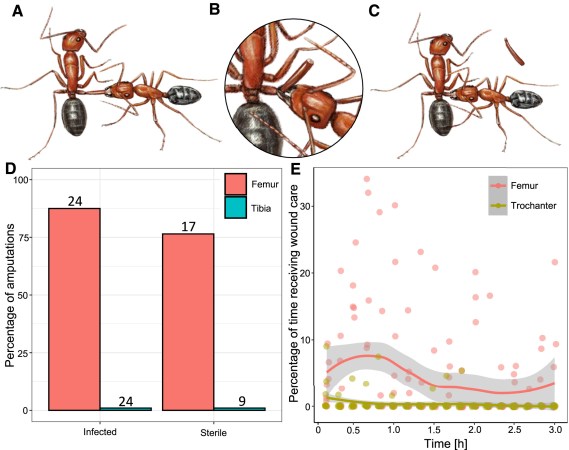
Amputation and wound care behavior in C. floridanus (A) Illustration of a worker providing wound care on a femur-injured individual. (B) A worker amputating (biting) the injured leg at the trochanter. (C) A worker providing wound care on the newly created trochanter wound after amputation. (D) Percentage of amputations performed on ants with an infected or sterile femur (red) or tibia (blue) injury after 24 h. Numbers above the bars represent the sample size for each treatment. (E) Percentage of time the injured ant received wound care behavior over 3 h, binned in 10 min intervals, with a local polynomial regression (loess) showing a 95% confidence interval for the first 3 h after the experimental femur injury (femur, red: n = 8) and the first 3 h after amputation on the trochanter wound (trochanter, brown: n = 7).

Surgery — Not Just For Humans Anymore

Sometimes, a limb is damaged so badly that the only way to save the patient is to amputate it. Researchers have now found that humans aren’t the only species to perform life-saving amputations. [via Live Science]

While some ants have a gland that secretes antimicrobial chemicals to treat wounds in their comrades, Florida carpenter ants have lost this ability over the course of evolution. Lacking this chemical means to treat wounds, these ants have developed the first observed surgery in an animal other than humans.

When an ant has a wounded leg, its fellow ants analyze the damage. If the femur is the site of the wound, the other ants removed the damaged limb in 76% of cases by biting it off, while tibial wounds were treated in other ways. Experimental amputations of the tibia by researchers showed no difference in survivability compared to leaving the limb intact unless the amputation was performed immediately, so it seems the ants know what they’re doing.

Maybe these ants could be helpful surgical aids with some cyborg additions since they’ve already got experience? Ants can help you with programming too if that’s more your speed.

Continue reading “Surgery — Not Just For Humans Anymore”








