RFID Triggered Presentation Box

blasphemous_bible_box

[Lace] needed to build a “box project” for his college art class and figured he could spice things up a bit by adding some electronic components to the mix. His project, dubbed the ‘Blasphemous Bible Box‘ consists of a bible opened up the section of the book of Revelations that discusses the mark of the beast in an old cigar box. The box is normally locked, but has been programmed to unhook an internal latch when he passes the RFID chip embedded in his hand over it. The effect could have been achieved using a simpler circuit, but the enclosed Arduino seems to do the job decently enough. [Lace] has not mentioned if he has considered revising the box any, but a spring-loaded external latch secured with a magnetic lock would make for a nice effect if version 2 was ever built. Adding a servo to slowly open the box as well as including a speaker blaring Carmina Burana – O Fortuna upon opening would be pretty cool as well (hint, hint). We have video of the box in action after the break.

Continue reading “RFID Triggered Presentation Box”

Chroma – Mesmerizing LED Driven Fractal Display

chroma in action

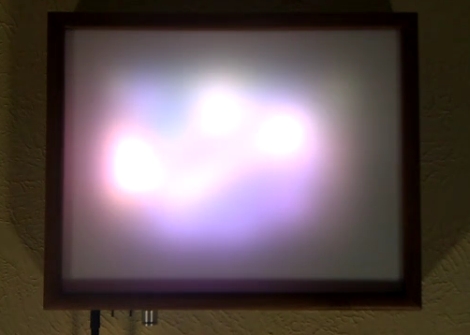
A big fan of generative art, [Andrew Magill] wanted to build an LED display for his wall that constantly displayed images from the Electric Sheep project.  After discounting the possibility of generating these fractals on the fly, he settled on using prerecorded video clips gathered over a year’s time by Electric Sheep users.  With thousands of video clips in hand, he wrote some custom software that enabled him to sequence these 5-second video clips into just over 6 hours of video, which he later downsampled to fit his 24×16 pixel display.

Now that he had some impressive video put together, [Andrew] began designing the LED panels he would use to show off his creation.  After choosing TI TLC5947 drivers to control the LED arrays, he got to work on designing the PCBs, soldering in all of the components, and testing the displays.  Initial testing completed, he wrote some more custom software to direct the individual LED boards from a master controller, and mounted everything in a frosted-glass adorned picture frame.

Be sure to check out mesmerizing video of Chroma in action after the break.

Continue reading “Chroma – Mesmerizing LED Driven Fractal Display”

Make A Knitting Machine Print Pixel Art

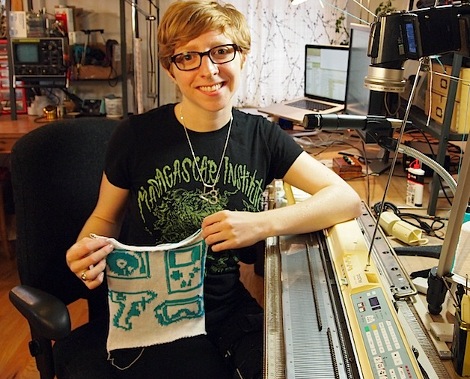
[Becky Stern] shows how to take an old electronic knitting machine and interface it with a computer. After seeing the Brother KH-930E knitting machine in the video after the break it looks like the controls function quite like a CNC milling machine. Patterns can be programmed in and stored on a floppy disk. Since we don’t want to use those anymore (unless they’re hacked as an SD card carriage) it is nice to see that this is how the machine is connected to a computer. Using an altered FTDI cable and a floppy-drive emulator written in Python a blank design file can be saved on the knitting machine, manipulated in the computer to add your own pixel art, then loaded back onto the machine for production. At the very least, it’s interesting to watch the knitting happen, but fans of knitted apparel and geek paraphernalia must be salivating by now.

We’ve never given up our dream to transition from Hack-A-Day to Craft-A-Day, this just fuels the fire for that cause.

Continue reading “Make A Knitting Machine Print Pixel Art”

Cellphone Crowd-pleasers

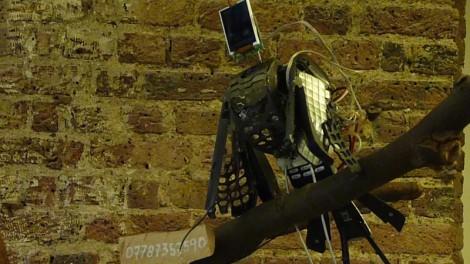
When you start to think about the cellphone waste our society produces it can be quite daunting. How many cell phones have you had in recent years? Now multiply that by five billion cellphone subscribers. [Anthony Goh] and [Neil Mendoza] found something to do with a very minuscule portion of those left-overs; building interactive birds out of the old parts. You’ll have to check out their accomplishments in the video after the break as the image above doesn’t do them justice. Interactivity for the exhibit is provided by an Arduino, which communicates with one working phone via a serial connection. The phone can still make and receive calls, and controls parts from other, less functional cellphones. They can call each other, or receive calls from the audience.

Yes, there is art in garbage. But there’s also a lot of hacks waiting to happen. Take a look at the Nokia cellphone LCD feature and then start scavenging.

Continue reading “Cellphone Crowd-pleasers”

Syyn Labs’ Glowing DNA

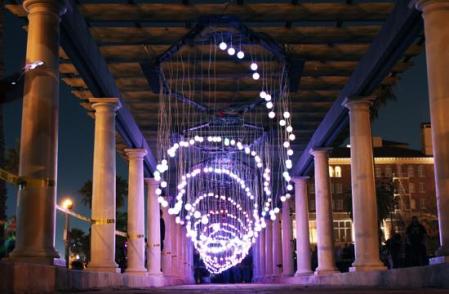
This beautiful music syncronized double helix was made by Syyn labs. Last time we saw them, they had created that amazing rube goldberg style music video for OK Go. This 100 foot long LED DNA strand took over 1000 combined man hours to build. It took 512 LEDs, 32 LED controllers, 4 Arduinos, 4 computers, over a mile of wire and a very dedicated team, which included [Eliot Phillips]. It takes input from beatmatching/VU software as well as a 32 button console or an iPad. You can catch a video of it in action after the break, and they plan on releasing a timelapse of the build in the near future.

Continue reading “Syyn Labs’ Glowing DNA”

New Term For Art: Sculptural Robotics

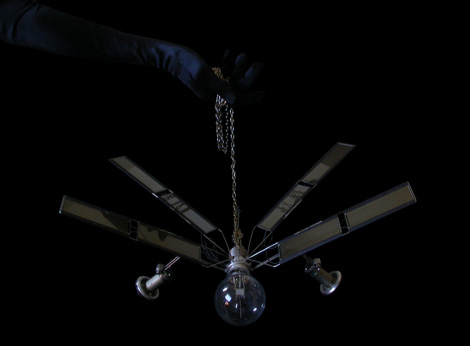
[Dan Roe] has been working on Sculptural Robotics for quite some time, and most recently presented his newest creation: Solar Flowers 2010. Typically, Sculptural Robotics (coined by [Dan] himself) are stand alone, static art presentations made from electronic components and wire. [Dan] of course has taken it quite a bit further; giving all his sculptures life using solar panels, motors, engine circuits, and more. Making them zero emission, and beautiful at the same time. You can catch four videos after the jump of his moving sculptures. Not that we’re picking favorites, but the dragonfly is pretty amazing if we do say so ourselves.

Continue reading “New Term For Art: Sculptural Robotics”

Small CNC Gadget Draws What It Hears

This art piece makes drawings based on sound. [Mario Marchese], who is responsible for those illusion props back in february, built this little guy out of a bunch of junk he had lying around. It features four microphones that listen to ambient sound and feed the signal through some LM386 audio power amplifiers. The output is translated into forward, backward, left, and right movements of the writing platform while the pen is fixed in the same position. Despite what we said in the title of the post this isn’t strictly a CNC machine, but more the primordial cousin of one.