Off-Grid, Small-Scale Payment System

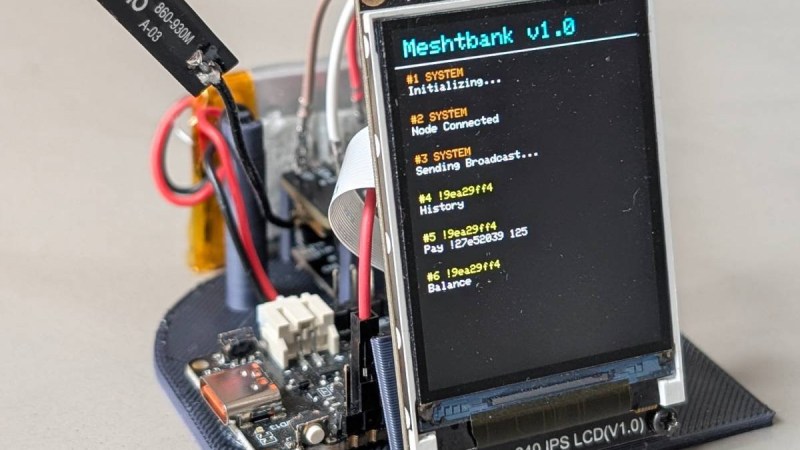
An effective currency needs to be widely accepted, easy to use, and stable in value. By now most of us have recognized that cryptocurrencies fail at all three things, despite lofty ideals revolving around decentralization, transparency, and trust. But that doesn’t mean that all digital currencies or payment systems are doomed to failure. [Roni] has been working on an off-grid digital payment node called Meshtbank, which works on a much smaller scale and could be a way to let a much smaller community set up a basic banking system.

The node uses Meshtastic as its backbone, letting the payment system use the same long-range low-power system that has gotten popular in recent years for enabling simple but reliable off-grid communications for a local area. With Meshtbank running on one of the nodes in the network, accounts can be created, balances reported, and digital currency exchanged using the Meshtastic messaging protocols. The ledger is also recorded, allowing transaction histories to be viewed as well.

A system like this could have great value anywhere barter-style systems exist, or could be used for community credits, festival credits, or any place that needs to track off-grid local transactions. As a thought experiment or proof of concept it shows that this is at least possible. It does have a few weaknesses though — Meshtastic isn’t as secure as modern banking might require, and the system also requires trust in an administrator. But it is one of the more unique uses we’ve seen for this communications protocol, right up there with a Meshtastic-enabled possum trap.
How Magnetic Fonts Twisted Up Numbers And Saved Banking Forever

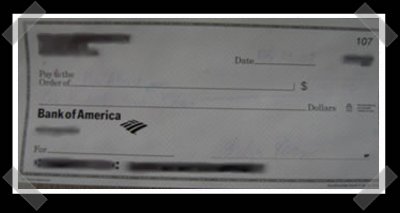
If you’ve ever looked at the bottom of a bank check, you probably glanced over some strangely formed numbers? If you’re a fan of science fiction or retro computers, you’ve probably spotted the same figures on any number of books from the 1980s. They’re mostly readable, but they’re chunky and thin in places you don’t expect.

Those oddball numerals didn’t come from just anywhere—they were a very carefully crafted invention to speed processing in the banking system. These special fonts were created to be readable both by humans and machines—us with our eyes, and the computers with magnetic sensors. Let’s explore the enigmatic characters built for Magnetic Ink Character Recognition (MICR). Continue reading “How Magnetic Fonts Twisted Up Numbers And Saved Banking Forever”

Retrotechtacular: Building The First Computers For Banking

If you’ve ever wondered where the term “banker’s hours” came from, look back to the booming post-war economy of 1950s America. That’s when banks were deluged with so many checks, each of which had to be reconciled by hand, that they had to shut their doors at 2:00 or 3:00 in the afternoon, just to have a hope of getting all the work done at a reasonable time. It was time-consuming, laborious, error-prone work that didn’t scale well, and something had to be done about it.

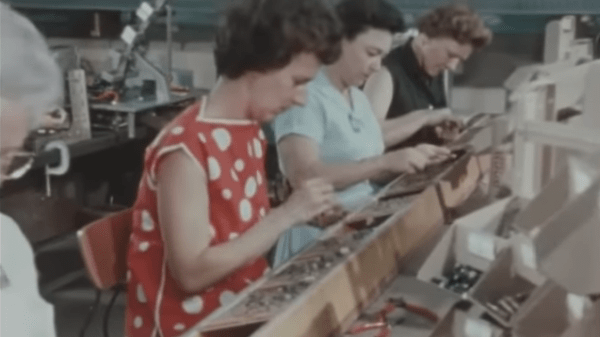
The short film below, “Manufacturing Competence,” details the building of ERMA, the Electronic Recording Machine, Accounting. ERMA was the result of years of R&D work, and by the early 1960s, General Electric was gearing up production at its new Phoenix, Arizona plant. The process goes from bare metal racks and proceeds through to manufacturing the many modules needed for these specialized machines, which were perhaps the first commercial use of computers outside of universities and the military.

The sheer number of workers involved is astonishing, especially in backplane assembly, with long lines of women wielding wire-wrapping guns and following punch-tape instructions for the point-to-point connections. PCB stuffing was equally labor-intensive, with women stuffing boards from a handful of seemingly random components. And the precision needed for some of the steps, like weaving the ferrite core memory, was breathtaking. We really enjoyed the bit where the tiny toroids were bounced into place with a vibrating jig.

The hybrid nature of ERMA, and the assembly methods needed to produce it, are what strike us most about this film. The backplanes were wire-wrapped, but the modules were wave-soldered PCBs. Component leads were automatically formed and trimmed, but inserted by hand. Assembly and testing were directed by punched tape, but results were assessed by eye. Even ERMA itself was prototyped with vacuum tubes, but switched to transistors for production. The transitional nature of electronics in the early 1960s is on full display here, and it offers an interesting perspective on how change in this field can be simultaneously rapid and glacial.

Continue reading “Retrotechtacular: Building The First Computers For Banking”