[Clement] Sees The Cargo Bike And Raises A Bicycle Cargo Trailer

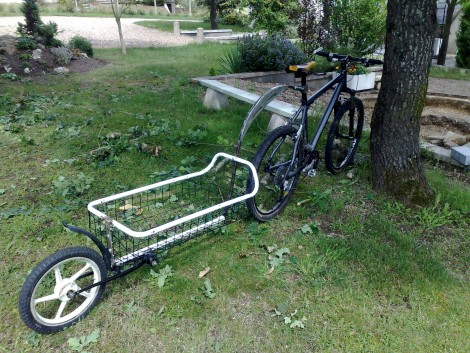
[Clement] and his friends were going on a long bike tour and needed a way to carry their gear along with them. They set to work and managed to build this cargo trailer from mostly reused materials.

The only part of this trailer that is reused junk is the connection mechanism that lets you attach it to just about any bike. That was made (presumably in a machine shop) to act as a removable pipe clamp, making it pretty quick to swap between different bikes. It has a universal joint welded to it so that the angle of the seat post won’t affect how the trailer rides.

A goose neck keeps the trailer far enough back to avoid getting in the way of the rear wheel. The mesh basket was made from parts of an old industrial machine. The rear wheel is attached with a swing-arm that has what looks like a rubber bumper to act as a shock absorber. But if you want to make sure a big bump doesn’t send your luggage flying, [Clement] included a picture at the bottom of his post showing a much nicer spring shock on a different bike trailer.

If you’re confused by the title of this post you must have missed the cargo bike that was recently featured.
Puncture Resistant Bike Tires From Old Seatbelts

puncture_resistant_bike_tires

[Nicolás] often rides his bike in the city, and on more than one occasion has ended up with a flat tire. A flat tire might not sound like a big deal, but imagine if you are a few miles from your destination and running late – now your day has gone from bad to worse.

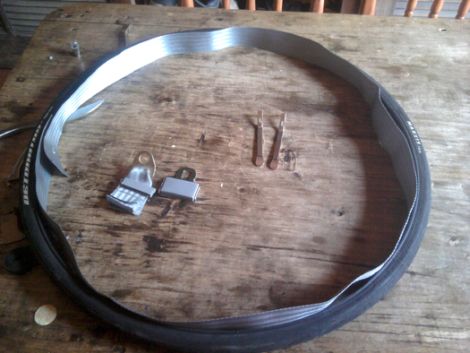
He was contemplating how he might protect his bike’s tires from being punctured by glass and other debris, when he came across some old car seat belts that used to serve as straps for various messenger bags. He pulled the tires off his bike and after removing the inner tubes, he unrolled the seat belts inside the wheels. The belts were cut to size, then the tubes were reinserted into the wheels and inflated as normal.

He hasn’t run into any glass shards just yet, but [Nicolás] is betting that the reinforced nylon mesh of the seat belts will keep his tubes safe whenever he does.

[via Make]

Spokes? We Don’t Need No Stinking Spokes!

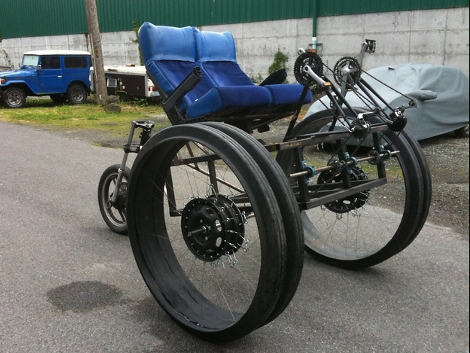
The Air Kraken is a bicycle for demon spawn. Well, that’s what it reminds us of anyway. [Gabriel Cain] took his inspiration from burning man and also had several reasons for building it, but the one that we just love to hear is ‘because I can’.

The over-grown tricycle built for two is more than just some bicycle frames welded together. [Gabriel] built the wheel set himself using some very interesting methods. We believe the hubs themselves are actually automobile rims drilled to accept eye bolts. Instead of rigid spokes, a network of steel cable keeps the rims, made from plastic culvert pipe, centered. For grip, mountain bike tires were cut into pieces and screwed onto the pipe parts. The whole shebang is steered using a ship’s wheel (not pictured above) to turn the small wheel located behind the two riders.

After the break we’ve embedded a video of the vehicle in motion. It is the second of three videos that have been posted so far, with the other two walking through how [Gabriel] solved the design challenges facing him during the build.

[Gabriel] sent us a link after seeing the quadbike post on Monday. Don’t keep your projects to yourself, make sure to send us a tip and we’ll make sure to keep posting about them.

Continue reading “Spokes? We Don’t Need No Stinking Spokes!”

Wooden Bike Hopes To Set World Record, Not Catch Fire

splinterbike

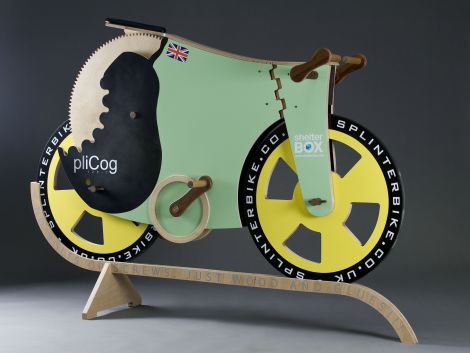
[Michael Thompson] has been hard at work for well over six months building a bicycle made entirely of wood. The project started as a bet between two friends, and has become much more over the last few months. The SplinterBike, as it is being called, has been constructed solely from wooden parts, as well as glue and paint – but not much else.

The bike uses many different woods in its construction, each chosen to fulfill a particular purpose. The axles are made from hardwood ekki, while all of the gears, wheels, and frame parts were constructed from birch plywood. Oiled ironwood was chosen to serve as a replacement for metal bearings wherever moving parts came together due to its durability. Other parts were constructed with random scraps that [Michael] had sitting around in the shop, such as the handlebars which were cut from an old broomstick.

Now that the bike is complete, [Michael] and his friend [James] are gearing up to set a wooden bike land speed world record. It should be doable, as they have calculated that the bike should hit about 31 miles per hour provided [James] can pedal fast enough. A date for the record attempt has yet to be set, but keep an eye out – it’s likely to be an entertaining show.

[via Gizmodo]

More Bike-controlled Google-travelling

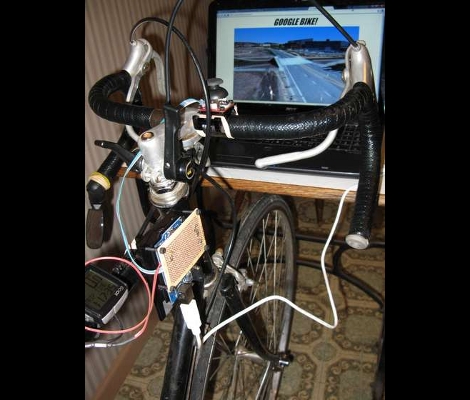
This is becoming such a popular hack we figure someone needs to come up with a name for it like Google-travelling or Google-cising (exercising with Google). It’s a bike controller for Google Earth. [Braingram] broke out his road bike, setting it up in the trainer in front of his laptop. If you already have a computer with a cadence sensor this will be a snap. These measure the crank rotation using a magnet and reed switch. So as not screw up his summer biking [Braingram] spliced into the sensor while leaving it attached to the bike computer. From there it is read by an Arduino which also monitors an analog joystick attached to the handlebars. A little bit of Python scripting and you’ll be ready to go.

Be sure to check out some of the other variants like using an exercise bike, or adding a wearable display.

Climbing Bike Storage Thwarts Thieves?

If you’ve got an expensive bike and don’t mind carrying around a whole bunch of extra weight in your courier bag you’ll like this concept. A design team built a pole-climbing bike rack in about 14 days. The video after the break shows the prototyping process as well as the finished “lock” in use. It’s a commercial for the company that employs the designers, but this is one kind of advert we don’t mind watching.

Square channel makes up the body of the device, with a set of Rollerblade wheels which grab a light pole and use three 12V gear motors for climbing. The controller is a wireless fob similar to those used for keyless entry on cars. In the video you can hear the cliché sound of a car alarm being set once the carrier reaches its finished height. Nice.

Continue reading “Climbing Bike Storage Thwarts Thieves?”

AVR Programming 04: Writing Code, Etc.

Welcome back to this fourth and final installment of the series. The first three parts should have been enough to get you off the ground, but a few more learning examples wouldn’t hurt. It’s also a good time to discuss some of the other things these little chips can do. Join me after the break to:

  • Expand the sample code, adding features to our simple program while I challenge you to write the code yourself.
  • Discuss AVR fuse bits, how to use them, and what to watch out for
  • Touch on some of the peripherals you’ll come across in these chips

As a grand flourish to the series, I’ve used the example hardware from this final part to build a bicycle tail light. Hopefully this will inspire you to create something much more clever.

Series roadmap:

Continue reading “AVR Programming 04: Writing Code, Etc.”