BornHack Radio 102.8 FM, Playing Radio At A Hacker Camp

Over the years I have been to many hacker camps and done a lot of very cool things, but BornHack 2026 brought me something entirely new: Radio. By which I don’t mean radio in terms of amateur radio, LoRa, or whatever, but Radio. Broadcast radio, because the camp had a special event FM radio station for the first time. And because in a previous life I spent an inordinate amount of time in my university’s student radio station and have the Radio Voice to prove it, I was totally there for it.
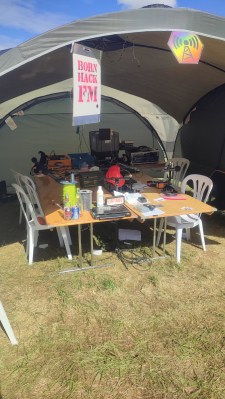
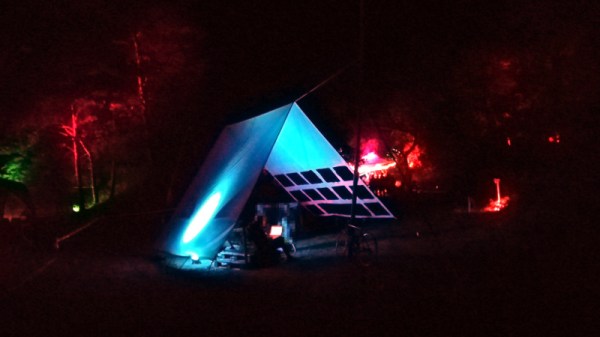
A view of a tent shelter in bright sunlight with studio equipment visible on a table in it. There's a sign: "BornHack FM".
The BornHack Radio nerve centre.

For a hacker camp, one of the special things about BornHack Radio was unexpected, that it was entirely analogue. No online streams, the only broadcast was over the air, 5 watts ERP from a vertical antenna stuck on a mast at the highest point of the Hylkedam scout camp site. I don’t know whether any of the residents of the isle of Funen listened, or what they made of it, but it certainly reached as far as the two closest towns.

The other unexpected feature of the station was that it had no music licensing. Personally I viewed this as an asset, because it forced the programming to be hacker-focused rather than suit the musical tastes of whichever people are enthusiastic enough to be DJs. I sincerely hope they don’t get a music licence at future events, speech-only gives it a special quality.

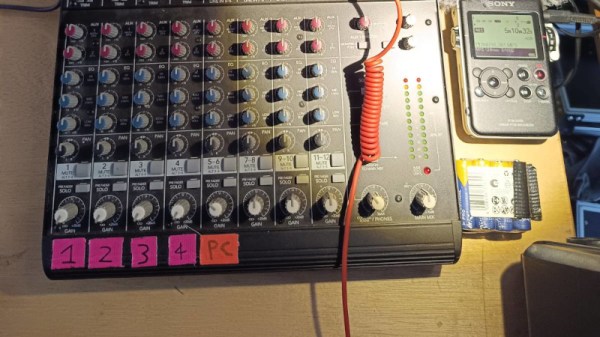
The studio for an analogue station like this one can be surprisingly simple, in that it’s a mixing desk to bring all the different microphones and other inputs together and set the levels, and not a lot else. the whole thing was in a Coleman shelter on the main drag through the camp, so as studios go it could have been quieter. Programming varied from talk shows through interview shows, a live feed from the speaker tent — is this the first ever Hacker Jeopardy broadcast? — and a beautifully done robotic numbers station which I suspect may also have been part of one of the on-camp games.

I brought two shows to the airwaves, both recorded, the first of which was a BornHack take on the Hackaday Podcast format, and the second a half-hour roving interview show. I believe I may be the first person ever to live-commentate a pixelflood screen in the style of Formula One coverage.
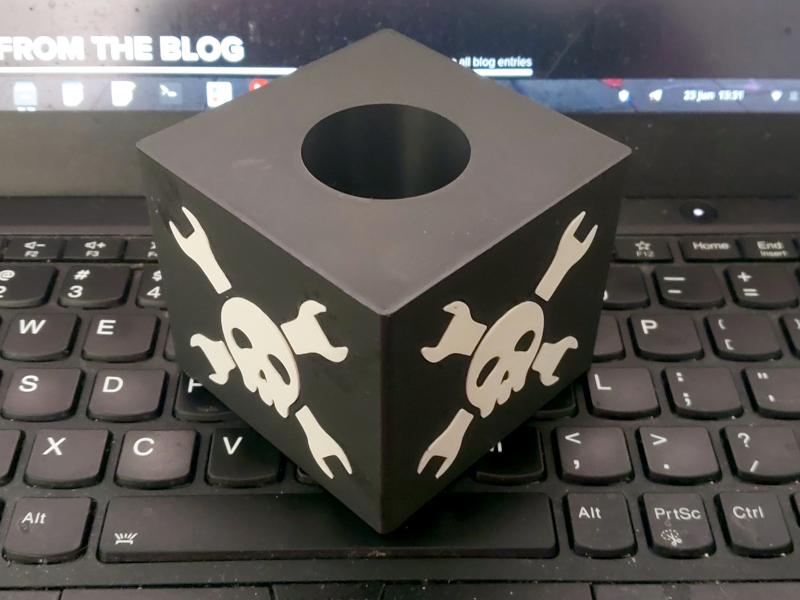
The thing that struck me most in my first foray into radio journalism was how straightforward it was. Wander the camp with microphone (complete with fluffy windshield and 3D-printed Hackaday cube), drop the results into Audacity, and a remarkably straightforward editing process compared to video. Last time I did this it involved 1/4″ tape and a razor blade.

So that was BornHack Radio, a new experience at a hacker camp both for those of us who ventured forth on the airwaves, and I hope also for the listeners. A format in which the live shows disappeared into the aether rather than having an online afterlife gave the whole thing a freedom rarely found in 2026. I really hope this isn’t the last time I break out the fluffy microphone at a hacker camp.

Thanks to [⁨Morel Sourvalley⁩] for the images.

The BornHack 2026 Cyber Ægg Is A Badge With A Life Afterwards

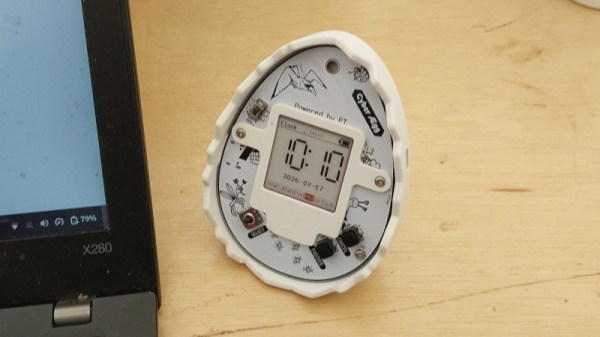
A problem facing the designers of event badges is this: what happens to the badge after the event? It’s one that designers have tried to solve in many ways with varying levels of success, whether that be by making it a dev board, a games console, a mesh-networked communicator, or as in the case of Electromagnetic Field, a continuing badge for future events. Ar BornHack 2026 they have taken a novel approach, by making it a useful desktop appliance. The BornHack Cyber Ægg is a half-egg-shaped badge with a 3D-printed case, and aside from its on-camp applications it’s both a desktop clock/calendar, and a MeshCore node.

Produced with the assistance of the badge.team European badge makers, it’s an egg-shaped PCB with a Nordic nRF52840 at its heart, a Semtech LoRa module, and an e-paper display. On-site there’s a Tamagotchi-style virtual pet game, an event calender, and an RFID token game, but it’s the other two features that give it a life after the camp. The clock and Meshcore, coupled with its case being designed with a flat spot to sit on a desk, make this badge as much an appliance as it is a badge. This is where it will sit in the Hackaday office, and we’re pretty sure most BornHack attendees will use it thus too.

We like this approach to giving a badge a life after the event, and we look forward to seeing what influence it has on future badges. A badge should be a thing to enjoy, not a piece of e-waste.

Two For The Price Of One: BornHack 2024 And 2025 Badges

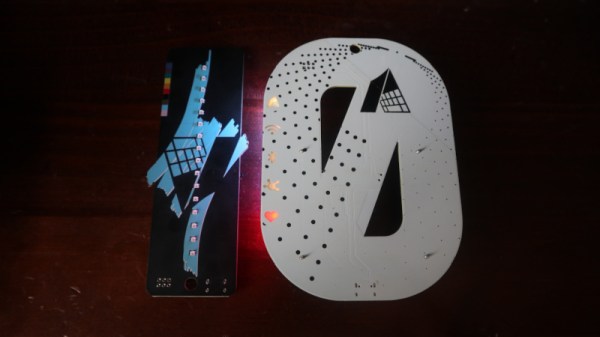
BornHack is a week-long summer hacker camp in a forest on the Danish island of Fyn, that consistently delivers a very pleasant experience for those prepared to make the journey. This year’s version was the tenth iteration of the camp and it finished a week ago, and having returned exhausted and dried my camping gear after a Biblical rainstorm on the last day, it’s time to take a look at the badges. In case you are surprised by the plural, indeed, this event had not one badge but two. Last year’s badge suffered some logistical issues and arrived too late for the camp, so as a special treat it was there alongside the 2025 badge for holders of BornHack 2024 tickets. So without further ado, it’s time to open the pack for Hackaday and see what fun awaits us. Continue reading “Two For The Price Of One: BornHack 2024 And 2025 Badges”

The Hackaday Summer Camp Survival Guide

It’s a feature of summer for us, the round of hacker camps in which members of our community gather in fields and spend a few days relaxing and doing what we do best. This summer I’ll have been to four of them by September, one of which was unexpected because a last-minute ticket came my way. For Hackaday they’re a chance to connect with our readers and maybe see come of the coolest stuff in person.

If you consult the wiki for your hacker camp of choice then you’ll usually find a page of tips about what to bring. Starting with a tent and a sleeping bag and probably going on to sunscreen, a hat, and maybe how to avoid dehydration. I’d probably add spare toilet paper and disinfectant spray in case the toilets are nightmarish. All very practical stuff, but expressed in a dry list format that doesn’t really tell you what to expect. A hacker camp can be overwhelming if you’ve not been to one before, so how do you get the best out of it? Here are a few tips based on our experience. Continue reading “The Hackaday Summer Camp Survival Guide”

Badges Of 2022: BornHack

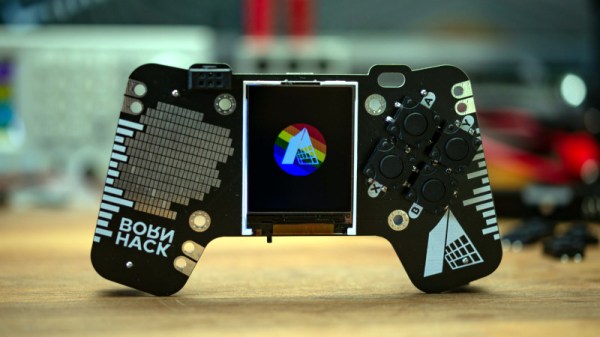
While the rest of the world’s hacker camps shut their doors through the pandemic there was one which managed through a combination of careful planning and strict observation of social distancing to keep going. The Danish hacker community gather every August for BornHack, a small and laid-back event in a forest on the isle of Fyn that has us coming back for more every year. They always have an interesting badge thanks to the designs of [Thomas Flummer], and this year looks to be no exception as they’ve dropped some details of the upcoming badge.

In short, it’s a beautifully designed hand-held games console with a colour screen, powered by the ubiquitous-in-the-chip-shortage RP2040 microcontroller. On board are the usual interfaces and a prototyping area plus CircuitPython for easy coding, and we expect it to sprout some addictive and playable gaming action. It’s the sort of PCB that we could imagine coming as a product from the likes of Pimoroni, but for now the only way to get your hands on one is to go to the event. We’ll being you a review when we have one. Meanwhile you can take a look at a previous year’s badge.

Reporting From BornHack 2021: Hacker Camps Making It Through The Pandemic

In a normal summer we would be spoiled for choice here in Europe when it came to our community’s events, with one big camp and a host of smaller ones near and far. Only the most hardcore of travelers manage to make it to all of them, but it’s usually possible to take in at least one or two over the season. But of course, this isn’t a normal summer. Many of us may now be vaccinated against COVID-19, but we remain in the grip of a global pandemic. The massive Dutch MCH camp was postponed until 2022, and most of the smaller camps have fallen by the wayside due to uncertainty. But one hacker camp carried on.

BornHack in Denmark was the world’s only in-person summer hacker event of 2020, and on its return last week made it the only such event in Europe for 2021. Having secured a ticket earlier in the year when they went on sale, I navigated the tricky world of cross-border European travel in a pandemic to make my way to the Hylkedam scout camp on the Danish isle of Fyn for a week in the company of hackers from all over Northern Europe. BornHack had achieved the impossible again, and it was time to enjoy a much-needed week at a hacker camp.

Continue reading “Reporting From BornHack 2021: Hacker Camps Making It Through The Pandemic”

The First Hacker Camp To Show Up On Google Maps

Our summer gatherings at hacker camps are fleeting and ephemeral, anticipated for months but over far too quickly. Afterwards we have only our memories, and perhaps the occasional Hackaday write-up. We think BornHack 2020 in Denmark was the only hacker camp that wasn’t forced to go online-only by the pandemic last year, and now as far as we know it has also become the only one ever that has left its mark for the wider world by being captured for posterity by Google Earth.

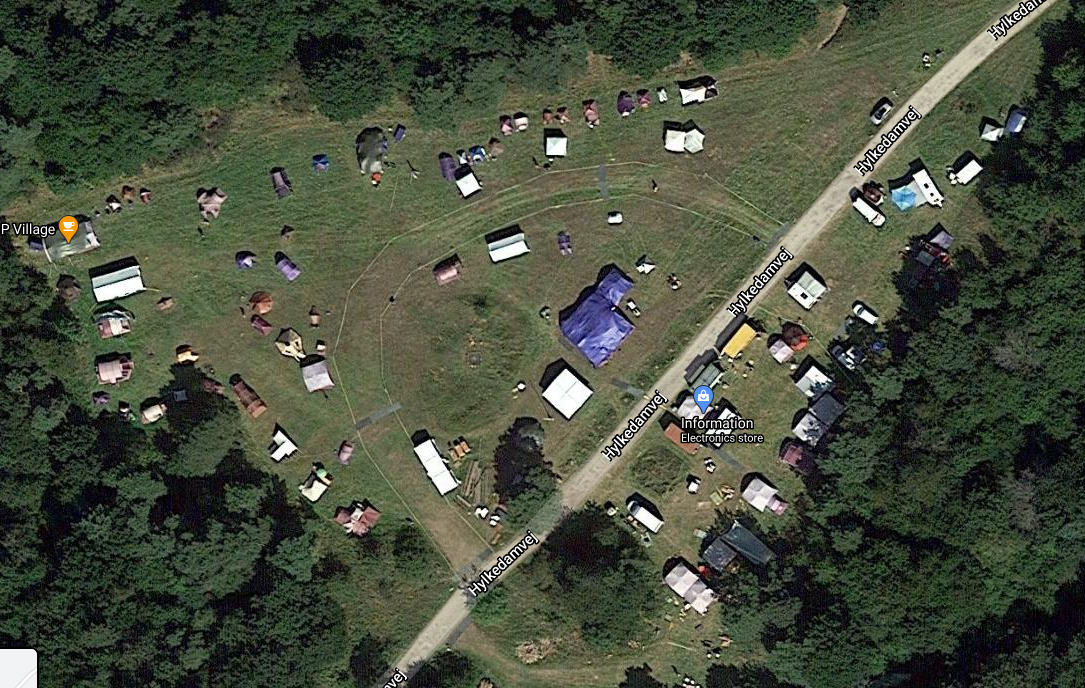
Visible in the forest is the sparsely populated and socially distanced main field of what was a considerably smaller camp than normal, as well as in separate clearings the speakers tent and the loud field. Perhaps it doesn’t help as much in explaining to outsiders what a hacker camp is as might a picture of one of the larger ones, but it does at least serve as a visible reminder that we weren’t quite snuffed out last year.

It’s a moment of nostalgia to see BornHack 2020 on Google Maps for those of us who were there, but perhaps the point of all this is to take a moment to consider the likely prospects for similar events in 2021 given the pandemic. Both the British EMF Camp and American Toorcamp had to cancel their events last year and should return in 2022, there’s no word as yet about 2021 from the Serbian BalCCon or the Italian IHC,  our latest update on Luxembourg’s HaxoGreen is that it’s still slated to go ahead with its move to 2021, and currently both BornHack and the Dutch MCH are expecting to run as normal this summer.

In the grip of a savage third wave of the pandemic where this is being written, it’s by no means a foregone conclusion that 2020’s cancellations may not repeat themselves. International borders remain difficult to cross without exacting quarantine requirements. If you make it to a camp this year you may be one of the lucky few, and in the increasingly likely event that we don’t, we’ll be suitably envious. Don’t loose hope, we shall all meet again… eventually.

If you fancy a closer look at BornHack 2020, have a read of our write-up.