Converting A Chinese Laser Cutter To Work With Mach3

laser

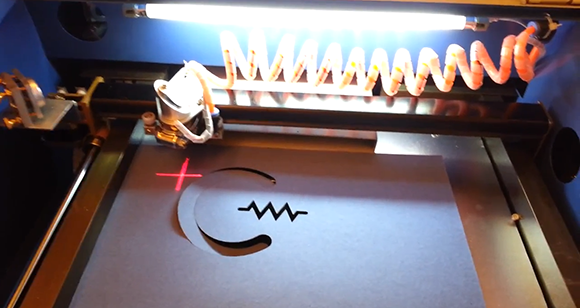
Like most of us, [Chris] has pined over the very, very inexpensive Chinese laser cutters available on eBay for a while now. When most of us disregarded these machines due to their inability to work with the file formats commonly used with laser cutters, [Chris] took the plunge. He was a might disappointed the included software didn’t allow him to use his machine with Mach3 CNC software, so he replaced the included electronics board with one of his own design, giving him all the features of a more expensive laser cutter at a low, low Chinese eBay auction price.

The laser cutter [Chris] bought came with the moshidraw software and controller board that according to one auction can only use BMP, JPEG, WMF, EMF, and PLT files.Wanting a board that can use more common file formats such as PDF and DWG, [Chris] built his own board to communicate with his Mach3 software.

From what we can tell, the new board works with off-the-shelf Pololu stepper drivers and is a complete drop in replacement for the moshidraw board. He’s still finalizing the design, but when the layout, BOM, and schematic are finalized, [Chris] will be putting the files up for everyone to copy. Wonderful piece of work, [Chris].

Continue reading “Converting A Chinese Laser Cutter To Work With Mach3”

Fitting A CNC Machine, 3D Printer, And Vinyl Cutter In A Suitcase

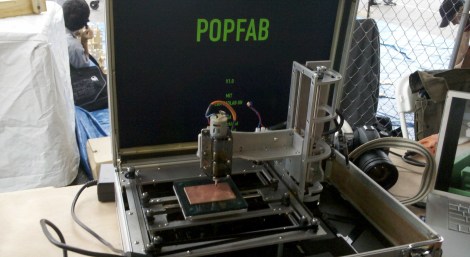
Maker Faire NY is awash with new and interesting computer controlled tools, but the most unusual so far appears to be Popfab, a combination router, 3D printer, and vinyl cutter able to collapse down into a suitcase.

Popfab is the brainchild of [Nadya Peek] and [Ilan Moyer] of the MIT CADLAB. With interchangeable heads for routing PCBs, 3D printing, and vinyl cutting. A conventional machine of this capabilities would have motors all over the place, but [Ilan] used a CoreXY system to make the stepper motors stationary relative to the frame of the machine.

The electronics are standard Printrboard and Pronterface fare, but it’s still a remarkable build that also fits into a suitcase.

Pictures of the machine, the XY system (good luck wrapping your head around that, but I can tell you it relies on the differential movement of the two motors) and the lovely [Nadya] holding up the plastic extrusion head. We’ll get a video up tomorrow. after the break

Continue reading “Fitting A CNC Machine, 3D Printer, And Vinyl Cutter In A Suitcase”

Adding Digital Readout To A Non-CNC Mill

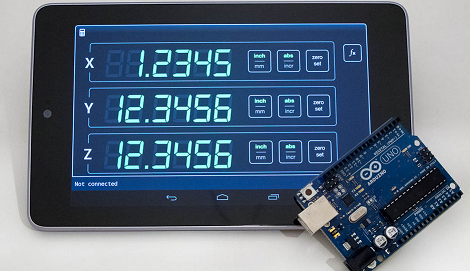
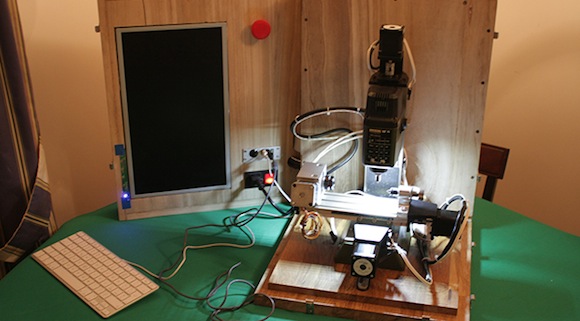
In the quest to add a digital readout to his mill, [Yuriy] has done a lot of homework. He’s sourced a trio of very capable scales, researched what kind of hardware his DRO should be based on, and even built a very cool display using seven-segment LEDs. After nearly a year of work, [Yuriy] finally hit upon something that works well: an Arduino and an Android tablet, perfectly matched for one of the prettiest machine shop displays we’ve ever seen.

[Yuriy] based his build off a trio of digital scales he bought from Grizzly. These scales bolt on to the frame of his mill and send data to their own display. An Arduino was used to pull the data off these scales and sent via Bluetooth to a Nexus 7 Android tablet.

Considering a DRO solely based on an Arduino and a character LCD would look a little chintzy – and the fact Arduinos can’t do floating point arithmetic – we’re really impressed with [Yuriy]’s very elegant solution.

Thanks [Lee] for sending this one in.

Building A Bigger Shapeoko Router

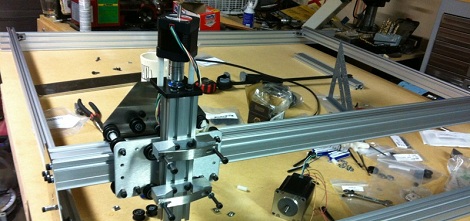
Hackaday alumni [Will O’Brien] sent in a few projects he’s been working on lately while he’s in the process of upgrading his workspace. He’s building a 1200 x 1200 mm CNC router based on the Shapeoko router, and it sure looks like he’s having fun doing it.

The Shapeoko router is based on the Makerslide open source linear bearing system. This system uses common aluminum extrusions as the frame of a very simple, very inexpensive CNC router. The Makerslide system is designed to be expandable; if you want a larger axis, just bolt in a longer piece of aluminum extrusion. We haven’t seen many Makerslide builds take advantage of this fact, a shame as the stock Shapeoko only has a build area of 200 mm square.

[Will] is expanding this build area to 1200 mm square, but of course this means beefing up some parts of the build. He’s already moved up to very hefty 250 oz/in Nema 23 stepper motors (up from the Nema 17s for a standard Shapeoko), as well as beefing up the motor mount a great deal.

[Will] also sourced a few lengths of cable drag chain (yes, that’s what it’s called) to keep all the wires for his huge CNC routers out of the path of a moving gantry and spinning motors. It looks like he’s got a very nice build shaping up, and we can’t wait to see it in action.

Portable Radio Station Gets A Beautiful Case

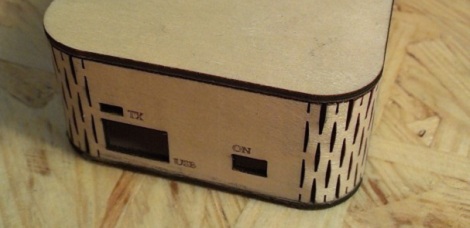
[Martin] put together a simple portable radio unit to take some MP3s with him while he’s out and around. The build was simple; just a no-name Chinese MP3 player, a battery, and an FM radio transmitter. To give his project a little more pizzazz, he came up with a very handsome laser cut wooden case to turn what would be a bunch of wires and components into an attractive build.

[Martin]’s case makes wonderful use of the kerf bending technique. By cutting small staggered lines in a piece of plywood, [Martin] was able to bend his laser cut enclosure into a surprisingly tight radius. With the help of a pair of laser cut forms and a bit of hot water and glue, he was able to make the shape of his case permanent.

The top and bottom of his case are also laser cut plywood, but [Martin] included a translucent plexiglas logo on the top. When his radio unit is activated a LED inside his project box lights up, illuminating his personal logo.

Kerf bending is something we’ve seen before, and we’re looking forward to seeing more project boxes use it in the future, hopefully with the application of a veneer to cover the diamond-shaped holes.

Toorcamp: Milling PCBs With KiCad

[Hao] from Noisebridge showed me their CNC mill being used to etch PCBs. Using copper clad board, this MAXNC 10 mill routes the PCB with decent accuracy. This makes for very rapid prototyping of single sided PCBs.

[Hao] designed the PCB using the open source KiCad EDA tool. This was used to draw the schematic, layout the PCB, and generate the Gerber files. Next, pcb2gcode was used to convert the Gerbers to G-code, which is a standard set of instructions for controlling CNC devices. Finally, LinuxCNC was used to send the G-code instructions to the mill. It’s a powerful application of a completely open source workflow.

The PCB being milled is for a pressure based touch sensor. It uses the Freescale MPL115A barometric pressure sensor encased in a rubber housing. This sensor is being incorporated into the Dora Opensource Robot Assistant project, which [Hao] and the Noisebridge folks are working on. We’re looking forward to hearing more about the Dora project in the future.

Largest CNC Router Is Controlled By Hand

Fresh from this year’s SIGGRAPH is a very interesting take on the traditional X Y-table based CNC machine from [Alec], [Ilan] and [Frédo] at MIT. They created a computer-controlled CNC router that is theoretically unlimited in size. Instead of a gantry, this router uses a human to move the tool over the work piece and only makes fine corrections to the tool path with the help of a camera and stepper motor.

The entire device is built around a hand held router, with a base that contains a camera, electronics, stepper motors, and a very nice screen for displaying the current tool path. After a few strips of QR code-inspired tape, the camera looks down at the work piece and calculates the small changes the router has to make in order to make the correct shape. All the user needs to do is guide the router along the outline of the part to be cut with a margin of error of a half inch.

You can read the SIGGRAPH paper here (or get the PDF here and not melt [Alec]’s server), or check out the demo video after the break.

Anyone want to build their own?

Continue reading “Largest CNC Router Is Controlled By Hand”