Easy Tactile Controls And Displays For Your Flight Simulator

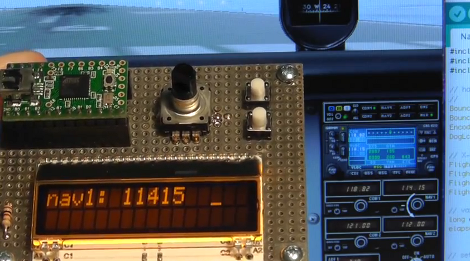
If you’ve been thinking of adding some tactile controls and readouts for your flight simulators this guide should give you the motivation to get started with the project. [Paul] explains how to build controls and connect them to the simulator data. He makes it look easy, and thanks the interface examples in his code it actually is.

Here he’s built the hardware using a Teensy controller board. The controller communicates via USB and the software is cross-platform. He’s controlling the heading information of the X-Plane simulator using the rotary encoder for fine adjustments and the buttons for increments of 100. But he doesn’t stop there. He’s working on an auto-throttle design that uses a servo motor to move the throttle lever. A potentiometer can be used to vary the throttle, with the servo mapped to the position of that knob. But it works both ways, dragging the virtual throttle on-screen will do the same.

This is one way to make flight simulators more interesting without devoting a whole room of your house to the cause. Don’t miss [Paul’s] fantastic demo video after the break.

Continue reading “Easy Tactile Controls And Displays For Your Flight Simulator”
A Simple, Self-contained 7-segment Display

self-contained-7-seg

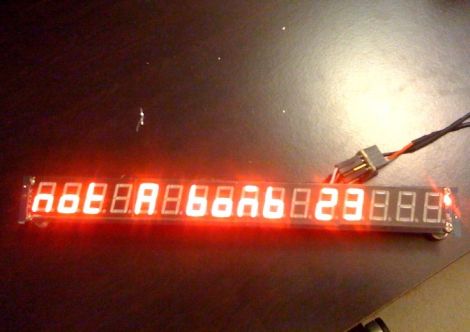
It’s no secret that seven-segment displays are an easy and useful way to relay data, so [Kelvyn Panici] decided to put together a minimalst, self-contained display for use around the house.

The display itself is a 16-digit model he picked up from DealExtreme for under $10. He wanted to find a microcontroller small enough to fit behind the display’s footprint, so he chose an ATtiny85 to control it. After mounting the mcu on a small piece of perfboard, he burned the Arduino bootloader and uploaded a small sketch to drive the display.

Things worked out quite well as you can see by the video below where he shows off a pre-perfboard prototype. [Kelvyn] currently does not have any immediate projects in the works that will utilize the display, though there are a plethora of possibilities. We think it would work great anywhere if it were fitted with a battery and some sort of wireless radio in order to make it completely self-contained.

Continue reading “A Simple, Self-contained 7-segment Display”

G-35 Christmas Lights Do Make A Great LED Matrix

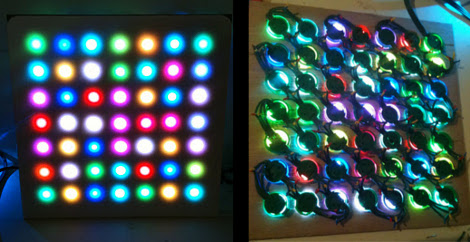
This fully-addressable RGB LED matrix was built by [John Graham-Cummings]. He didn’t start from scratch, but wisely repurposed a strand of GE Color Effect lights and built a pleasant looking case in which to mount the G-35 hardware.

We’ve seen this hardware used in a similar way before. Because each ‘bulb’ has its own microcontroller, color data is shifted in via a serial bus. Orient the modules in any pattern you choose and account for that layout in software.

Since the strings have 50 bulbs, [John] simply cut off the one on the end to form his 7×7 matrix with the remaining 49 units. A square of plywood with a grid of holes holds each in place. Cord mess is not a problem as the extra was cut out and the remainders were soldered together again. [John] uses an Arduino Pro to feed in the data, which you can see for yourself in the clip after the break.

Continue reading “G-35 Christmas Lights Do Make A Great LED Matrix”

Rear Window LED Display Gives Other Drivers A Piece Of Your Mind

rear_window_led_matrix

[Gagandeep] was sick and tired of discourteous drivers on the highway, so he decided that he would put together a display to let them know what he thought of their poor driving skills. He planned on putting the display up in the rear window of his car, so he had to ensure that it did not obstruct his view while driving.

He decided that an LED matrix would be the best way for displaying images and text while on the go, so he got busy constructing a 40×16 mesh grid for his rear window. Using a wooden template to get the spacing and positioning just right, he spent several days soldering the 600+ LEDs to one another. He used 74HC595 shift registers to manage the LEDs in groups of 5 columns, while an ATmega AT89C51 was tasked with generating the text and images to be displayed. All of the ICs were deadbugged in place, helping achieve [Gagandeep’s] desire of keeping his view unobstructed.

While we’re not well-versed on the legality of such a display, it looks great when animated. There are plenty of pictures of the grid in various stages of construction as well as videos of it in action in his Picasa album, so be sure to check them out. If you are looking for code or Eagle files, you can find those here.

Live NBA Scoreboard With Huge 7-segment Displays

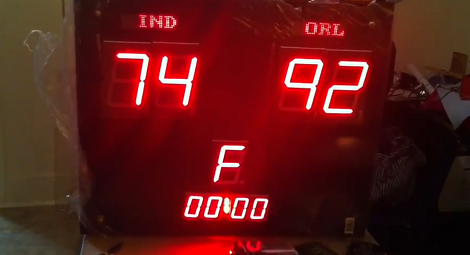
[Kianoosh] was in Las Vegas over spring break and was fascinated by the real-time sports scores displayed at the casinos. He figured that this would be an easy enough project to duplicate, so he built a gigantic NBA scoreboard that updates live from the NBA website.

The build uses the OS X Automator to pull scores down from the NBA’s mobile site. Sending this through a parser written in Java, the scores are then sent to an ATMega32 over an XBee. [Kianoosh] posted all the code and schematics, as well as a PDF writeup. Because the scoreboard is sport-agnostic, [Kianoosh] plans on writing new code for the NFL, MLB, and NHL. We’re really impressed with this build, and with the giant 7-segment LEDs, this would be a great addition to a sports bar (or really any bar).

Continue reading “Live NBA Scoreboard With Huge 7-segment Displays”

ChibiMo – An AVR-based USB Display

chibimo_usb_arduino_external_monitor

[Ko] wanted to add an extra monitor to his computer, but he wasn’t looking for something huge that would sit atop his desk – he desired something smaller, much smaller.

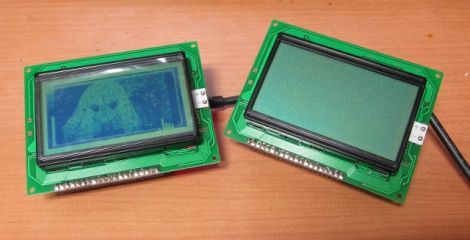
His ChibiMo mini USB monitor is a neat little creation that lets you extend or mirror your Windows desktop onto a tiny 128×64 pixel LCD panel. At first glance you might think that it is too small to be useful, but it is recognized in Windows in the same fashion as any standard monitor. This means that it would be quite easy to load system monitoring software solely on the LCD panel, keeping the clutter off of your main display.

The display is wired to an Arduino like any other standard shield, and is connected to his computer via a USB cable. Once the ChibiMo sketch is uploaded to the Arduino, the display driver needs to be loaded on the PC. This allows you to tweak the ChibiMo’s display settings in Windows’ display manager.

It’s a great concept, one we would love to see explored further. As of right now, the ChibiMo is only supported on x86 versions of Windows XP, and we weren’t able to find source links anywhere on his site. Perhaps there are some talented members of our community who would be interested in taking a whack at it…

Home Made BlinkM Units

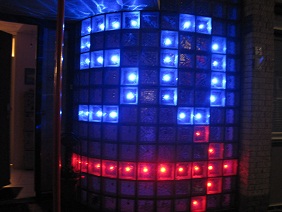
[Stephen] wrote in to show us this fun LED wall he constructed in his house. He says he was inspired by this project, but found the cost of the BlinkM units from sparkfun to be out of his price range. He really liked how they worked though, so he downloaded the schematic and firmware and built his own. He was able to fabricate 130 of his own for roughly 250 euros as opposed to the 1,452 euro price tag his sparkfun shopping cart had. That’s not a bad deal at all if you’re willing to invest the time in making your own PCBs and assembling the units. You can follow along on his site to see the entire construction process, as well as some pictures of his glass wall in action. The videos, however, aren’t loading for us. Great job [Stephen]!