
Ask Hackaday: How Do You Digitize Your Documents?

Like many of you, I have a hard time getting rid of stuff. I’ve got boxes and boxes of weirdo bits and bobs, and piles of devices that I’ll eventually get around to stripping down into even more bits and bobs. Despite regular purges — I try to bring a car-load of crap treasure to local hackerspaces and meetups at least a couple times a year — the pile only continues to grow.

But the problem isn’t limited to hardware components. There’s all sorts of things that the logical part of me understands I’ll almost certainly never need, and yet I can’t bring myself to dispose of. One of those things just so happens to be documents. Anything printed is fair game. Could be the notes from my last appointment with the doctor, or fliers for events I attended years ago. Doesn’t matter, the stacks keep building up until I end up cramming it all into a box and start the whole process starts over again.

I’ve largely convinced myself that the perennial accumulation of electronic bric-à-brac is an occupational hazard, and have come to terms with it. But I think there’s a good chance of moving the needle on the document situation, and if that involves a bit of high-tech overengineering, even better. As such, I’ve spent the last couple of weeks investigating digitizing the documents that have information worth retaining so that the originals can be sent along to Valhalla in my fire pit.

The following represents some of my observations thus far, in the hopes that others going down a similar path may find them useful. But what I’m really interested in is hearing from the Hackaday community. Surely I’m not the only one trying to save some storage space by turn piles of papers into ones and zeros.

Continue reading “Ask Hackaday: How Do You Digitize Your Documents?”
Getting IEC Standards For Free

The International Electrotechnical Commission (IEC) is an international body that issues standards on a wide range of electronics-related topics. How wide? Their mandate seems to span rules for household product safety to the specification of safety logic assemblies in nuclear power plants. Want to know how to electrically measure sound loudness? Test methods for digital door lock systems? Or maybe you’re interested in safety interlock systems for laser processing machines. There’s an IEC standard for that too.

Unfortunately, this information is kept behind a paywall. OK, it’s a lot more like a pay fortress. They really, really don’t want you accessing their documents without first coughing up. This is a shame.

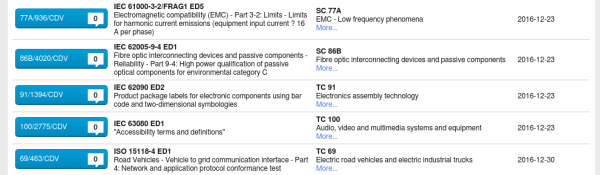
The IEC doesn’t just make the standards in a vacuum, however. Before the scribes touch their chisels to the stone tablets, there are draft versions of the standards that are open for public comment by those knowledgeable in the field. And by “those knowledgeable”, we mean you, dear hacker. Head on over to the public commenting page, sign up, and you’ve got free access to every document that’s currently up for discussion.

Now, it does look like the IEC doesn’t want you sharing these PDFs around — they watermark them with your username and threaten all sorts of things if you use them for anything other than commenting purposes — so don’t go abusing the system. But on the other hand, if you are a private individual who knows a thing or two about a thing or two, we think you’re entirely right to look over their shoulders. Let us know in the comments if you find any gems.

They’ve even got a weekly update feature (in the registration pages) that’ll keep you up to date. And who knows, maybe your two cents, submitted to your country’s chapter of the IEC, will influence future international standards.

Thanks to [Johann] for the great tip!









