Hackaday Links Column Banner

Hackaday Links: March 22, 2026

On Friday, Reuters reported that Amazon is going to try to get into the smartphone game…again. The Fire Phone was perhaps Amazon’s biggest commercial misstep, and was only on the market for about a year before it was discontinued in the summer of 2015. But now industry sources are saying that a new phone code-named “Transformer” is in the works from the e-commerce giant.

At this point, there’s no word on how much the phone would cost or when it would hit the market. The only information Reuters was able to squeeze out of their contacts was that the device would feature AI heavily. Real shocker there — anyone with an Echo device in their kitchen could tell you that Amazon is desperate to get you talking to their gadgets, presumably so they can convince you to buy something. While a smartphone with even more AI features we didn’t ask for certainly won’t be on our Wish List, if history is any indicator, we might be able to pick these things up cheap on the second-hand market.

On the subject of AI screwing everything up, earlier this week, the Electronic Frontier Foundation reported that The New York Times had started blocking the Internet Archive’s crawlers, citing concerns over their content being scraped up by bots for training data. The EFF likens this to a newspaper asking libraries to stop storing copies of their old editions, and warns that in an era where most people get their news via the Internet, not having an archived copy of sites like The Times will put holes in the digital record. They also point out that mirroring web pages for the purposes of making them more easily searchable is a widely accepted practice (ask Google) and has been legally recognized as fair use in court.

Assuming we take the NYT’s side of the story at face value, there’s a tiny part of our cold robotic heart that feels some sympathy for them. Over the last year or so, we’ve noticed some suspicious activity that we believe to be bots siphoning up content from the blog and Hackaday.io, and it’s resulted in a few technical headaches for us. On the other hand, what’s Hackaday here for if not to share information? Surely the same could be said for any newspaper, be it the local rag or The New York Times. If a chatbot learning some new phrases from us is the cost of doing business in 2026, so be it. Can’t stop the signal.

Continue reading “Hackaday Links: March 22, 2026”

Cory Doctorow Rails Against Technological Nihilism; Wants You To Have Hope

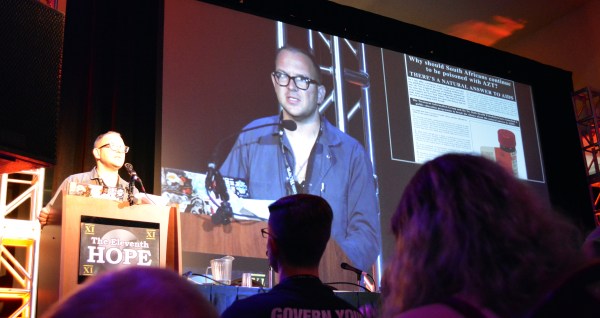
I was skeptical about a two hour block allotted for Cory Doctrow’s keynote address at HOPE XI. I’ve been to Operas that are shorter than that and it’s hard to imagine he could keep a huge audience engaged for that long. I was incredibly wrong — this was a barnburner of a talk. Here is where some would make a joke about breaking out the rainbows and puppies. But this isn’t a joke. I think Cory’s talk helped me understand why I’ve been feeling down about our not-so-bright digital future and unearthed a foundation upon which hope can grow.

Continue reading “Cory Doctorow Rails Against Technological Nihilism; Wants You To Have Hope”

Bunnie And EFF Sue US Government Over DMCA 1201

This morning Bunnie Huang wrote about his reasons for suing the US Government over Section 1201 of the Digital Millennium Copyright Act (DMCA).

The DMCA was enacted in 1996 and put in place far-reaching protections for copyright owners. Many, myself included, think these protections became far-overreaching. The DMCA, specifically section 1201 of the act which is known as the anti-circumvention provision, prohibits any action that goes around mechanisms designed to protect copyrighted material. So much has changed since ’96 — software is now in every device and that means section 1201 extends to almost all electronics sold today.

So protecting copyright is good, right? If that were the only way section 1201 was enforced that might be true. But common sense seems to have gone out the window on this one.

If you legally purchase media which is protected with DRM it is illegal for you to change the format of that media. Ripping your DVD to a digital file to view on your phone while on the plane (something usually seen as fair use) is a violation. Want to build an add-on for you home automation system but need to reverse engineer the communications protocol first? That’s a violation. Perhaps the most alarming violation: if you discover a security vulnerability in an existing system and report it, you can be sued under DMCA 1201 for doing so.

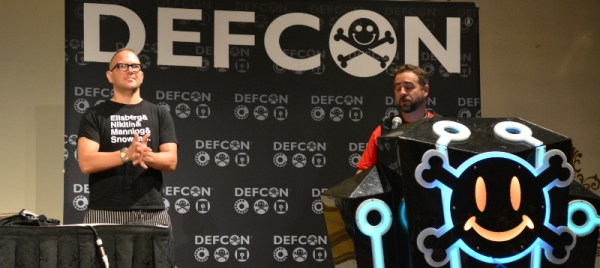
Cory Doctorow gave a great talk at DEF CON last year about the Electronic Frontier Foundation’s renewed push against DMCA 1201. The EFF is backing Bunnie on this lawsuit. Their tack argues both that section 1201 is stiffling innovation and discouraging meaningful security research.

If it’s illegal to write about, talk about, or even privately explore how electronics are built (and the ecosystem that lets them function) it’s hard to really master creating new technology. A successful lawsuit must show harm. Bunnie’s company, Alphamax LLC, is developing hardware that can add an overlay to an HDMI signal (which sounds like the continuation of the hack we saw from him a few years ago). But HDCP would prevent this.

Innovation aside, the security research angle is a huge reason for this law (or the enforcement of it) to change. The other plaintiff named in the suit, Matthew Green, had to seek an exemption from the DMCA in order to conduct his research without fear of prosecution. Currently there is a huge disincentive to report or even look for security vulnerabilities, and that is a disservice to all. Beneficial security research and responsible disclosure need to be the top priority in our society which is now totally dependent on an electronically augmented lifestyle.

Cory Doctorow Rails Against The Effect Of DRM And The DMCA

If you weren’t at [Cory Doctorow’s] DEF CON talk on Friday you missed out. Fighting Back in the War on General Purpose Computing was inspiring, informed, and incomparable. At the very lowest level his point was that it isn’t the devices gathering data about us that is the big problem, it’s the legislation that makes it illegal for us to make them secure. The good news is that all of the DEF CON talks are recorded and published freely. While you wait for that to happen, read on for a recap and to learn how you can help the EFF fix this mess.

Continue reading “Cory Doctorow Rails Against The Effect Of DRM And The DMCA”