
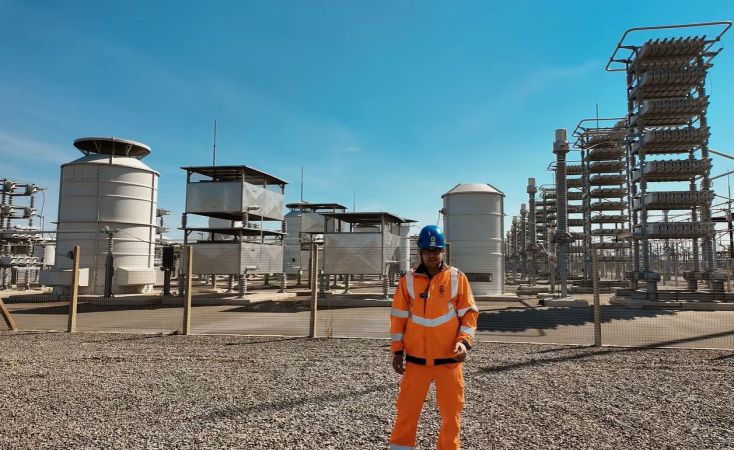
How The Grid’s Harmonic Filters Keep The Power Clean

A fun way to think about a national electrical grid is as a massively upscaled electrical circuit, one in which you have multiple power supplies injecting AC power, with various bits and bobs involving resistors, inductors and capacitors in between working to synchronize and clean-up this power before it gets to the end users. Recently [Jordan Taylor], also known as [The Electric Brit] took a look at the grid’s harmonic filters that do a lot of this sinewave scrubbing after the HVDC to AC conversion.

Using a UK-based line-commutated converter (LCC) HVDC converter station as a physical example [Jordan] takes us through the elements of this harmonic filter, what it is, what it does and why it’s a necessity. The design considerations with components at this immense scale are also covered, along with the types of filters possible.

The Cliff’s Notes version is that following the conversion step from said HVDC there are harmonics introduced in the AC, not unlike in a much lower-voltage converter. This results in a noisy sinewave that can potentially cause harm to AC-powered devices, not to mention cause heating and other losses along the way. The answer is naturally to add an LC-filter, just on a slightly larger scale than for consumer electronics.

Also noted by [Jordan] is the nice synergy of these harmonic filters when it comes to absorbing and generating reactive power on the AC grid, due to their massive capacitors and inductors. This helps to dampen oscillations on the grid and thus further contributing to its stability.

Continue reading “How The Grid’s Harmonic Filters Keep The Power Clean”

Retrotechtacular: One Does Not Simply String Up A Half-Million VDC Transmission Line

It takes strong and determined population to build a lasting civilization. If the civilization includes electricity and the inhabitants live in a hilly place with an often-unforgiving climate, the required strength and determination increases proportionally. Such is the case of the gentlemen who strung up the first half-million VDC transmission line across New Zealand, connecting the country’s two main islands.

Construction for the line known as the HVDC Inter-Island link began in 1961. It starts at the Benmore hydroelectric plant on the south island and runs north to Cook Strait via overhead cables. Then it travels 40km underwater to the north island and ends near Wellington. This is the kind of infrastructure project that required smaller, preliminary infrastructure projects. Hundreds of miles of New Zealand countryside had to be surveyed before breaking ground for the first tower support hole. In order to transport the materials and maintain the towers, some 270 miles of road were laid and ten bridges were built. Fifteen camps were set up to house the workers.

The country’s hilly terrain and high winds made the project even more challenging. But as you’ll see, these men were practically unfazed. They sent bundles of steel across steep canyons on zip lines and hand-walked wire haulage rope across gullies because they couldn’t otherwise do their job. Six of these men could erect a tower within a few hours, which the filmmakers prove with a cool time-lapse sequence.

Splicing the mile-long conductors is done with 100-ton compressors. Each connection is covered with steel sleeve that must be centered across the joint for optimum transmission. How did they check this? By taking a bunch of x-rays with a portable cesium-137 source.

Continue reading “Retrotechtacular: One Does Not Simply String Up A Half-Million VDC Transmission Line”









