
Detection Of A Four-Carbon Sugar In Interstellar Space

Although life tends to find a way, something first has to kickstart said lifeforms. Exactly how the first biological cells formed on Earth – and potentially on other worlds – remains an enduring mystery. Some theories point to the early Earth’s surface conditions as a viable laboratory for the self-assembly of the first viable membranes, RNA, DNA and associated molecular machinery, while seeding of the Earth’s primitive atmosphere by sugars and other precursors from asteroids and kin is required in other theories.

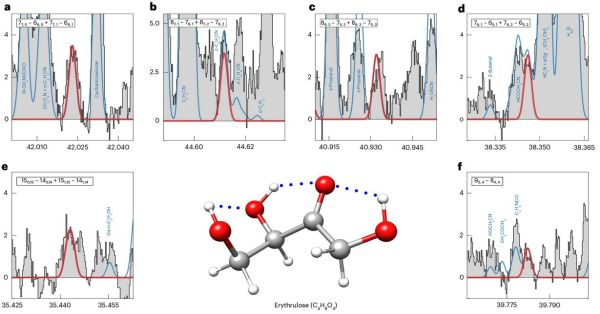
Recently [Izaskun Jiménez-Serra] et al. added to this debate with the reported detection of four-carbon sugars in the form of erythrulose in the interstellar medium. Using the 40 meter radio telescope at Yebes and the 30 meter radio telescope at Granada the signatures of this sugar was detected in a molecular cloud near the center of the Milky Way.

These sugars likely form on these interstellar dust grains from more basic two-carbon aldehydes and alcohols, with them providing conceivably a source of energy for early metabolic processes of developing lifeforms. This specific type of sugar is highly prevalent in Earth’s fruits, and thus its prevalence in interstellar space is at the very least an interesting coincidence, if not another puzzle piece in the overarching question of abiogenesis.

Voyager 1 Once Again Returning Science Data From All Four Instruments

As humanity’s furthest reach into the Universe so far, the two Voyager spacecraft’s well-being is of utmost importance to many. Although we know that there will be an end to any science mission, the recent near-death experience by Voyager 1 was a shocking event for many. Now it seems that things may have more or less returned to normal, with all four remaining scientific instruments now back online and returning information.

Since the completion of Voyager 1’s primary mission over 43 years ago, five of its instruments (including the cameras) were disabled to cope with its diminishing power reserves, with two more instruments failing. This left the current magnetometer (MAG), charged particle (LECP) and cosmic ray (CRS) instruments, as well as the plasma wave subsystem (PWS). These are now all back in operation based on the returned science data after the Voyager team confirmed previously that they were receiving engineering data again.

With Voyager 1 now mostly back to normal, some housekeeping is necessary: resynchronizing the onboard time, as well as maintenance on the digital tape recorder. This will ensure that this venerable spacecraft will be all ready for its 47th anniversary this fall.

Thanks to [Mark Stevens] for the tip.








