Musical Tesla Concert Is Electrifying

musical_tesla_coil

Hackaday reader [Tyler Laseter] wrote in to tell us about an event that he and his fellow Tesla Orchestra team members are hosting next month.

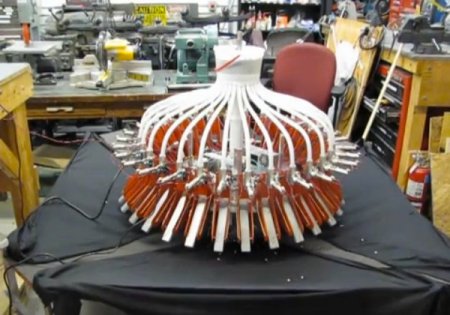
The “Open Spark Project” is a concert event taking place on May 14th, which melds together electricity and music in spectacular fashion. The event features two large Tesla coils which are tuned to play musical notes while shooting bolts of electricity through the air.

Musical Tesla coils are nothing new around here, but we have yet to see someone allow the general public to play music on their coils. That’s what makes this event unique – anyone is encouraged to submit their to the Tesla Orchestra team, which will then be played back via a live video stream next month. Their web site offers up all of the technical details as well as the file format requirements for submitting music for the event, so get started on your entry today!

If a passive approach is more your style, stick around for a quick video demonstrating their coils’ abilities. Sure it’s Lady Gaga, but we won’t tell anyone you watched it. Plus, it’s totally legit when the song is being played using 20,000 volts.

Continue reading “Musical Tesla Concert Is Electrifying”

Robotic Berimbau Plays Itself

berimbau

If you have ever seen capoeira, you have undoubtedly heard the music of a berimbau. If you are not familiar, Capoeira is a Brazilian art form that melds martial arts, acrobatics, and music. This graceful fighting form is often accompanied by the sounds of a berimbau, a single-stringed musical instrument comprised of a gourd, a wooden bow, and a steel string.

[Ivan Monsão] and [Paulo Libonati] have constructed what is considered to be the first robotic berimbau in existence, capable of playing music without any human interaction. The robot strikes the berimbau’s metal string, mechanically muting the gourd when appropriate, and even shakes the caxixi (a rattle) in time with the music.

The builder claims that the berimbau learns songs by “listening” and repeating rather than having songs pre-programmed into the system. We can’t see any evidence of that functionality from the video, though we’d love to see the learning process in action.

While we try to find our VHS copy of “Only the Strong”, be sure to take a look at the following video of the berimbau playing itself.

[Thanks, Camilo]

Continue reading “Robotic Berimbau Plays Itself”

RFID-based HTPC Controller Gets A Wireless Refresh

RFiDJ_Refresh

[roteno] recently wrote in to let us know that he has completed work on the RFiDJ Refresh, a follow up to his 2009 project, the RFiDJ.

The concept is pretty simple – he has a set of RFID enabled tiles, which contain references to particular online streaming audio stations. He uses these tiles to tune into audio feeds on his HTPC by placing them on a block containing an RFID reader.

His previous implementation had the RFID reader tethered to his HTPC, which didn’t make it all that convenient to use. The newer version utilizes a 433 MHz transmitter/receiver pair in order to communicate with the PC, so it can be used anywhere through out his house. The reader and transmitter were placed in a shadow box picture frame, along with a rechargeable Li-poly battery that powers the whole setup. He also mentions that he has added a tactile interface that allows him to initiate mobile phone calls from the RFiDJ as well.

It’s a nice update to an already great project. We imagine it’s a bit more fun for [roteno] and his guests to tap a coaster on the transmitter box than fumble with a remote to change radio stations on the HTPC, but that’s just us.

Check out the videos below to see his new setup in action.

Continue reading “RFID-based HTPC Controller Gets A Wireless Refresh”

Giant Oscilloscope Music Display

oscilloscope_wall

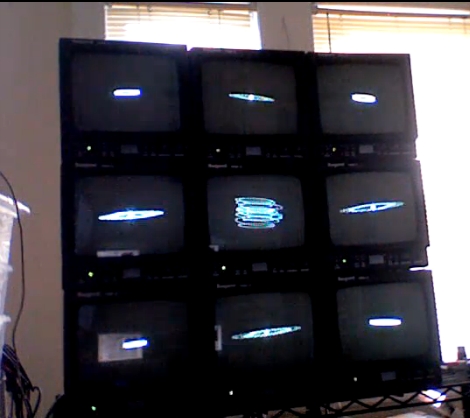
[Andrew] sent us a video of his home made oscilloscope wall, which he uses to visualize different audio tracks he has created. The wall is made up of nine old broadcast monitors he wired together in his studio. At first it appears that the monitors are split into two sets of four, with the center monitor running separately, but upon further inspection it looks as if he can control the display of each monitor independently.

We’re pretty sure he is not using an actual oscilloscope to generate the visuals, but rather visualization software that can approximate the output of an O-scope set in X-Y display mode. Though the screens run independently, it would be great to see all nine screens working in concert to display one large visualization. [Andrew] mentions that an high-def version is in the works, so perhaps we’ll see more features added in that iteration.

Stick around to watch a video of his oscilloscope wall in motion.

Continue reading “Giant Oscilloscope Music Display”

IR-controlled Musical Alarm Clock

Music-Playing-Alarm-Clock

Forum user [Frank] shared with us his recent project, a musical alarm clock. More than just a simple alarm clock, his creation allows the user to load music onto a micro SD card, has alarm settings for each day of the week, and best of all, can be controlled using an IR remote. He uses a Teensy++ to control most of the clock’s functions including the display, delegating the time keeping to a DS1307 real-time clock. All of the audio playback is handled by a separate music decoder mounted on a breakout board.

His Instructables writeup is extremely detailed, with tons of annotations, pictures, diagrams, and source code available. He walks through each step in detail, making this a great learning guide for others looking to start in on AVR programming.

His final presentation is a great lesson in recycling, though unfortunately a bit lackluster, as the clock is packaged in an old SparkFun cardboard box. He does mention that there were some time constraints towards the end, which may explain this choice – it would be nice to see a revised version of this clock packaged in a nice plexi case.


Valentine’s Day Love Song Machine

tellart_bell_ensemble

Just in time for Valentine’s day, [Adam Meyer] and the folks over at tellart.com have put together a little project they call the “Love Song Machine“. Using a web-based form, anyone can submit a song, which will then be played on a system of bells that they have set up in their office. You can choose from several pre-defined love songs, or you can create your own unique arrangement with which to serenade them. Once you are ready to go, your song will be queued up, and you can watch a video of your creation as it is being played.

The system is comprised of 8 solenoid-actuated bells which are all controlled by the Arduino they have hooked up to their web server. It’s a pretty fun idea, and there are sure to be plenty of people submitting songs, so get yours in before things get too busy!

Keep reading to see a video preview of their system in action.

Continue reading “Valentine’s Day Love Song Machine”

Range Finder Musical Toy

parallax_arduino_ping_organ

Instructables user [sketchsk3tch] was looking to make a fun toy for his kids using things he had around the house and came up with the Ping Organ. The organ is played by standing in front of the Parallax Ping range sensor, and moving around any which way you please. He interfaced the range sensor with an Arduino, scavenging a small speaker from an old toy for audio output.

The code for the project is fairly straightforward, borrowing most of it from the demo software that shipped with the Ping and the Arduino. He made a few small tweaks in order to get the organ to play frequencies of actual notes, as well as to allow for some flexibility when calculating the specific note to play.

While not the most complex project we have ever featured, [sketchsk3tch] reports that his kids love to spend time flailing around wildly in front of the organ, which is exactly what he intended.
Video of the organ being tested after the break.

Continue reading “Range Finder Musical Toy”