
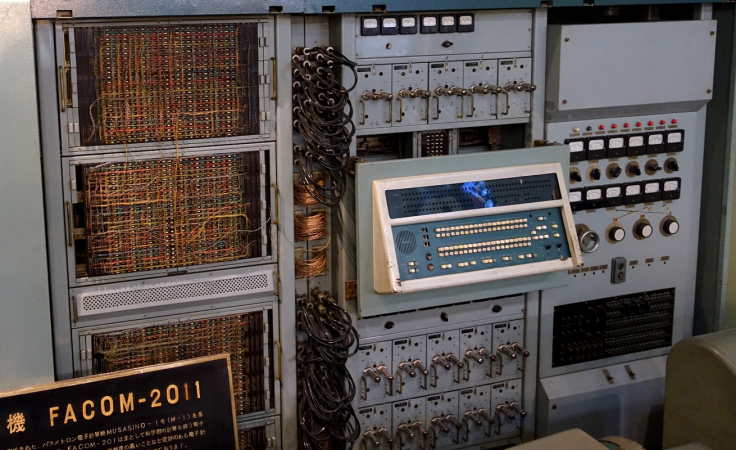
However you make a digital computer, you need something to represent a binary digit. Usually this is some form of switch: a relay, a tube, or a transistor, although there have been other ways to represent state. In 1954, [Eiichi Goto] of Japan invented the parametron, a resonant circuit using a ferrite core and a capacitor that could be moved between two phases.
According to [Goto’s] 1959 paper, the device is effectively a parametric oscillator, similar to some used at UHF frequencies by hams. The idea is that a tuned circuit is set to some frequency and driven with twice that frequency.
A What?
A parametron is essentially a resonant circuit made with inductors or capacitors whose reactance is varied at twice its resonant frequency. That “pumping” causes the circuit to oscillate at half the pump frequency. The neat trick is that there are two equally stable oscillation states at half the pump frequency, separated from each other by 180° of phase. Those two phases become binary 0 and 1. Depending on the incoming signals, one phase will win over the others.
Continue reading “PC-1: The 1954 Computer With No Tubes, Relays, Or Transistors”









