
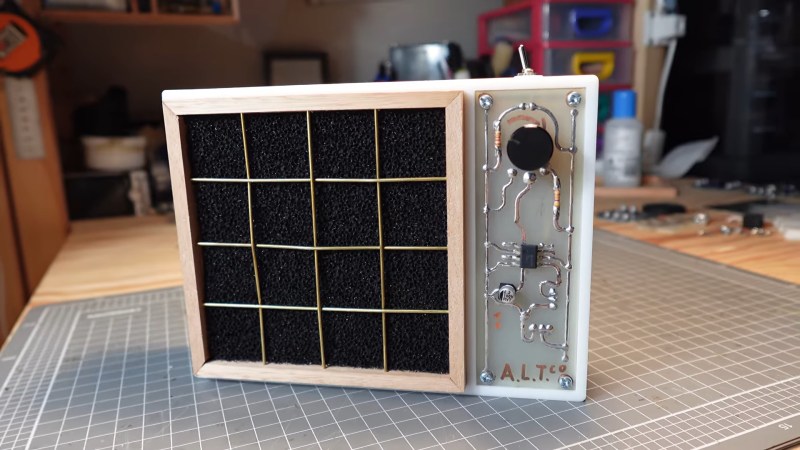
A desk fan with an air filter. On the side, the final assembled PCB is visible.

Making A PCB The Old-Fashioned Way

Nearly all modern PCBs are designed with the help of EDA software, but not all of them. [ALTco] shows us the process of plotting out a board the old-fashioned way — by hand.

Back in the day, drawing out the traces on a PCB lead to beautiful, smooth lines that [ALTco] wanted to imitate. But first, he needed to figure out how the rest of the fabrication process worked. He starts by just experimenting, both with the “resist” markers and paint, and the etching compound. Things rarely work first-try, and neither did his home-made etchant. So then it was time to buy some ferric chloride, the standard copper etchant for PBCs. A few more tests sorted out which permanent marker worked best.

[ALTco] starts by thoroughly cleaning a raw copper-clad board so the marker sticks properly, then draws the circuit for a little analog fan controller. The board is then laid in a bath of the etchant for several minutes while gently rocking it to keep the reaction going. Finally the board is taken out, etchant stored for re-use, and the board washed with water and then presumably IPA to remove the remaining marker. Some assembly of the newly-printed circuit board later and you have a cute little smoke absorber for your soldering projects.
Continue reading “Making A PCB The Old-Fashioned Way”

Testing The Efficiency Of PCB Etchants

etchIn the interest of the scientific method [Feynmaniac] (great name, btw) over on Instructables has posted a little experiment on something we all, no doubt, care about: putting PCB traces in copper clad boards with the most common etchants out there.

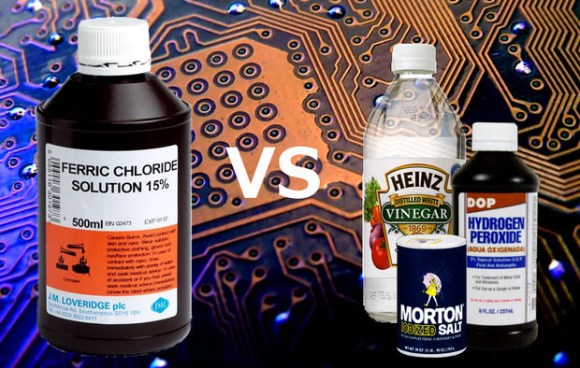
The experiment used the ‘ol standard, ferric chloride, and the safe, inexpensive newcomer, vinegar, hydrogen peroxide, and table salt. Finding the most efficient mixture of ferric chloride is easy: just use what’s in the bottle. The vinegar and H2O2 requires some stoichiometry, though, and [Feynmaniac] calculated that with an 8% acetic acid solution and the most commonly available 3% peroxide solution, a 2:3 ratio of peroxide to vinegar is the best. Salt to taste, or until everything turns green.

Four copper clad boards were used for the test, masked off in a ‘barcode’ pattern. Two methods of applying the etchant were used: either rubbing the etchant on with a sponge, or immersing the boards in a bath of the etchant being tested.

In terms of speed, ferric chloride was by far the fastest, with 3 minutes until the board was etched using the rubbing method, or 10 minutes when simply immersed. Vinegar/peroxide took longer with 11 minutes rubbed, and 20 minutes immersed. No differences in the quality of the etch were noticed.

While ferric chloride was by far the fastest etchant, it does have the downside of being environmentally unfriendly and fairly expensive. The vinegar and peroxide etchant is safe, cheap, and can be found in any grocery store on the planet.

This experiment didn’t test other common etchants like HCl and H202, or cupric chloride (which is is the byproduct of HCl and H202). Still, it’s a good confirmation that the vinegar and peroxide method actually works, in case you were wondering.








