3D Printed Robot Arm Built For Learning Purposes

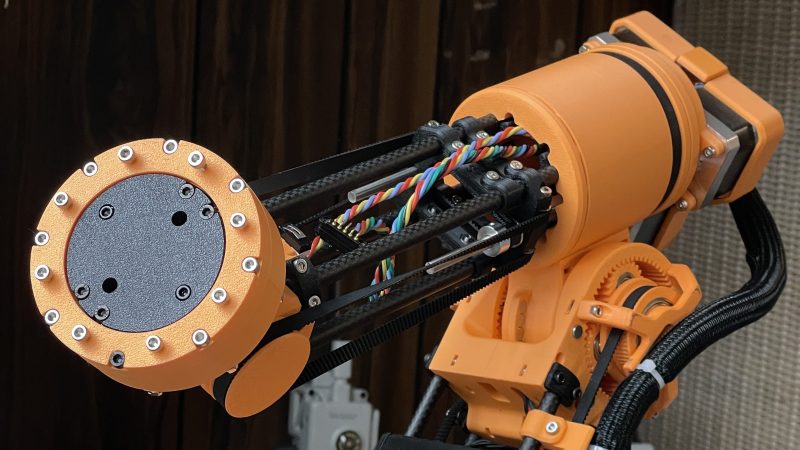
If you want to work with robots you can do all sorts of learning with software and simulation, but nothing quite beats getting to grips with real machinery. That was the motivation for [James Gullberg] to build this impressive robot arm. 

Featuring six degrees of freedom, the robot arm is mostly constructed of 3D printed components. This let [James] experiment with a wide variety of joint and reducer designs for the sake of learning and investigation. The base of the robot uses a fairly conventional planetary gear drive, while shoulder and elbow joints rely on split-ring planetary gearboxes to allow for high torque density with regards to size. [James] implemented a neat sensing technique here, integrating alternating magnets into the output ring gear which are monitored via a magnetic encoder. The wrist joint switches things up again, running via an inverted belt differential.

Running the show is an STM32 microcontroller, which talks to all the encoders, communicates with a Raspberry Pi over CAN bus, and handles all the necessary PID control loops and step generation for the drive motors. The plan is to run higher-level control on the Raspberry Pi which will run a ROS 2-based software stack. Already, the various joints look smooth and impressive in motion.

If you’re looking to learn about robot arms, you really can’t beat building one. We’ve featured a few projects along these lines before. Most of them aren’t exactly production-line ready, but they will teach you a ton about control, motion planning, and all sorts of associated skills. That experience can be invaluable if you intend to work with robots in industry.

Continue reading “3D Printed Robot Arm Built For Learning Purposes”

Telepresence Robot For “Doing The Rounds”

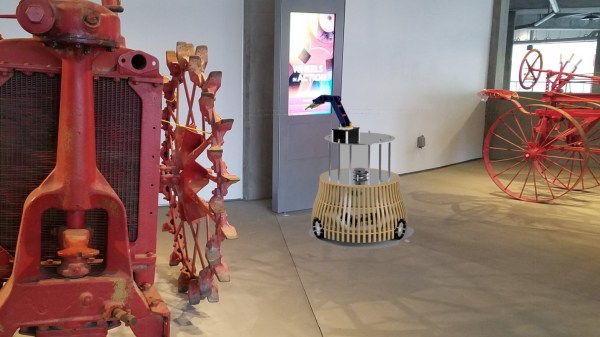
When you are responsible for maintaining devices at a client’s location, software tools like remote desktop and SSH are great, but sometimes they are not enough. For some problems, you need to get eyes and hands on the device to figure out what’s going on and fix the problem. This is a challenge [Will Donaldson] from EDM Studio is all too familiar with. They develop and maintain interactive museum exhibits all over the world, so they created Omni, a modular telepresence robot for inspection, maintenance, and a variety of other tasks.

The Omni uses a set of three omni-wheels under its base, powered by DC geared motors with encoders, each controlled by a separate motor driver and Arduino Nano. A similar arrangement was used by Mark Rober for his domino art robot. The main controller is a Raspberry Pi 4 running ROS2 (Robot Operating System), which takes inputs from a 360 LIDAR sensor, high-quality camera module, and IMU.

All the components are mounted on a series of plates separated using threaded rods. This arrangement allows for maximum flexibility and space, especially the open-top plate, which has a grid of holes machined in to allow almost anything to be mounted. In this case, a robotic arm is mounted for manipulating the environment. Another neat feature is the charging station connector, consisting of two parallel metal strips on the outside of the robot.

Omni’s mission is very similar to that of Spot, the robotic dog from Boston Dynamics intended, among other things, for Industrial Inspection. What practical purposes would you use Omni for? Let us know in the comments below.

Dashing Diademata Delivers Second Generation ROS

A simple robot that performs line-following or obstacle avoidance can fit all of its logic inside a single Arduino sketch. But as a robot’s autonomy increases, its corresponding software gets complicated very quickly. It won’t be long before diagnostic monitoring and logging comes in handy, or the desire to encapsulate feature areas and orchestrate how they work together. This is where tools like the Robot Operating System (ROS) come in, so we don’t have to keep reinventing these same wheels. And Open Robotics just released ROS 2 Dashing Diademata for all of us to use.

ROS is an open source project that’s been underway since 2007 and updated regularly, each named after a turtle species. What makes this one worthy of extra attention? Dashing marks the first longer term support (LTS) release of ROS 2, a refreshed second generation of ROS. All high level concepts stayed the same, meaning almost everything in our ROS orientation guide is still applicable in ROS 2. But there were big changes under the hood reflecting technical advances over the past decade.

ROS was built in an age where a Unix workstation cost thousands of dollars, XML was going to be how we communicate all data online, and an autonomous robot cost more than a high-end luxury car. Now we have $35 Raspberry Pi running Linux, XML has fallen out of favor due to processing overhead, and some autonomous robots are high-end luxury cars. For these and many other reasons, the people of Open Robotics decided it was time to make a clean break from legacy code.

The break has its detractors, as it meant leaving behind the vast library of freely available robot intelligence modules released by researchers over the years. Popular ones were (or will be) ported to ROS 2, and there is a translation bridge sufficient to work with some, but the rest will be left behind. However, this update also resolved many of the deal-breakers preventing adoption outside of research, making ROS more attractive for commercial investment which should bring more robots mainstream.

Judging by responses to the release announcement, there are plenty of people eager to put ROS 2 to work, but it is not the only freshly baked robotics framework around. We just saw Nvidia release their Isaac Robot Engine tailored to make the most of their Jetson hardware.