
Repairing A Cheap Rotary Evaporator For The Home Lab

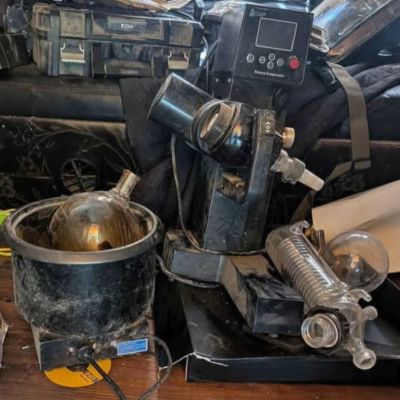
After running through the chemical reactions required to get whatever substance you were targeting, it’ll often still be mixed in with a lot of solvent. Getting rid of this solvent can be done in a variety of ways, but the quickest and most gentle approach is to use the rotary evaporator, or rotovap. Unfortunately, despite being rather simple devices, buying them new is quite the financial decision, so [ProjectsInFlight] opted to try and fix up a cheap broken one that he bought online.

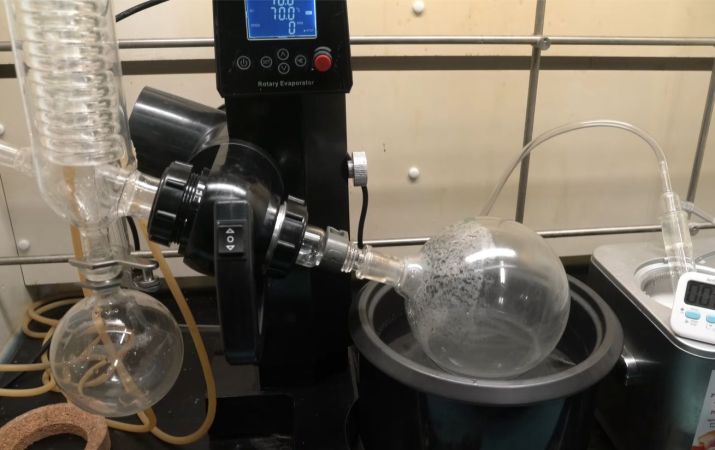
A rotovap, as the name suggests, rotates the flask that the liquid is contained in. A heating bath provides gentle heating to the flask, while a vacuum lowers the boiling point of the solvent. The evaporated solvent is then condensed and collected for reuse or disposal. With even a ‘cheap’ budget rotovap starting at around $1,600, finding a rather trashed one for $100 might be a steal, even with the broken glass condenser section.

A replacement condenser was sourced for pretty much the price of the rotovap, with the hope that this would create one whole unit. After some testing it turned out that this rotovap probably fell down a tall flight of stairs, with a busted bearing block for the vertical lift. This is where having a milling machine and some scrap aluminium came in useful.

Ultimately the whole machine came together just fine, and a demonstration of why you want one of these puppies in your lab. For just over $200 this rotovap is excellent at massively speeding up evaporating over a basic hotplate, although you do need to supply your own vacuum pump, plus a cold trap or similar moisture trap if you use a rotary vane vacuum pump. Here using staged (eccentric) membrane pumps might be a budget solution.

Drying things in a vacuum is overall a very useful concept, one that can be used for more than just making chemistry tasks go faster, but also speed up drying of desiccant and FDM filament.

Continue reading “Repairing A Cheap Rotary Evaporator For The Home Lab” →
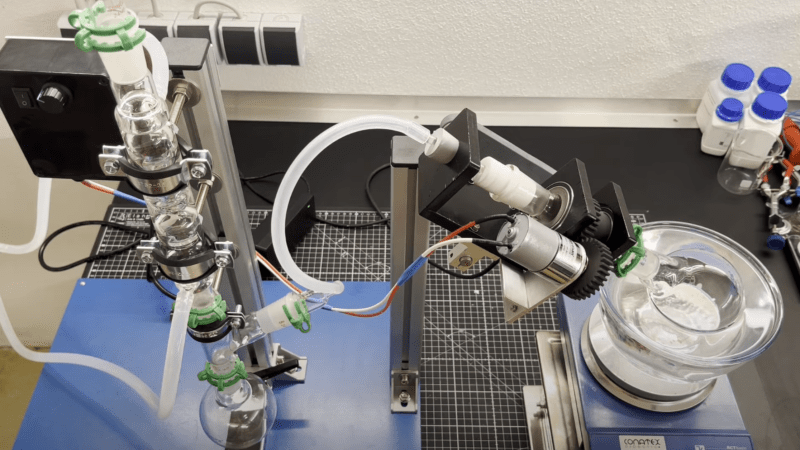
A laboratory benchtop is shown. To the left, there is a distillation column above a collecting flask, with a tube leading from the flask to an adapter. The adapter has a frame holding a glass tube with a teflon stopper at one end, into which a smaller glass tube leads. At the other end of the larger tube is a round flask suspended in an oil bath.

Building A Rotary Evaporator For The Home Lab

The rotary evaporator (rotovap) rarely appears outside of well-provisioned chemistry labs. That means that despite being a fundamentally simple device, their cost generally puts them out of reach for amateur chemists. Nevertheless, they make it much more convenient to remove a solvent from a solution, so [Markus Bindhammer] designed and built his own.

Rotary evaporators have two flasks, one containing the solution to be evaporated, and one that collects the condensed solvent vapors. A rotary joint holds the evaporating flask partially immersed in a heated oil bath and connects the flask’s neck to a fixed vapor duct. Solvent vapors leave the first flask, travel through the duct, condense in a condenser, and collect in the second flask. A motor rotates the first flask, which spreads a thin layer of the solution across the flask walls, increasing the surface area and causing the liquid to evaporate more quickly.

Possibly the trickiest part of the apparatus is the rotary joint, which in [Markus]’s implementation is made of a ground-glass joint adapter surrounded by a 3D-printed gear adapter and two ball bearings. A Teflon stopper fits into one end of the adapter, the evaporation flask clips onto the other end, and a glass tube runs through the stopper. The ball bearings allow the adapter to rotate within a frame, the gear enables a motor to drive it, the Teflon stopper serves as a lubricated seal, and the non-rotating glass tube directs the solvent vapors into the condenser.

The flasks, condenser, and adapters were relatively inexpensive commercial glassware, and the frame that held them in place was primarily made of aluminium extrusion, with a few other pieces of miscellaneous hardware. In [Markus]’s test, the rotovap had no trouble evaporating isopropyl alcohol from one flask to the other.

This isn’t [Markus]’s first time turning a complex piece of scientific equipment into an amateur-accessible project, or, for that matter, making simpler equipment. He’s also taken on several major industrial chemistry processes.









