A Solar-Powered Automatic Chicken Coop

Although we’ve featured many chicken-related hacks here, this chicken coop features a solar-powered door to save one from having to open up the coop in the morning.  As [chrisatronics] puts it “keeping chickens has one major drawback: You have to get up with them in the early morning and open the door at the coop. Everyday. Including Sundays and holidays.” This would help explain why so many people seem to be hacking their coops.

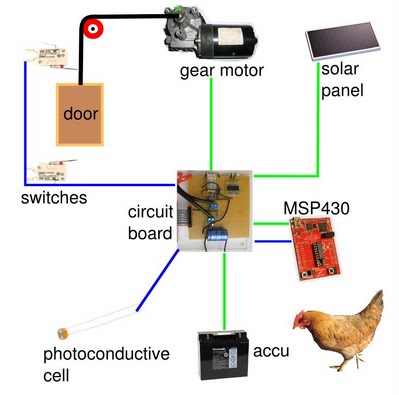
Solar power may be an interesting idea in itself, but when coupled with the fact that a chicken coop isn’t necessarily near a power supply, this becomes a very expedient solution. Controlling the setup is a MSP430 microcontroller (programming featured here for Linux) with a salvaged windshield wiper gearmotor. [Chrisatronics] did a great job writing this hack up, so if you want to try this yourself, make sure to check out the article.

Also, don’t forget to check out the video after the break for the ‘coop in action! Continue reading “A Solar-Powered Automatic Chicken Coop”

High Efficiency Solar Charger Circuit Tops Off Those Lead-acid Batteries

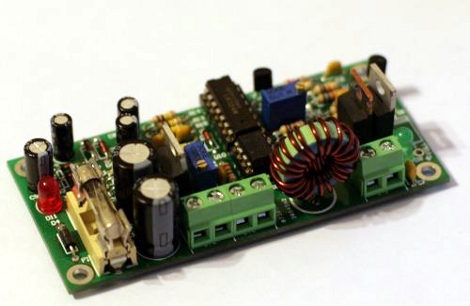
Make your next project solar-powered with this charging circuit. It’s completely through-hole, and there are no microcontrollers that need to be flashed. If you can source parts and are handy with a soldering iron building this will be a breeze.

Both the maximum system voltage and the low voltage drop out are configurable. After assembly, you just need to attach a regulated power supply to the load terminals. Tune the power supply to the max voltage and turn a potentiometer until an LED comes on, then repeat the process for the drop out voltage. Board artwork for the two-sided PCB and a schematic are available from the page linked at the top. If you’re not into etching your own circuit boards you can buy one for around $10.

[Thanks Murray]

Building A Solar Power Heliostat

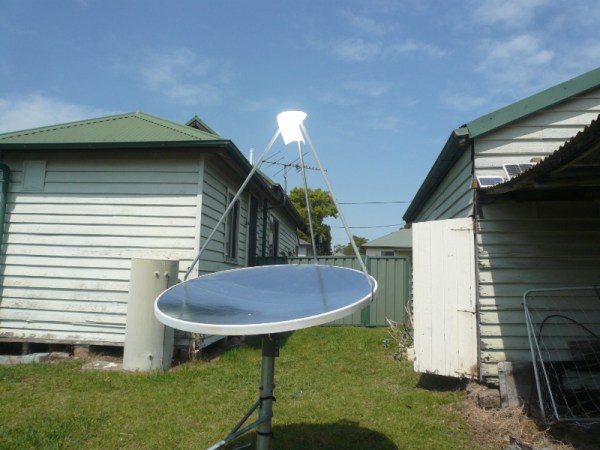
[Frits] has been working on an solar panel heliostat (in Dutch, check out the translated page here).

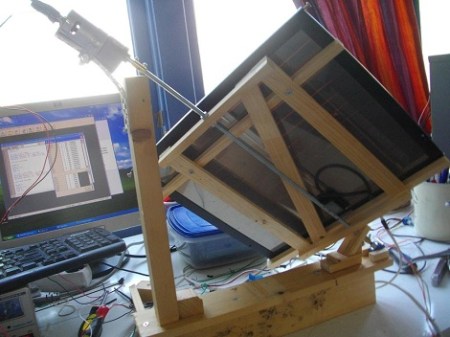
The heliostat uses a small PICAXE to control the motor, along with an DS1307 real-time clock to make sure the motors start at dawn. Instead of using optical encoders or magnetic sensors, the angle of the heliostat is measure with a pot attached to the drive shaft. [Frits] did a lot of data collection to figure out that this method is accurate to about 1 degree – just fine for something that doesn’t need to be exact.

According to [Frits] this heliostat will put out 12 to 50 percent more electricity than a fixed panel. Although the build does seem a little bulky, putting it on a  house with a roof pitch of 23.5° would greatly reduce the horizontal profile.

A video of a solar panel rotating at 15 degrees/hour isn’t that interesting, so [Frits] posted a clip of 6 mirrors slewing around fairly fast to demonstrate his system. Check it out after the break.

Continue reading “Building A Solar Power Heliostat”

Selective Solar Sintering With Sand

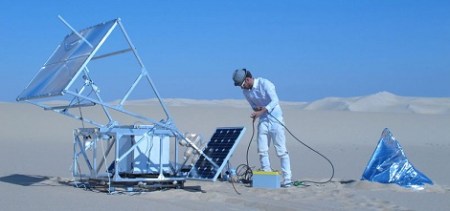
[Markus Kayser] built an amazing solar powered SLS printer, but instead of using lasers and powdered plastics his machine uses the power of the sun to heat sand into complex shapes.

[Markus]’ printer uses the same concept as his earlier solar cutter – burning things with a magnifying glass. Interestingly, the printer isn’t controlled with stepper motors and reprap electronics – it’s completely cam driven. The solar panels only power the motor attached to the frame moving on bearings made from skateboard wheels.

We’d guess that [Markus] is using a little more than 2 square meters of Fresnel lenses in his project. Since solar irradiance is about 120 W/m² (PDF warning), [Markus] is concentrating a lot of energy onto a point the size of a quarter, which would be necessary to heat up sand to its 1500° C melting point. The resolution isn’t what you could get with a laser, but [Markus] was able to print an amazing bowl along with other complex 3d shapes.

Check out [Markus]’ video of the solar sinter printer after the break. There’s also a video of his previous experiment with the solar cutter.

Continue reading “Selective Solar Sintering With Sand”

25C3: Solar-powering Your Gear

solar

The 25th Chaos Communication Congress is underway in Berlin. One of the first talks we dropped in on was [script]’s Solar-powering your Geek Gear. While there are quite a few portable solar products on the market, we haven’t seen much in the way of real world experience until now.

Continue reading “25C3: Solar-powering Your Gear”

LED Sensor Solar Tracker


More of my EV kick coming through. A solar tracker is used rotate a solar panel to get optimum energy from the sun. This one uses LEDs as the light sensor and mosfets to drive the output to rotate on a single axis. He even reduced the duty cycle on the fets so no heatsink is needed. Mounting in a peanut butter jar keeps the circuit dry and allows the sun to shine through. (The designer sells these, but has circuits up on the site)