
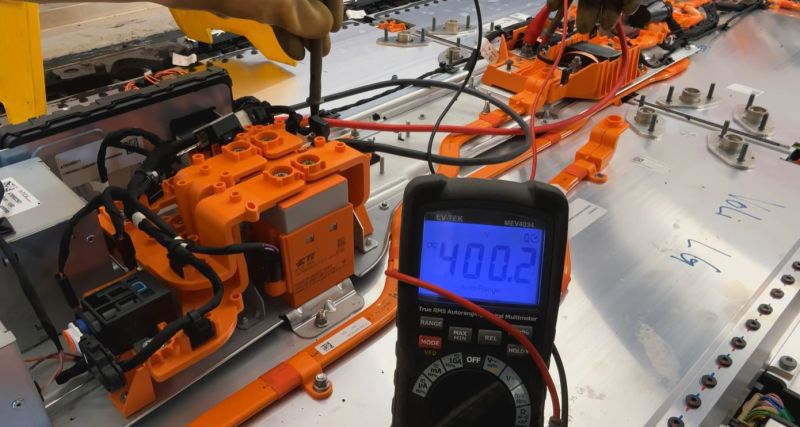
When [OGS Mechanics] got a Mercedes EQC 300 battery-electric car in for repair, it was found to have a bit of a weird issue: after sitting in a garage for a while, its range on battery had suddenly reduced significantly without clear cause. Although the typical response here is to just mark the battery pack as ‘faulty’ and replace the whole unit, [OGS] decided to dig into the pack to see what was going on.
The short version is that this particular battery pack consists of two individual batteries, each with its own BMS, one of which had reported a condition to the master BMS that triggered the ‘replace battery module’ error observed with the scan tool. From this it could also be seen that the first battery was at a 10% state-of-charge (SoC), and the second at 95%, making them incredibly unbalanced. Unfortunately the dealer procedure to rebalance did not work here, with only the second battery wanting to charge even after draining both to the same initial level.
To diagnose the underlying issue in earnest required gently prying open the battery pack like a massive glued-shut smartphone. Going by the theory that it is a software glitch, since the first battery was still at a healthy voltage level, it was decided to manually charge it. With both batteries now fully charged, the BMS for the first battery was then removed to have its memory overwritten with that of a known good BMS module, clearing the ‘replace battery module’ error.
Although in the preview for the next video it’s hinted that there’s also an internal balancing issue in the first battery pack, this could be another symptom of its BMS glitching out. Either way, it would seem that BEVs battery modules are both heavily dependent on software, as well as afflicted by the same throw-away culture that has people just buying a new smartphone when the battery fails.












i had a laptop like this once…it would be working fine and then one day it wouldn’t charge the battery anymore. At first i thought maybe i had deep discharged it through my carelessness, but one of the batteries i happened to catch it when it was still more than 50% charged, but nonetheless refusing to accept a new charge. By that time, i had a pile of dead ones so i took one apart to inspect all the different protection/monitoring chips on the board. It was surprisingly easy to get datasheets for everything, and i found the chip that is supposed to blow up a fuse if it decides to permanently restrict the battery…but the fuse had not been blown! So it was, as far as i could tell, “just fine”, but it would not charge. I checked balance and thought it was balanced…i charged one manually and it still wouldn’t accept a charge after that.
I happened to have two of the same laptop (looking for parts, a second laptop was the same price as a replacement part) and my overall impression is that one of the two had a mainboard fault that triggered this battery behavior. At $40 per battery, and mostly more than a year from each battery, it wasn’t a huge problem but it was frustrating and i ultimately solved it by buying a new laptop.
Can’t imagine trying to diagnose basically the same kind of problem, but on a battery pack that costs 100x as much. So frustrating! Imagine how much money could disappear before you find out it’s some (undiagnosable!) flaw in the car or charging station!
Bigger is easier but potentially more fatal. That’s why brick becomes a design parameter
youtubeaday.
complainaday.
Defeatistaday
It would be SOOO trivial to put the BMS in an external place where it could be easily (and cheaply) replaced. It’s a crime that they bury them in a glued shut battery pack.
No it’s not. The BMS must be close to the battery (ideally, it should be above each cell). Because it’s measuring temperature and current and voltage for battery resistance that are in the milliohms range, if you move the BMS 20cm apart, the 40cm of wire will induce both a resistance and a capacitance (and an inductance) that will mess the BMS knowledge of the cell. Even worse for temperature. The issue is the glue not the BMS location. And the glue is there because, you know, the pack voltage is deadly and water gets in, and stupid consumers too.
I want to slap people every time they overuse/misuse “throw away culture.”
It is not economically viable to have people sufficiently trained to rip it apart, troubleshoot it, put it back together, test it. Someone with those skills isn’t going to work for cheap.
What is economically viable is having a shipper pick it up and drop it off at an e-waste recycler who will find the most economically viable way to deal with it, whether it’s to rip it apart and sell the cells on ebay or to off-gridders or people repairing their ECQ300s (say where you know the issue is just one bad cell)…or rip it apart enough to sell it to a company that will recycle the battery materials, the metal of the case, plastics, etc.
I know a guy who does e-waste recycling and he constantly comes across nice electronics/computer equipment he could ebay and get much better money for $-per-pound.
But that involves the time to take pictures, write up a listing, deal with brain-dead buyers, package it up, get it to the post office, deal with them complaining about something or trying to get it for free by exploiting paypal’s buyer protection.
Versus: taking a minute or less to pop the case open, pull out the CPU and RAM, and throw the rest in the giant bin that goes off to the scrap recycler, who pays him on the spot per pound cold hard cash and doesn’t whine about anything.
It’s Mercedes; their customer may not expect them to have someone with that sort of skill in every small town, but they sure will expect that sort of service technician in most major cities. And their customers are prepared to pay accordingly.
Or if a particular part is too specialized, they ought to at least be able to send it to a repair center.
What a really cool solution that there are two batteries in one pack. So you have some kind of redundancy and can still drive when there are issues with one part of the whole battery
Great article on the battery pack design! As someone who works with US manufacturers helping them connect with international buyers, I see this kind of engineering challenge firsthand. The point about BMS placement is critical – as the commenter mentioned, moving the BMS 20cm would introduce resistance and capacitance errors. For the US manufacturing sector, EV battery pack repair and refurbishment is becoming a significant opportunity. Would be interesting to see a follow-up on what diagnostic equipment is needed to interface with these packs.
I wouldn’t be surprised if it’s because of weird “bit flip” style fault conditions and overzealous protection system in order for the manufacturer to avoid potential liability in the shape of spicy lithium fire.
After all, the more complex something becomes, the bigger the “surface area” is for flaws and faults to occur.
“Either way, it would seem that BEVs battery modules are both heavily dependent on software, as well as afflicted by the same throw-away culture that has people just buying a new smartphone when the battery fails.”
Send it to Ukraine.
https://www.carscoops.com/2023/11/north-americas-totaled-tesla-evs-are-fueling-ukraines-electric-car-hunger/
I’m not convinced it’s fixed,
What caused the issue in the first place???
Is this the first time he’s looked at a German car?
This is all by design, battery, IC engine doesn’t matter.
Modern German cars are status symbols and money pits (being money pits makes them BETTER status symbols).
Never buy a water cooled German car or a Porsche.
Leaves a short list of German cars to buy.
Those aren’t worth the money anymore, no more $500 bugs.