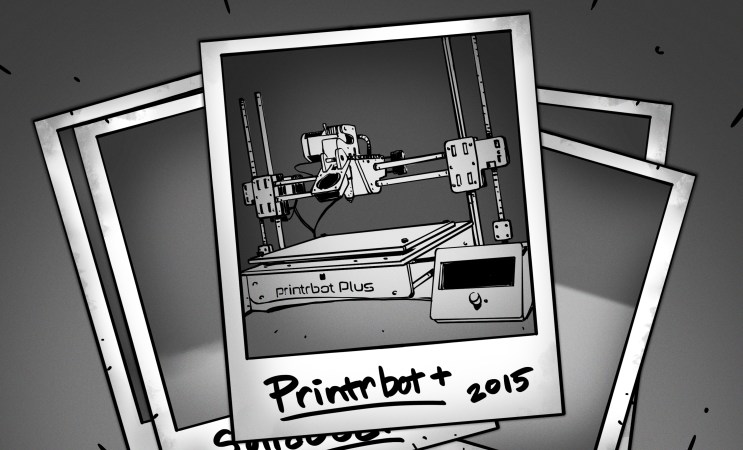
The Teenage Angst Of 3D Printing: Solidoodle, Printrbot, And Bridges

Bridges are a part of our constructed landscape that we take for granted. And bridges by themselves aren’t especially important. What is important is that bridges let you get from one place to another. Technology is often the same. We get from point A to point B through some bridge technology that, probably, most normal people never even notice.

Years ago, point A was commercial 3D printing. Industry had stereolithography, selective laser sintering, fused deposition modeling, and other rapid-prototyping technologies. These were not toys. They were expensive industrial systems used by companies that needed prototypes badly enough to pay serious money for them.

Fast Forward to Today

Today, you can go to a big box store and buy a 3D printer for well under $1,000, and often far less. Modern machines are almost plug-and-play and tend to do all the hard parts for you. That’s point B. How we got between points is a story of hackers who had a dream, and many Hackaday readers lived through it and even played a part in that bridging.

For a long time, RepRap was synonymous with hobby-level 3D printing. The project, started by [Adrian Bowyer] at the University of Bath in 2005, was built around a powerful idea: a machine that could print many of its own parts, thereby helping make more machines. RepRap Darwin reached its early self-replicating milestones in 2008, and the movement produced a thicket of descendants, variants, and arguments about rods, belts, bearings, extruders, firmware, and what “self-replicating” really meant. Of course, the machine could only print some of the parts you needed, but it was still impressive how much of a printer you could make with one printer.

Without RepRap, the desktop 3D printer boom would have looked very different. It created a common pool of ideas: Cartesian frames, printed brackets, hobbed bolts, heated beds, RAMPS boards, Marlin firmware, and a whole common vocabulary. It also created the expectation that a 3D printer was something you could understand, modify, repair, and improve. That expectation would not survive everywhere, but it defined the early culture.

Continue reading “The Teenage Angst Of 3D Printing: Solidoodle, Printrbot, And Bridges”
Restarting 3D Prints

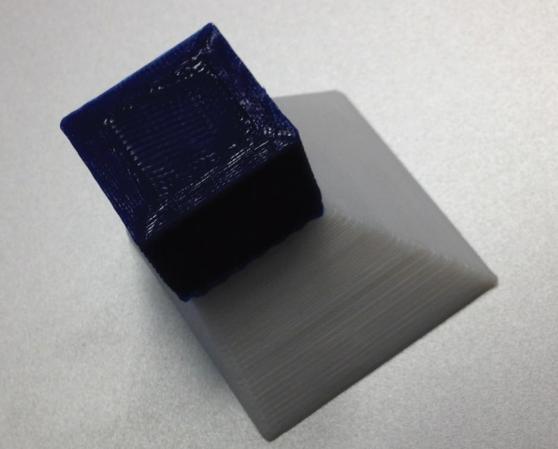
Image of a 3D print which was restarted using a different material

If a 3D printer is interrupted during a print, it will usually result in a junk part. Resuming the print can be very difficult. A group of researchers at MIT have built an add-on for 3D printers that uses a laser scanner to evaluate the state of the print, and allows the printer to restart.

While this will allow you to salvage some partially competed prints, the interesting application is switching between materials. In the image above, the lower piece was printed in ABS. The print was interrupted to change materials, and the top cube was printed in PLA. This allows for prints to mix materials and colors.

The add-on was tested with the Solidoodle 3D printer, and can be built for about $60. It requires a laser mounted to the print head, and a low-cost webcam for performing the measurements. While the group will not be continuing work on this project, they plan to open source their work so others can continue where they’ve left off.

After the break, we have a video of the printer performing a scan and resuming a print.

Continue reading “Restarting 3D Prints”

Print Tasty Treats With MIT’s Ice Cream Printer

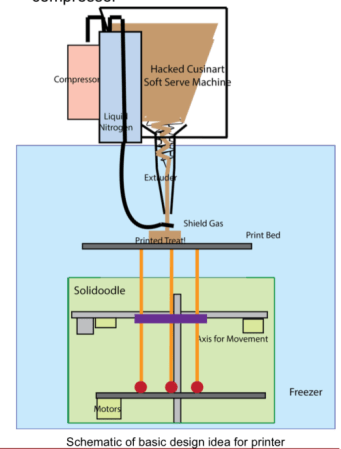
Ice Cream Printer

Three MIT students decided that 3D printers just aren’t interesting enough on their own any more. They wanted to design a new type of printer that would really get young kids engaged. What’s more engaging to children than sugary treats? The team got together to develop a new 3d printer that prints ice cream.

The machine is built around a Solidoodle. The Solidoodle is a manufacturer of “accessible” 3d printers. The printer is enclosed inside of a small freezer to keep things cold during the printing process. On top of the machine is a hacked Cuisinart ice cream maker. The machine also contains a canister of liquid nitrogen. The nitrogen is used to blast the cream as it leaves the print head, keeping it frozen for the 15 minute duration of the print.

It sounds like the team ran into trouble with the ice cream melting, even with the liquid nitrogen added. For a single semester project, this isn’t a bad start. Be sure to watch the clip of the machine running below.

Continue reading “Print Tasty Treats With MIT’s Ice Cream Printer”

Solidoodle, A $500 3d Printer

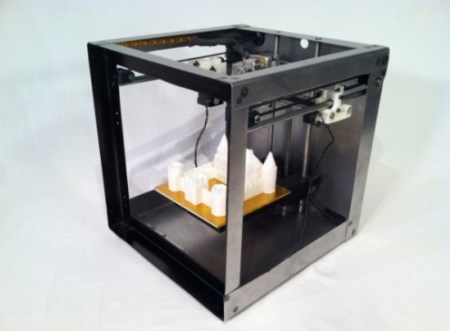
3D printers are very popular right now. We’ve seen them go from an interesting project to multiple commercial entities. Makerbot seems to be the poster child for the commercial side of things, at least they were. Their former COO [Samuel Cervantes] is now in charge of a new company called Solidoodle. Their main product is a complete 3d printing kit for $499. You supply power and a computer.

The Solidoodle is capable of building things 6″x6″x6″. The quality seems to be comparable to most of the others we’ve seen. They tout a .1mm layer thickness in HD mode (makerbot shows .2-.3mm). Not bad considering it is less than 1/3 the price of the makerbot replicator with a single extruder. The video after the shows it in action, as well as both with the optional case and door and without.