
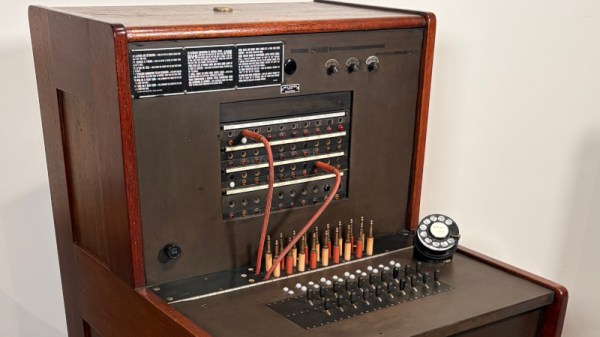
A Switchboard Operator Simulator, On Real Hardware

After having been around computer games since the end of the 1970s, one might think that, to borrow a Who lyric, from Soho down to Brighton, you must have played them all. Games get flashier, have more depth, or longer stories, but substantially they fit into familiar categories. Then along comes [Mark Sidell] with a Western Electric telephone switchboard, and changes all that. We ain’t seen nothing like it, in any amusement hall.

The premise of this game is simple. In front of you is a real 1950s telephone switchboard, and you play the operator at a hotel. Your job is to route calls between guests, hotel-functions, and external lines. There are sixty characters on the line, and 120 scenes played out over the phone.

Behind the scenes is a PC with a multichannel sound card, and perhaps most importantly the switchboard hasn’t been modified. It’s a board with a history, having been used at the Southern California Edison office before being given to its former operator, and then donated to the Connections Museum. It’s thus really unusual in that it retains all of its internal hardware, something frequently removed in decommissioned boards to save weight. There’s a video below which shows it in action, and if you’re like us, we think you’d want to give it a go too.

We like this project for its novelty, its attention to detail, and above all, for its respect of the original hardware. Meanwhile, it’s not the first piece of venerable telephone hardware we’ve brought you.

Continue reading “A Switchboard Operator Simulator, On Real Hardware” →

Retrotechtacular: Basic Telephony In The Field

Here is a great introduction to a practical application of electromagnetic theory—the field telephone. It’s a training film from 1961 that covers the sound-powered, local battery, and common battery systems along with the six basic components they use: generators, ringers, transmitters, receivers, induction coils, and capacitors.

Clear illustrations and smart narration are the hallmarks of these Army training films, and this one begins with a great explanation of generator theory. The phone’s ringer uses electromagnetic attraction and repulsion to do the mechanical work of striking the bells. Similarly, the sound waves generated by a caller’s speech move an armature to create an alternating electrical current that is transmitted and converted back to sound waves on the receiving end.

In the local battery system, the battery pushes pulsating DC to carry the voice transmission. An induction coil increases the capabilities of this system, but capacitors are required to filter out the frequencies that would overload the receiver, passing only the higher speech frequencies.

In order for several stations to communicate, the use of a switchboard is required to patch the calls through. There are many advantages of a common battery system with regard to call switching: no local battery is necessary, nor is a generator needed at each station. Calls are easier to place, and communication is much faster.

Continue reading “Retrotechtacular: Basic Telephony In The Field” →









