No-Drill Sailing Kit For A Canoe

The first known use of humans using wind to perform mechanical work with machines dates back to ninth-century Persian windmills. But if we count sailing vessels among those machines, the history goes back to sometime just before the invention of written language. Since then, humans have been sailing everything from the tiniest of Sunfish to the largest of shipping vessels, and even sailing boats like canoes that aren’t typically designed for efficient sailing. For those who already own a canoe, the conversions can be straightforward but often involve drilling into the hull. This homemade conversion kit, on the other hand, requires no drilling at all.

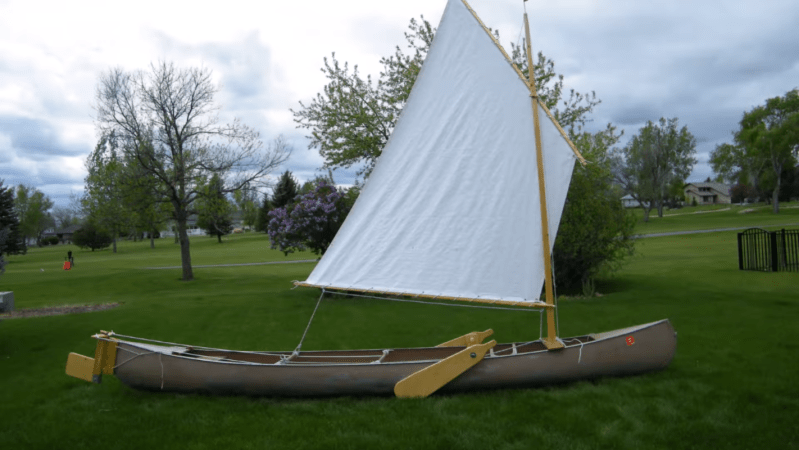
The first, and most obvious, part of the conversion is to add a mast and sail. [Tea]’s primary setup does involve drilling a mast thwart into the gunwales of the canoe, but he also built an alternative setup which clamps to the gunwales and the bow deck instead. The standing lug sail is then hoisted on an unstayed wooden mast. The next major component of the build are a pair of leeboards which also clamp to the gunwales and function like a centerboard, and can be adjusted for one’s preferred amount of weather helm. Rounding out the stern of the boat is a custom-built rudder with a pair of lines in lieu of a tiller which can be positioned anywhere along the length of the boat.

All of the wooden parts of this build were custom-built from common lumber with finishing touches from a router to soften all of the hard edges. Canoe sailing is fairly popular, although without the leeboards these common sailing kits are often meant for downwind sailing only. A complete setup like this turns it into a much more capable craft. Without a canoe as a base vessel to start with, though, a complete sailing vessel can be built from common lumber as well.


Continue reading “No-Drill Sailing Kit For A Canoe”

Man Overboard Systems Aim To Increase Survival Rates At Sea

When you hear the cry of “Man Overboard!” on a ship, it’s an emergency situation. The sea is unkind to those that fall from their vessel, and survival is never guaranteed—even in the most favorable conditions. Raging swell and the dark of night can only make rescue more impossible.

Over the centuries, naval tradition has included techniques to find and recover the person in the water as quickly and safely as possible. These days, though, technology is playing an ever-greater role in such circumstances. Modern man-overboard (MOB) systems are designed to give crews of modern vessels a fighting chance when rescuing those in peril.

Continue reading “Man Overboard Systems Aim To Increase Survival Rates At Sea”

Unmanned Sailboat Traverses The North Atlantic

Sailboats have been traversing the Atlantic Ocean since before 1592, sailing through sunshine, wind, and rain. The one thing that they’ve all had in common has been a captain to pilot the ship across this vast watery expanse, at least until now. A company called Offshore Sensing has sailed an unmanned vessel all the way from Canada to Ireland.

The ship, called the Sailbuoy, attempted the journey last year as well but only made it about halfway before the mission was abandoned. This year, however, the voyage was finally completed, and this craft is officially the first unmanned ship to cross the Atlantic Ocean. The journey took about 80 days using sails and a small set of solar panels to drive the control electronics.

Using this technology, the company can investigate wave activity in specific areas of the ocean without having to send out a manned vessel to install a permanent buoy. The sailbuoy simply uses its autonomy to stay in a particular patch of ocean. There have been other missions that the sailbuoy has been tasked with as well, such as investigating the aftermath of the Deepwater Horizon oil spill in the Gulf of Mexico. With a reliable craft like this, it becomes much easier, safer, and less expensive to explore the ocean’s surface.

Thanks to [Andy] for the tip!

Tracking Ships Using Software-defined Radio (SDR)

tracking-ships-using-sdr

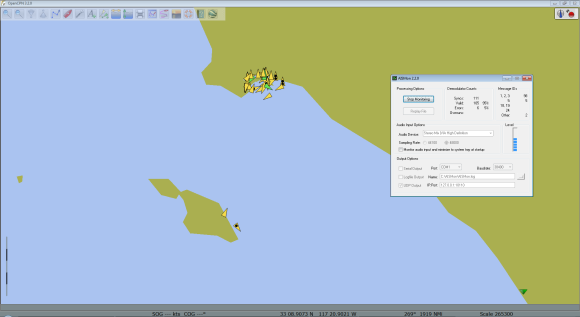
When we first started hearing about software-defined radio hacks (which often use USB dongles that ring it at under $20) we didn’t fully grasp the scope of that flexibility. But now we’ve seen several real-life examples that drive the concept home. For instance, did you know that SDR can be used to track ships? Ships large and small are required by may countries to use an Automatic Identification System (AIS) transponder. The protocol was originally developed to prevent collisions on large ships, but when the cost of the hardware became affordable the system was also brought to smaller vessels.

[Carl] wrote in to share his project (which is linked above). Just like the police scanner project from April this makes use of RTL-SDR in the form of a TV tuner dongle. He uses the SDRSharp software along with a Yagi-UDA. The captured data is then decoded and plotted on a map using ShipPlotter.