Reviving Mystery Nintendo 64 Game Cartridge Found In The Woods

As far as things go that you are likely to find during a relaxing walk in the forest, Nintendo 64 game cartridges probably do not rank high on that list. Yet this is what happened to a friend of [BlueBox Tinkers] a few years back, leaving him dying to see whether the cartridge would still work, as well as what game it is since its labels got obliterated courtesy of its time spent enjoying the outdoors. Fortunately he recently got a chance to see whether he could revive this cartridge.

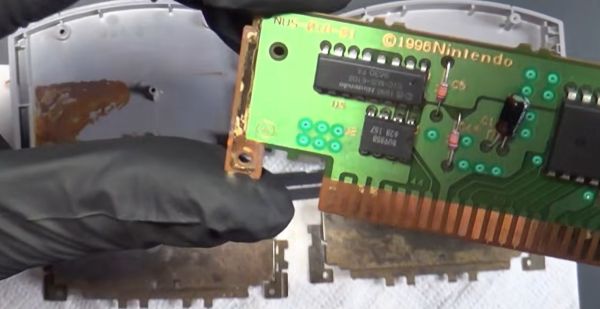
The insides look pretty much like what you’d expect after presumably months or years of exposure, with the metal shield severely corroded. The PCB does however look pretty decent still, with obvious signs of corrosion on the front-side vias, and a pretty gross-looking back side.

Unfortunately it wasn’t confirmed whether this friend tried to stick this old cartridge into an N64 console, but [BlueBox Tinkers] wasn’t going to take any such chances. First up was an inspection and deep cleaning of the PCB, showing that it had escaped real damage, with the shield having taken the brunt of the corrosion. Cleaning up the shield and the insides of the plastic shell is by far the hardest part, with the pitted metal and rust stuck on the plastic. For a full restoration you’d probably want to for a reproduction shell and shield here.

Ultimately the game turned out to still work, with the mystery game sadly fairly predictable, but with someone’s old save files still intact. Somehow it seems that what Nintendo did to make N64 cartridges dust- and child-resistant also makes it survive in the woods, so if you find one during a forest walk, it’s totally worth it to adopt it and take it home.

Continue reading “Reviving Mystery Nintendo 64 Game Cartridge Found In The Woods”
Building The Sanni Cartridge Reader To Back Up And Restore Games And Saves

Game cartridges are generally seen as a read-only medium with the contents as immutable as text chiseled into a granite slab, and with accompanying save files on the cartridge surviving for generations. The unfortunate truth is that as with any media storage, cartridges can and do fail, and save files are often just ethereal bits in battery-backed SRAM. This makes being able to copy not only the game data but also the save files off these cartridges essential. Projects like the Open Source Cartridge Reader by [sanni] make this something that everyone can do.

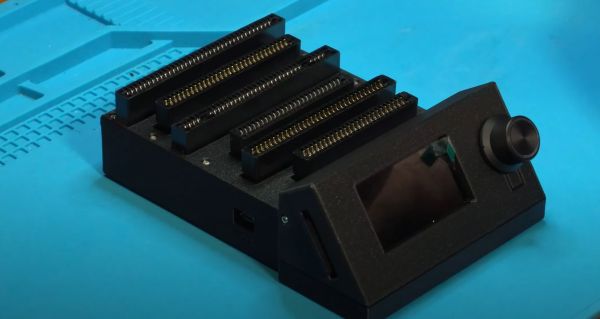
Intended to be a kind of Swiss Army knife of game cartridges, many game systems are supported directly, and many others via (user-created) adapters. A how-to-build tutorial is provided on the project wiki, though anyone interested in building such a system would do well to look at the expected price tag on the BOM page, which comes in at $134. A recent video by [Kytor Industries] (also included below) demonstrates how to assemble one of these systems, including some modding of the preassembled components.

The main components are the Arduino Mega 2560 Pro MCU module, a Makerbase assembly with LCD, control knob, and SD card slot, an SI5351-based clock generator, a PIC12F629 MCU (for snesCIC and handling SNES DRM) and a lot of pin headers and card edge connectors for specific cartridge types. The assembly is rounded off with a surface-mounted GBA card reader and an enclosure.

One important gotcha is that some of these cartridges run on 5V, while others use 3.3V.  N64 cartridges require the dedicated voltage switch to be set to 3.3V, lest 5V gets sent into the unsuspecting cartridge. Once everything is configured properly, the firmware is flashed onto the Mega 2560 Pro module. The Sanni reader is then ready to run. You can use it to dump ROMs onto SD cards, along with dumping and restoring save files and loading ROMs onto new cartridges.

(Thanks to [Roman] for the tip)

Continue reading “Building The Sanni Cartridge Reader To Back Up And Restore Games And Saves”

Jerry Lawson biography

Jerry Lawson And The Fairchild Channel F; Father Of The Video Game Cartridge

The video game console is now a home entertainment hub that pulls in all forms of entertainment via an internet connection, but probably for most readers it was first experienced as an offline device that hooked up to the TV and for which new game software had to be bought as cartridges or for later models, discs. Stepping back through the history of gaming is an unbroken line to the 1970s, but which manufacturer had the first machine whose games could be purchased separately from the console? The answer is not that which first comes to mind, and the story behind its creation doesn’t contain the names you are familiar with today.

The Fairchild Channel F never managed to beat its rival, the Atari 2600, in the hearts of American youngsters so its creator Jerry Lawson isn’t a well-known figure mentioned in the same breath as Atari’s Nolan Bushnell or Apple’s two Steves, but without this now-forgotten console the history of gaming would have been considerably different.

Continue reading “Jerry Lawson And The Fairchild Channel F; Father Of The Video Game Cartridge”