
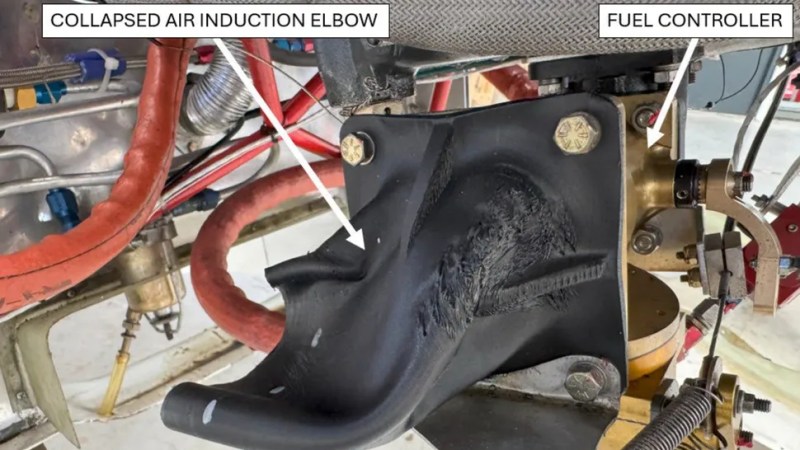
Back in March, a small aircraft in the UK lost engine power while coming in for a landing and crashed. The aircraft was a total loss, but thankfully, the pilot suffered only minor injuries. According to the recently released report by the Air Accidents Investigation Branch, we now know a failed 3D printed part is to blame.
The part in question is a plastic air induction elbow — a curved duct that forms part of the engine’s air intake system. The collapsed part you see in the image above had an air filter attached to its front (towards the left in the image), which had detached and fallen off. Heat from the engine caused the part to soften and collapse, which in turn greatly reduced intake airflow, and therefore available power.

While the cause of the incident is evident enough, there are still some unknowns regarding the part itself. The fact that it was 3D printed isn’t an issue. Additive manufacturing is used effectively in the aviation industry all the time, and it seems the owner of the aircraft purchased the part at an airshow in the USA with no reason to believe anything was awry. So what happened?
The part in question is normally made from laminated fiberglass and epoxy, with a glass transition of 84° C. Glass transition is the temperature at which a material begins to soften, and is usually far below the material’s actual melting point.
When a part is heated at or beyond its glass transition, it doesn’t melt but is no longer “solid” in the normal sense, and may not even be able to support its own weight. It’s the reason some folks pack parts in powdered salt to support them before annealing.
The printed part the owner purchased and installed was understood to be made from CF-ABS, or ABS with carbon fiber. ABS has a glass transition of around 100° C, which should have been plenty for this application. However, the investigation tested two samples taken from the failed part and measured the glass temperature at 52.8°C and 54.0°C, respectively. That’s a far cry from what was expected, and led to part failure from the heat of the engine.
The actual composition of the part in question has not been confirmed, but it sure seems likely that whatever it was made from, it wasn’t ABS. The Light Aircraft Association (LAA) plans to circulate an alert to inspectors regarding 3D printed parts, and the possibility they aren’t made from what they claim to be.












That’s crazy honestly
I’m going to err on the side that the seller was just an enthusiast who designed and printed it themselves but they live in a cold place so the problem never manifested during their own use? Or they’re just not very familiar with material properties of 3D printable plastics?
Glad no one was injured too badly
Smart enough to create a very complex 3D model of that, but stupid enough to use PLA in a high heat environment? A 3D model somehow available on the net then printed by an idiot? The report gives no details other than it was purchased at an airshow in the US and Grok despite extensive searching produces nothing more than found is in the accident report.
Perhaps he grabbed the wrong roll of material and rather than using ABS he ended up using PLA. But in any case if making a part for an engine the part should have been annealed first and at that point it would have been obvious that the wrong material was used. Never buy 3d printed stuff that your life could depend on! Just stick to articulated dragons and you can’t really go wrong!
Printing a part like this in PLA when all your settings are for ABS would never work. ABS prints way hotter than PLA.
unless you have smart 3d printer that reads NFC tag on the roll and reconfigures temperatures automaticaly :-D
Report says the part was purchased. A possible scenario was that the manufacturer made a prototype out of PLA before starting the manufacture in CF-ABS and the parts got mixed up. You should be able to tell the difference between the two, but if the PLA has carbon fibres in it and is the same colour, the only way to tell is through heat testing.
@Darj: “but if the PLA has carbon fibres in it and is the same colour”
If the part printed in PLA was just a prototype and got mixed up… Why would anyone use the expensive type of PLA with carbon fibres in it? If it’s a prototype, only used to check if the dimensions are right, I would use the cheapest PLA I had.
But even then: if I print it in ABS, the plastic is different, the settings are different and I might have to iterate another few times before I get it right.
Also, in the picture, the plastic looks smooth, like it was post-processed. Why smooth it, if it’s just a prototype?
I don’t buy that explanation.
Except that’s not true in the least. We’ve had pla put in our machines when they were configured for PET so the part printed at 280c. It was ugly but the part was basically isotropic.
ABS prints require very different printer settings and an enclosure around the printer to keep the temperatures high enough, and you need to extract the fumes. With filaments with carbon or other fibers you also need a hardened print nozzle, not the standard brass nozzle that works so well with PLA. PLA is much much simpler to print. But even with ABS or a Nylon based filament with carbon or glass fragments you will need to anneal the part to achieve engineering strength for this kind of application.
What happened here is the seller told the customer something that wasnt correct, it was wildly different.
Lol at the idea that asking grok something counts as research.
The Pilot gets a Runner UP Darwin Award.
At this point; I believe this guy should give up building and flying his own planes before he gets Hurt.
His A&P guy is going to get him killed…..
It’s a homebuilt aircraft so the builder/owner isn’t required to use a certified A&P mechanic who is only installing parts that are direct replacement or have a supplemental type certificate (or whatever the UK equivalent of a US STC is called.) But this sort of failure is exactly why certificated aircraft require an A&P and traceability of repair parts. (But there are repair parts out there with forged traceability documentation, and that’s caused plenty of crashes and scandals.)
I am FAA certified flight instructor instrument, A&P, ERAU BS and MS. Taught A&P for many years. It is foolish to use non-tested, non-certified, non-scientifically unqualified parts. Parts for aircraft need to be tested. Your life and others is in danger if you do something stupid. If you are not an a engineer in the appropriate areas and I stress areas, you become a test pilot. Many test pilots have died in research.
If you want to die go do that where no one but yourself can get hurt.
Perhaps the seller just downloaded the model and started to print it. Maybe even considered that “Air intake is cold, right?” followed by “Poly-Carbonish™ looks nice, feels solid, easier to print than ABS, it’ll sell.”
I believe this hypothesis more than the accidental wrong filament in the printer.
There are a lot of crooks out there that will do anything selling 3D printed parts downloaded from the web for a quick buck from a stall at an airshow to be never be traced again.
You’d think that would be a little risky.
I mean, if I was a pilot walking the booths at an airshow and I came upon someone selling garbage that could get me killed, I might engage in some improvised justice.
Bet nobody would have seen a thing.
It’s not like someone selling patches at a biker convention, but it’s close.
Seller could have picked up the wrong filament – one black filament looks a lot like another – but I’ve also heard of filament suppliers marking/re-marking one type of filament as another or selling weird blends that print better and are labelled as the thing they are “most like” but aren’t actually based on them at all, I’m sure one that cropped up recently was a PLA blend re-labelled as PETG.
I can clearly distinguish the PLA from PETG by the smell, the difference would be a lot bigger between ABS and PLA/PETG smell (I’ve never printed ABS but many times melted with soldering iron). And printing PLA/PETG with heated bed of 90-100C will be fun. So the seller in my opinion scammed the customer with all its intent.
Yep. You can’t mix up ABS and PLA at any stage, it prints different, it smells different, it smooths different, and speaking as someone who has printed ABS-CF and PLA-CF enough, are completely distinguishable on the spool. Even automated systems like Bambu’s make it plain when you set up the print; jobs that are sliced and prepped for PLA will flat out block you from using a different filament type that isn’t close enough to your original filament. The non or less automated systems will just fail spectacularly when the bed heats and the first layer goes down. Just ask my Sovol with its encased print head.
Ultimately it is the aircraft owners responsibility to ensure he is installing an airworthy part on his aircraft ! Period !
That glass transition temperature indicates PLA, not ABS with its much higher temperature.
From the report:
“The aircraft owner who installed the modified fuel system stated that the 3D-printed induction elbow was purchased in the USA at an airshow, and he understood from the vendor that it was printed from CF-ABS (carbon fibre – acrylonitrile butadiene styrene) filament material, with a glass transition temperature3 of 105°C.”
CF-PLA filament does exist, but who would have the capability to 3D print such a complex part so professionally based upon its external finish and be stupid enough use PLA in an engine compartment unless it was a mis-marked filament spool?
On second thought about a mismarked filament spool , to successfully print the part with PLA and not ABS, the printer would need to be set for PLA since the print head (hotend) temperature for ABS is much higher than PLA and using PLA at ABS settings would create a mess. So, someone intentionally used PLA.
Maybe they used a printer with NFC tags on the filament spool, causing the printer to use the correct settings for the material? Maybe the part was printed from PLA as a test, and either unknowingly sold as ABS, or the owner of the plane bought this one cheap, knowing it was PLA, but not understanding the implications, or thinking it would be fine because there is a constant flow of cold air through it?
That would prevent the part from overheating, until the throttle is set to idle while the engine compartment is hot.
It could be the sellers fault, the owners fault, or a genuine mistake.
It’s also bad luck. If the engine was a bit hotter, the part would have melt completely (and I guess PLA burns ok in this motor?), freeing the air intake and probably saving the plane.
Maybe I’ve only used dumb printers or something, are there printers that automatically slice a model based on the filament presented?
Slice a model not so much, modify the g-code that tells them the right temperature and extrusion coefficient of the spool they are coming from though isn’t all that strange. NFC style spool ID stuff has been around in 3d Printing for a long long time, but its not all that common.
Yeah, my first printer (it was heavily discounted) had a companion mobile app where you chose or uploaded a model and it would do all the slicing behind the scenes. Mine only “supported” the manufacturer’s PLA, but others have different systems for forcing you to use their first party filaments.
Bambu printers do these days
There very much are. My P1S currently has PLA, PETG and TPU all sat in AMS, and all I have to do to switch between materials is a single keyboard stroke, and the slicer does the rest.
Thanks for the info, everyone.
Not that I’ve seen. You still need to slice it for the filament you intend to use. The Bambu ones do this with NFC tags but it still shows in the slicer that the printer is loaded with what filament.
If the seller thought it was ABS but it was actually PLA then it would have printed terrible with a 100C bed, possible heated chamber (my H2D at work heats the chamber to 65C for ABS), hotter printing temps (250C+ for ABS, 190-210ish for PLA) and no cooling. It would have been a mess and instantly apparent.
If it wasn’t intentional the only thing I can think of is what another commenter said – it was a prototype part made from CF-PLA that got mixed in with the real CF-ABS parts accidentally. This is why you should print your prototypes in a different color than the production parts so they don’t get mixed up.
Then again this is all speculation and nobody except the seller knows for sure what happened here.
Another huge issue that people fail to understand is that plastics don’t have a glass transition temperature. There isn’t a magical temperature where it goes from a pure solid into something that deforms. It’s a range, and this can start 20 degrees lower then the common listed temperatures.
Which makes PLA pretty useless for anything structural.
It could also be outsourced printing to someone who didn’t even know the purpose of the part, but decided to cut some corners.
50-80 and 80-100° C seem like relatively low margins and temperatures for something that requires structural integrity. Why not use something with much higher tolerance? Weight considerations?
It seems crazy that these things could be pushed to their limits by direct sunlight or something as pedestrian as a hairdryer.
I wouldn’t be surprised if original 85°C glass transition temperature was quite pessimistic ex. contaminated batch made by a hungover technician in a hurry on a Monday morning. Besides thermoset polymers may handle operations near GTT differently from thermoplastics. Also fabrics making the bulk of the composite would provide for much higher creep resistance as they would have to either delaminate or slide along which would require quite high force.
This is quite crazy, I love 3d printing and being “cheapo” but this is the extreme combination of smart and dumb. It reminds me the guy that died making his own rocket to see how the earth was flat.
That was the guy who sat on top of a rocket shaped giant kettle and was grifting the flerfers wasn’t it?
Read this a few days ago, I’m wondering if the part was designed and sent with bad specs to some commercial 3D print service or the service cheaped out on material
Report: “A review of the design of the laminated induction elbow in the Cozy Mk IV plans showed
that it featured a section of thin-walled aluminium tube at the inlet end of the elbow, where
the air filter is attached. The aluminium tube provides a degree of temperature-insensitive
structural support for the inlet end of the elbow. The 3D-printed induction elbow on G-BYLZ
did not include a similar section of aluminium tube at the inlet end.”
So we have a different construction that does not match the idea behind the function of the laminated epoxy part.
Correct! Most cars have a plated steel insert or aluminum insert in the end of the tube, which supports the tube when an air filter is installed or the tube has to make a transition to a silicon boot for ducting and assembly reasons.
A lesson for many in this.
Take great care!
One thing is for sure;
You can tell who does their homework and who doesn’t.
It’s the Pilot’s fault, time to hang it up Dude before you get yourself killed and take someone else with you.
And how are you supposed to non-destructively test a part for your light aircraft in the hanger? If it looks and feels right, which I’d bet it did, and no published specs point to it being flawed…
Really can’t blame the pilot or aircraft maintainer if the part is replaced with a in theory perfectly valid part by specification that happens to be either a dud or intensional cheaping out by the vendor/manufacturer. Its only their fault if they knowingly fit a substandard part, which might be the case, but doesn’t seem to be.
“”The part in question is normally made from laminated fiberglass and epoxy, with a glass transition of 84° C. “”
There is a big difference between the glass reinforced part and one printed out of crap plastic.
All I have to say; you have to be highly inexperienced to not be able to tell the difference.
It is still the pilot’s fault, as it seems he maintained the plain himself.
Just because there is a way that part has often been made doesn’t make a functionally valid substitution and invalid choice.
Which ABS-CF filament construction should be – might well actually be better than the ‘normal’ construction for the job, not like you are replacing that classic car’s asbestos brake parts with fresh asbestos….
Unless of course for regulatory reasons you must use 1:1 certified parts of something.
Well, with 3D Printing you can test destructively. Making multiples of something is very simple.
But knowing how to test and what lessons to draw from that, that’s non trivial.
Anyway, I have a hard time seeing how to be certain a 3D printed part is good in a critical temperature and pressure situation, with a hobby setup. Layer adhesion can differ bases on too many factors. You add more items to a plate and that alone changes things… timing on how layers stack. Colder lower layer vs hotter lower layer, will bond differently.
There I agree, except in this case the vendor is the one with the ability to test destructively, and you’d have to hope have done so – its not the pilot/maintainer that fitted a part that should be suitable to blame as they don’t have option to test destructively and just make another however many times it takes.
This is why so many of us in the comment section get irritated about misuse of 3d printing and especially PLA. Of course we’re usually overturning our chicken tendies over some fool ground-based contraption that has minimal safety implications, but we’re imagining “what if our engineering mattered?” when we get so excited about poor choices.
I understand doing it on your own airplane. If you have an experimental certificate. This looks like a Rutan kit plane so i imagine it qualifies. But printing something for resale for someone else’s airplane! That’s ballsy and clearly wrong. The liability is epic. There’s an unambiguous tort claim here for tens of thousands of dollars. I’d be curious to know where the mistake was made but once you’re offering it for resale, you own that mistake.
The Long EZ has a poor safety record even without this sort of thing, RIP John Denver, among others. This was a pretty minor crash, the pilot was lucky. 3d printed parts in an experimental airplane are technically fine, but in the engine compartment? For something as important as this I don’t know man. That was definitely the wrong resin. I’d say unless you do testing on every single roll of filament, maybe even the the seller of the thing didn’t know what it was made out of.
The report has lots of interesting information, worth a read:
This was not a Long EZ but a Cozy Mk IV airplane (a 4-seater version of the 2-seater Long EZ).
The elbow in question was part of an overall modification done to replace the engine’s throttle body fuel injector with a mechanical fuel (meaning, not part of the original design)
The pilot/builder had purchased the part at an airshow, and understood from the vendor that the part was printed in ABS-CF
It’s been a long time since I read John Denver’s accident report but it was not a result of an inherent design fault of the Long EZ, but a combination of multiple issues (I’m quoting from memory here):
That Long EZ was fitted with a non-standard fuel tank switch mechanism (positioned in a different location). I think also the airplane as-built was lacking fuel level sensors and instead relied on some see-through viewports into the fuel tanks.
John Denver was not truly familiar with the airplane (I believe that was his first trip on it), including fuel consumption, emergency procedures, etc
As a result, he wrongly believed he had enough fuel and decided to not load additional gas in his last stop
Eventually, he run out of gas over the ocean, and when tried to switch to the other fuel tank, found that it was also empty
Yeah the holistic approach to safety means we aren’t just looking at “design flaws”, but systemic flaws. The vari-ez / long-ez / variants are numerous enough that pilots are getting ahold of them who aren’t really well-positioned to operate an experimental aircraft. And they are each a little bit different from eachother so there’s little “type familiarity” among the scattered pilot population. These basically social and economic factors are what killed Denver, and are an inherent safety flaw in popular kit-built aircraft even if they aren’t a “design flaw.” Sometimes, problems emerge that just can’t be solved by the designer.
There’s a lot of room for debate over terminology but there’s no denying that popular kit airplanes in general have a lousey safety record, and the EZ planes (being among the most popular) have a significant number of mishaps.
Actually, it’s thought that, as the tanks expired he tried to turn the tank switch, which was in a non plans location, somewhere over his left shoulder. As he did that, he involuntarily stomped in the rudder and spun the plane.
Also, at the time, Denver’s license to fly had been revoked as a result of his alcohol addiction.
Please stop with the lack of evidence saying kit planes have a lousy safety record.
It is just not true!
what_kills_us.pdf https://share.google/naOAe1915mZypxfBW
There are a couple designs that require an experienced pilot because they are high performance. Kit builders lose skills while building because they are building and not flying.
Builder error accounts for about 5% of the accidents, maintenance errors is another 5%. These have nothing or very little to do with the design. Like factory built aircraft, pilot decision making is the biggest cause of accidents.
Please use documentation before saying bad things about anything. We all try or best everyday to scratch an itch, building electronics or airplanes. It is all about risk management.
You assert the fact isn’t true (but it is), and then you explain the fact by assigning blame. In apologia it’s essential to pick one of these two tactics and not try to pursue both at once.
Pilot decision making is indeed the number one cause of the lousey safety record of kit built aircraft.
Well, sir, you have an excellent memory. It was just purchased the afternoon of his crash. Compounded error on his part was no thorough preflight and just a few feet above the swells. He was a deadman from engine start, sad to say.
Long EZ is typically powered by a bug motor.
Cozy is powered by a Lycoming 360, a purpose built airplane engine.
Would do a great job in a bug, but $$$ (and updraft intake on bottom), even for an expired one. LS-6 much cheaper. Plaid Tesla drive much cheaper. Digressing…
The first, no doubt, has custom engine parts, to make it work.
The second has available, expensive parts w FAA papers.
Newer LongEZs might have Subaru motors, don’t know. Same point stands.
Available certified parts make this even more on the pilot and his wrench.
He didn’t even run the modified engine up to power for a few minutes on the ground first.
I do better when I fix my GD push mower (powered by rat!)
The Rutan designs have an excellent safety record compared to many other homebuilt designs.
The big failure mode is not following plans, which you are allowed to do. It is experimental aviation, it says so on the airplane!
There is a safety margin in the design because not all builders are perfect.
For my authority check my email address. Yes, I built one of these planes. Every time I decorated from the plans, I asked myself “how might this kill me”.
It looks like PLA. ABS should’ve stood up fine, I print ABS engine parts all the time.
That’s insane that anyone would put PLA near any major heat source. Its predictable that it would soften and fail
This is the issue with hobbyists and uncontrolled modifications. In civil passenger carrying engine applications we are required to certify the components with endurance and cyclic testing. This isnt the case in this type of aviation and a blase attitude to BoM control and conformity means these accidents are just waiting to happen.
Proof print for fit. They probably printed it in a similar color as their production prints and somebody packaged and sold it as a finished part.
Never do that. They should be using a high contrast color for prototype/fit parts, and only use production colors for production parts.
(And it wouldn’t be hard to embed some 3D elements to tag such prints.)
I am sure that, as with counterfit money, after suposedly handling “proper” 3D printed parts, you should be able to feel that this PLA test is different (weight, texture, the way it flexes and sounds, etc).
If its CF filled I doubt you’d be able to tell the difference without real lab tools without a both materials in hand at the same time – printer setting, print geometry etc all make such a different to the texture and density of a part that its only with the cad model and slicer settings to calculate the correct mass or that direct A-B comparison you’d have much hope of feeling the difference between stiff CF filled slightly textured plastics.
If that exact same part from exactly the same supplier is noticeably different from a ‘genuine’ version of the part with experience maybe, but nobody is handling hundreds of ‘identical’ parts for an aircraft like this one…
I mean, the easiest way to check is to heat it up in a controlled environment to 85-90C. If it starts getting melty and collapsing on you, it’s not CF filled ABS.
That wouldn’t be a great test without a lab grade oven IMO – too many variables to how even the heat would spread, the potential for the PLA to be annealed enough that drives its softening point up, along with the fact most heaters are just not that precisely temperature controlled so thermal degradation of an originally safe part might occur even though the temperature setting is supposed to be fine…
The test in theory isn’t a terrible idea, but unless you are a composites workshop or something to really have that relatively tightly temperature controlled oven with good even heating I think you’d have to call it destructive testing and not test the part you actually fitted.
I dunno why I can’t reply directly to your other comment replying to me, but the button isn’t there so I’m replying here.
A NIST traceable calibrated thermometer with +/-1C accuracy up to 120C can be had for $130, pair that with a convection oven, adjust oven temp until thermometer reads steady state of w/e, and then throw the part in there. The air flow from the convection fan provides a much more even temperature, and thermometer gives you accurate temperature. Set the temp to 70C-75C, let the part come up to temp (stick a calibrated thermocouple on it if you want to be really accurate), then give it a poke (with a tool of some sort, not your finger). PLA and PETG will almost certainly deform, even if annealed, ABS shouldn’t.
That said, I remembered an even easier way to check if a part is actually ABS/ASA based: acetone. Put a little acetone on a paper towel or rag, put that on the part in an inconspicuous part of the print, and give it a bit of a rub. ABS and ASA will become sticky/soft/melty almost immediately, PETG and Nylon won’t/shouldn’t at all, and, depending on the blend, PLA will require significantly more time before melting, if it melts at all.
A good thermometer would help dial in and at least let you log if the temperatures at the test point of the thermometer get problematic but it doesn’t fix the temperature regulation and distribution – fan assisted is better at even heating though less effective when the oven is so full of part as it would be here. But either way your domestic oven just isn’t that accurate at holding the temperature setting as a rule – really no need for it to be (though just how bad your particular example is no doubt hugely varied).
Has no one mentioned the filament supplier? ABS-CF is $50 to $120 per kg while PLA is $20 to $25 per kg. Very tempting for filament suppliers to mislabel and get a nice premium.
However, shame on both the part printer/provider and the buyer to not verify.
Assuming that this was the cause.
Lots of other possibilities too, including an extremely overheated engine, unidentified damage to the part affecting the CF, etc. pretty sure if you compress ABS-CF in the wrong way, you lose fibre integrity.
Just not enough to know but honestly, buy a part at a show and put it in your dishwasher? Sure. In your car? Maybe. In your plane? Fugedabotit.
It’d be hard for me to put a 3d printed part in the dishwasher either, since i know it gets hot and if it fails it’ll potentially flood my house. Lower stakes than an airplane but i’m still paranoid about it. :)
I’m not sure if you’ve ever 3D printed anything but ABS wound print with PLA settings and vice versa. It’ll quickly be apparent something is wrong a little way though the print.
And where else would you find the the right sort of parts for your odd hobby/device but at a gathering filled with the right experienced white good/classic car/aircraft people – if you bought a part for your aircraft off me at a model railway show you are fool, or know I’m an aero engineer or something and this was just the easy place to make the exchange – better be a darn good reason to trust it. But if you buy that same part from me, likely with my own aircraft with similar/identical part fitted and even flying at a meeting of aviators….
Worried about a new part, especially if its a new part construction method I can get, but at some point you have to use what you can get and trust the vendors to actually sell you what they claim – not like even the biggest names in the industry never make a mistake, or end up without knock off lower grade copies of parts entering the chain somewhere… Can’t trust it just because it says Boeing on the box!
This is a fine attitude for you to have and i don’t mind much that you might fly over my house someday. There is luckily a lot of empty space around me that you’re more likely to crash into than my small house!
But this attitude is frankly wrong and completely incompatible with good airmanship. “Where else would I get this part?” is fundamentally not part of the safe aviation formula. If you have the choice between getting the part at the wrong place, and not getting the part at all, YOU DO NOT GET THE PART AND YOU DO NOT FLY THE AIRPLANE. This is drilled into everyone at flight training and licensing. Every pilot takes an oath to decide not to fly if he cannot fly safely.
Sure, they violate this principle all the time. But it’s the only correct principle according to the FAA. Taking off is optional, landing isn’t.
“Sure, they violate this principle all the time. But it’s the only correct principle according to the FAA.”
This is a religious argument: even knowing the consequences of sin, they still sin.
The obvious implication is that individual humans cannot be trusted to follow the rules without deviation even if they take an oath to be compliant. This human nature is why governments continue to make rules/laws more restrictive as violations become part of the accident review data. Arguments that the “bad eggs” are but a small percentage of the total will not sway authorities when accidents create highly visible catastrophies.
Philosophical opinion aside, building and flying an Experimental Aircraft is a privilege and there is a personal responsibility to ensure safety at all levels and all times. However, from personal experience, some pilots view these machines no differently as I did my motorcycle back in my youth.
The wages of sin are death!
But after they take out taxes all you get is a tired feeling.
So what is the ‘right place’ in this instance?
Given even the massive aerospace names and their sub contractors mess up from time to time and these smaller hobby aircraft might well need parts that haven’t been made on the original “official, certified safe” production line for 40years, and for age reasons a New Old Stock if you could find it may well be definitively unsafe…
You need a replacement, you source a replacement that should be safe from a place surrounded by people that should know, and quite possibly with a working example of the part that actually flew into the show, might even be actively flying during the show… Way more likely to be safe than hiring a guy like me with the prototyping shop that could make the part just fine to make the part to the “original spec” based on no doubt incomplete documentation of how the original was made.
(obviously I don’t know the exact situation of this purchase, maybe there were warning signs that shouldn’t but were ignored. But fundamentally the material its supposed to be made of and design of the part appears to be very much adequate, and short of destructive testing to find it is flawed you’d expect probably should have similar if not larger safety margins than the ‘original’ part).
This is gonna seem like a nit to you because you’re fundamentally opposed to understanding safe aviation practices but: You WANT a replacement. You don’t NEED a replacement. Taking off is optional. The replacement is optional. The airplane is optional. Only once that is accepted can correct decision making possibly follow.
The “should know” appeal to authority in safe aviation is rigid. It’s been tested or it hasn’t. This hadn’t been. It’s been certified or it hasn’t. This hadn’t been. It’s good enough or it isn’t. This wasn’t.
Buying an uncertified and untested part means that you don’t know if it’s fit for purpose or not. You don’t even have the appeal to authority that you assumed. You have to test it. This pilot chose to test it in flight. Bonehead mistake.
Sometimes it’s hard to do the right thing. The comprehensive test regimen I would want to subject this part to would be difficult for an individual without a lab, especially to perform non-destructively. C’EST LA VIE! Experimental aviation isn’t easy. The easy choice in experimental aviation is often the deadly choice.
No I’m not, I just realist enough to know that 100% safe is always a lie, and curious as where you’d consider ‘the right place’!
As even if you are flying something with a huge parts market so you can buy straight from the original manufacturer you will end up with a dud sometimes, damaged in shipping, install, or right from the production line in ways that didn’t get caught all happen even with the biggest players in the industry!
Also have to disagree with “The replacement is optional. The airplane is optional.” as while that might be true no doubt a great many aircraft are not optional to their operators. So getting a part that on paper should be good, quite possibly after seeing one that has flown many many hours to be there….
For certified aircraft, there are certified components, certified vendors, certified installation procedures, certified validation procedures, certified technicians. It’s not perfect but it’s also not something that comments forum people need to reinvent from first principles.
As for people who consider their airplane to not be optional. They are bad aviators, full stop. They are often written up in gory detail in NTSB mishap reports. “Get-there-itis” — when a trip/destination is seen as non-optional — is a well known cause of death.
Great, but not at all applicable to this case or many others it seems. What should this guy have done differently is the question! Not what would/should/could you do if you are flying the something else entirely…
Or it is their darn livelyhood, and if they can’t fly they won’t eat (eventually anyway), and quite possibly something their customers really rely on too. I’m certainly not advocating for being reckless even then, but if your choice is able to fly with a part that should be a perfectly good substitution or put yourself and your customers in hardship…
Dang, Foldi, you just can’t let go of being wrong. TAKING OFF IS OPTIONAL. That’s not my radical personal take. That’s airmanship 101. Flying-for-hire is not the exception to the rule but rather the case where this rule is most iron-clad. I’m giving you an axiom that you somehow don’t know about because you’re not an aviation buff. You can argue with an axiom but only at the cost of being wrong.
Prices have come down a lot, and with sales you can get glass or carbon filled ABS for pretty cheap. A 1kg roll of ABS-GF is only $24 from Bambu right now, with an advertised heat deflection temp of 99C and Vicat softening temp of 103C. ASA-CF from them is $29.59 per kilo, with an advertised heat deflection temp of 110C and Vicat softening temp of 108C. PA6-GF or PA6-CF is definitely still in that $45-$70 per kilo range though, and is probably a better option for an air intake/intake manifold anyway.
I see a lot of back and forth if it’s the supplier or the pilot’s fault. Here’s the biggest question in my mind: Is there a better way besides “heat until failure & note temperature” to distinguish between plastic types? Because walking up to vendors with a battery powered heat gun (if such a thing even exists) doesn’t seem like a great plan. Because maybe my purchase won’t make my plane fall out the air if it’s wrong, but it’ll ruin my day in another less dramatic way.
FWIW, when it was printing, they could smell the difference between ABS and PLA.
Can always use a battery powered soldering iron like a pinecil or ts100 to do a spot test.
Everyone seems to forget about how acetone softens ABS and ASA and not PLA/PETG (has acetone smoothing been that forgotten?). Just take a acetoned-rag and wipe the plastic in question.
Bonus points if the surface didn’t dry right and got a white haze that vanishes if you “pour” some acetone vapor from a bottle.
That should probably be considered destructive testing in this case…
Would verify the plastic, probably anyway – with CF infill I wonder if the result would actually look rather similar even with plastics that are not very soluble in acetone – not something I’ve ever tried, not even tried solvent welding CF filled stuff as straight ABS as a rule is fine for my needs. But all those chopped fibres may well disguise the effect of so small a solvent dose on the surface.
Either way though deliberately dissolving a crucial part even slightly just to prove it is what it claims to be…
A part that crucial should have been made from cast aluminum or machine made, 3d printed plastic does not belong near a hot engine
Absolutely, I would never trust a 3D printed part, no matter what material for such a critical component.
Aluminum machining is easily available from multiple places and it is not that expensive, when you compare it to the price of a crashed plane and possible deaths.
There is a huge volume of usually ABS around most modern car engines – all those stupid ‘make it look pretty’ panels, and for direct comparison to this situation the air intakes are very often entirely plastic you could print…
The concept isn’t a real problem, and plastics (by they printed or epoxy and fibres) can be a great material to choose being cheaper to form into complex shapes. It is just the execution in this example that is flawed, and it would seem largely if not entirely because the wrong plastic was used.
My inner engineer screams, “if the original part was made from fiberglass, why abandon reinforced materials for the replacement part when composite 3D printers already exist?” I know they are more expensive, but “amateur hour” has its costs too. I hesitate to suggest more regulation. The experimental aircraft community is made up of serious people who can take care of themselves, but the advent of 3D printing does cry for 1) new self-imposed standards, 2) as-build documentation (e.g. start by writing down specs from the filament reel), and 3) better product testing by “cottage manufacturers” of aircraft parts. This incident might have been prevented by “an extra set of eyeballs” (e.g. peer review by a materials engineer). I am certainly grateful to my own friends who keep me from making stupid mistakes. Fortunately my hobbies would only threaten to burn down my house if I’m not careful enough.
I’ve been prototyping 3D prints since around 2012, it’s become rare for a major brand to sell you straight ABS as they really don’t want returns from failed prints because of how hard it is to print on consumer machines. Much like PETG to PET, seemingly very different but much of the PLA and ABS come with modifiers that can have significant mechanical differences. I have to retest the same filament brand’s ABS every year to make sure its still the same stuff. At this point I can smell the difference between ABS, PC, nylon, etc and when they don’t smell the way they should
I mean, not a critical part but I’ve had 2 GM vehicles (a 1988 Buick Century and my 2012 Cruze) where ridiculously the glue used on the hood ornament is not high temperature enough, they both had the glue melt and the logo insert fall off in hot weather. The 1988 I’m like ‘meh late malaise era’ but I would have thought they used better glue in the intervening 24 years.
I’m just saying apparently even a big manufacturer will use inappropriate materials occasionally.
I often print test parts in PLA because it’s faster and usually less headache. Once I am happy with the fit, I print the final part in ABS. I could see how finals parts may have gotten mixed up with a test part. Very unfortunate situation. Glad nobody was hurt.
You need to print in different colors if you make test parts for critical components. Also devise a theoretically non-destructive way to test, if it does not pass it does not sell.
Well call me old fashioned, If you cannot buy the original OEM part, and have a 3d sketch, bring it to a machinist and ask them to make one from aluminum or stainless, will last forever, you flight on that thing damnit…
I pretty much agree. This would cost a couple hundred if made from curved tube and a metal plate. I don’t know how they certify the welds, but even casting it from aluminum is a great option, you can use a 3d printed plastic to make a sand mold.
I think the terminology of the report and this article is a little confused.
Glass transition temperature in polymers is mostly an academic property and doesn’t mean anything with respect to determining how it will handle heat. Nylon 66, for instance, is more heat resistant than PLA but has a lower glass transition temperature than PLA. What you need to look at is instead Heat Deflection Temperature at some reference pressure. For instance, Nylon 66 has a heat deflection temperature of ~180C at 0.46 MPa but a glass transition temperature of only ~50C. Meanwhile PLA has a higher glass transition of ~60C but a heat deflection at 0.46MPa of only 53C.
I’m sure what you’ve said is entirely accurate, but is it pertinent? The print causing the accident here wasn’t under any external load, certainly nothing like 0.46MPa. It collapsed under its own weight.
Does it change that most likely the wrong plastic was used and melted? No, of course not. I don’t disagree with the conclusion of the report but if you’re trying to get to the root cause as to why something happened, using accurate terminology in an investigative report is important. Using a term that signals a common misconception about plastics in a report and providing no details as to the testing methodology in the report doesn’t boost confidence.
It collapsed due to the lower air pressure inside the tube. The suction produced by the engine breathing in through the air filter creates a vacuum inside the intake tube. The pressure drop across an air filter in an airplane engine at full throttle can be 1″ to 2″ of mercury, which equates to about 0.5 to 1.0 PSI (about 3.4 to 6.8 KPa).
Interesting that you read it that way around. I read it that the air filter fell out first and that caused the lack of structure that caused the collapse due to gravity.
Obviously neither case should happen, and equally obviously either case can happen with softened plastic.
Man the amount of people in here who have no idea what they are saying and are arrogant is hilarious. Your not going to “feel” the difference between abs cf and pla unless your extremely versed in 3d printing. You guys are blaming a pilot who probably never felt a 3d print at all. Not to mention this falls squarely on the seller. You dont build parts like that without doing your own testing. You’d test each and every role regardless of material.
This may also be a case of wrong application for 3d printing. From the looks of that part an off the shelf Aluminum or Stainless elbow welded to a laser or plasma cut plate would have worked wonderfully. Aside from FAA certified welds being expensive it would also probably be cheaper.
It’s not that I don’t trust 3D printed parts, it’s just I do not trust them bolted to combustion engine in an automobile, let alone a plane.
Good news, any more of these and the FAA will jump in with certification requirements and we can all go back to using metal. Bare minimum I would expect the material source to be certified and actual heat tests performed on the part. At least tracked by a number so one failure can trigger a recall.
While “additive manufacturing is used in aviation all the time” may be true – in general additive manufacturing is prohibited for (US) Government contracting.
Still, I’ll agree with the consensus of the group, and as an experimental aircraft builder, that “just because you can, doesn’t mean you should”.
My pilot training was in gliders exclusively, although I’ve flown SEL a bunch with friends.
So every landing I do is a no go-arounds possible landing, and for me (and the whole community) it is perfectly safe. In casual inspection of SEL pilot training, “dead stick” or engine failure training definitely is a thing. Soooo regardless of why some garbage part failed, why did this pilot wreck the aircraft so badly? Can an SEL shed some light on that? Maybe cannot feather prop and huge drag causing controllability issues?
A cozy isn’t really suited for off field landings (small wheels, and brittle nose gear).
The pilot tried to make the field, but came up short.
More details on the design at:
Marc J. Zeitlin’s UNOFFICIAL “COZY” Web Page https://share.google/qrUwOOoS7xi8KPhW
I know the internet is mainly for pronouncements about what an evil fool everyone else is, and I wouldn’t have it any other way. But what if there’s an even better way to process stories like this?
There might well be someone in the supply chain who we could all pile on here. But if you set out to identify the asshole, you rule out the most useful question, which is how you could make a similar mistake.
Great take.
You may be talking about root cause analysis. A lot of research (Toyota? 70’s?) figured out if blame one asshole he goes home feeling like shit and nothing changes. But if you look at the systems and why the error/mistake/near miss happened and assume that dude didn’t show up to work to royally F-up, you can look at the systems and institute systems change to prevent future problems and avoid blaming one dude.
Here- I’m certain he didn’t intend to crash an airplane. But looking at the systems that allowed a 3d printed part to fail could lead to process that prevents this in the future and does not dismiss this as “what a moron”
For a horrible moment I thought this was going to be Justin from The Fabrication Series but his screw up was only cosmetic and the clever 3D printed section of this was from stainless – it’s very cool that this sort of thing is possible now:
https://www.youtube.com/watch?v=5fNzZT17SEs
It’s almost HaD worthy although I’m sure people would say it’s not a hack, his videos are always great – informative and honest.
Stupid amateurs and stupid PLA. PLA is garbage, suitable only for childish starwars junk and tugboats. Don’t buy PLA. Don’t print with PLA. EVER. If you’re teaching someone how to use a 3D printer, don’t show them how to use PLA. Tell them to NEVER use PLA. PLA will only disappear when people stop buying the stuff.
PLA is a perfectly valid plastic for a great many things, a rant like that isn’t going to be helpful. What would be is a rational explanation to them of why you might want to use TPU/ABS/PET/PLA/etc and when you shouldn’t.
I’d suggest for 99.99% of things folks print even into the engineering spaces while ABS (Etc) might be technically slightly better, PLA is perfectly adequate and much easier to print with, and also makes a good support material if you have multi-material printing capabilities etc.
We shouldn’t want PLA to go away, even though I don’t really use it either, as it is cheap, more biodegradable, easy to use and good enough for so many things. Ban PLA and the price of the filaments I want to use would have to increase 20x? 40x? maybe 200x? to make up for the demand.
It is possible that the ABS composed of non virgin materials, that is to say “recycled” material.
Non virgin materials are completely unreliable and, in my humble opinion should be banned!
An potential problem are assorted easy print ABS formulas. They reduce warping by introducing other polymers into the mix. Which leads to somewhat lower Vicar temp, but sometimes significantly reduced HDT values, the latter being deformation under stress.
Gets worse if you only read the data sheet – it indicates higher temperature tolerance. Because the test reads the deformation within a short time frame. CF stiffness helps the metric, but doesn’t stop creep above a certain temperature. It just slows it down. Bad for parts under long term load near an engine.