
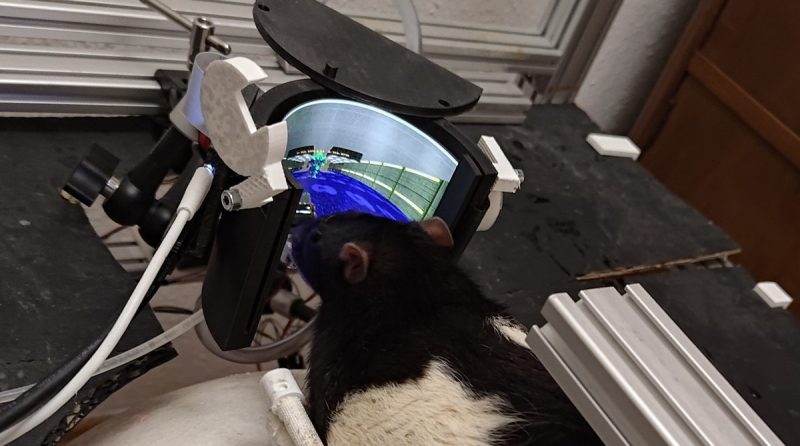
We all know that you can play DOOM on nearly anything, but what about the lesser known work being done to let other species get in on the action? For ages now, our rodent friends haven’t been able to play the 1993 masterpiece, but [Viktor Tóth] and colleagues have been working hard to fix this unfortunate oversight.
If you’ve got the feeling this isn’t the first time you’ve read about rats attempting to slay demons, it’s probably because [Victor] has been working on this mission for years now — with a previous attempt succeeding in allowing rats to navigate the DOOM landscape. Getting the rodents to actually play through the game properly has proved slightly more difficult, however.
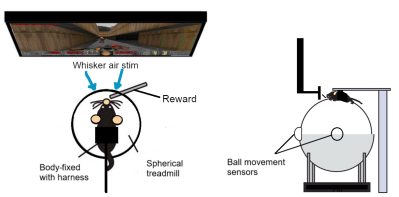
Improving on the previous attempt, V2 has the capability to allow rats to traverse through levels, be immersed in the virtual world with a panoramic screen, and take out enemies. Rewards are given to successful behaviors in the form of sugar water through a solenoid powered dispenser.
While this current system looks promising, the rats haven’t gotten too far though the game due to time constraints. But they’ve managed to travel through the levels and shoot, which is still pretty impressive for rodents.
DOOM has been an indicator of just how far we can take technology for decades. While this particular project has taken the meme into a slightly different direction, there are always surprises. You can even play DOOM in KiCad when you’re tired of using it to design PCBs.












Teaching rats to play Doom? You want a Planet of the Rodents? Cause this is how you get a Planet of the Rodents!
❤️
Might as well. They can’t do worse than humans have been doing.
And i thought than only rats were playing DOOM… I´m surprised other species too !
What is the short term memory of a rat? What is their long term memory like?
For people it’s about 2 minutes – that’s about as far as your present “now” extends. You can’t really remember any feeling or motivation beyond that, which is why you may walk into a room and forget why you went there.
The illusion of continuous thought comes from the fact that we’re very good at reasoning from circumstances. Most thinking is “opportunistic”. I.e. we’re driving along a road, why are we driving, we’re going to the store…. okay, we’re driving along the road, why are we driving, we’re going to the store… etc. Every two minutes, give or take. We’re constantly forgetting what’s happening and re-constructing it out of the scraps of memory and the circumstances we have, with a tiny bit of long term memory to help us keep focus.
There are people for whom long term memory no longer works, and they’re stuck in the present two minute loop forever. They’re sitting in a hospital asking the nurses every two minutes, “Why am I here?”, and they just keep resetting. They can learn new skills, like playing the piano, but they can’t remember doing it. They just live two minutes at a time and don’t know anything about the rest of it.
I wonder if that’s the same thing for the rats, which don’t have the brain capacity to experience much more than what their short term memory provides. Not in much detail anyhow.
agitated christopher nolan noises
“For people it’s about 2 minutes – that’s about as far as your present “now” extends”
Speak for yourself dude
i am pretty sure you are selling our rat friends short. a little long-term memory is easy to include in a rat’s capacity and would serve her well evolutionarily
As someone who got brain injury and long term memory was spotty (until I got better and all of a sudden actually remembered most of it), at least for me it was very easy. I never got bored. Laying a couple of minutes in bed just relaxing wasn’t hard, and since memory didn’t work, it was always a couple of minutes. I had no real feeling of time passing. I got to the toilet when I needed. Ate when I needed. When it got dark outside it went to sleep.
The main issue was things like microwaving food. I got hungry and decided to microwave something, walked out into the kitchen and see an open container of food sitting in front of the microwave. Huh. That’s strange. Open the microwave and there is another in there slightly luke warm. Huh. Apparently I had done that a couple of times, but wasn’t quick enough to take it out after the ‘ping’ that I didn’t remember it. I decided to eat the luke warm instead of repeating it, and put the opened in the refrigerator until next meal. Oh there already is two there.
But it was all good, because while eating I had forgotten all about it anyway, and no I was no longer hungry.
The issue was when my memory started to function slightly more, and I did remember most of it, and did feel time slowly pass, but at least I’m much better and more functioning today.
Its said that brain size is mostly related to amount of muscles to control..
“There are people for whom long term memory no longer works, and they’re stuck in the present two minute loop forever.”
If you take two people like that and make them play chess – will they play the same game every time?
The whole reason why they use rats for lots of experiments is because they can learn things, things that require long term memory.
As for your 2 minute thing, that sounds like some writer took some research he skimmed over and then ‘simplified’ it to publish some piece in a Sunday paper or something with the purpose of amusing the reader rather than to relate science.
Ready Player Rat – where is the video!!!
Rat LAN parties, when?
With proximity chat!
Rats which can shoot? Thanks a lot, guys. That was the only advantage we had against them!
dang!
Presumably they carry small caliber weapons.
So we still have a chance, as long as there aren’t too many at one time.
Apparently rats also like to drive, so against humans they will probably drive tanks (with 9mm cannons) or fly those quadcopters with bombs.
Well, they had those pigeon-guided missiles….
This opens up whole new frontiers to the question of “Can it play Doom?”
Next up, they’ll have ’em powering AI… Billions of them. Cheaper and more energy-efficient than silicon.
Just thinking out loud…isn’t this a neural network in the real-est sense? It has positive feedback, it has inputs (probably more than required) and it has outputs. Hidden layers are well…neurons in the rat’s brain…
Wow a rat (or any animal) is really just a computer waiting to be trained… I wonder if there’s a way to train rats or smaller animals to drive cars, trains etc.
I mean surely, if they are trained from birth, I bet they would be better than most humans at the job. Its gotta be cheaper too?
Yes and they like it. https://theconversation.com/im-a-neuroscientist-who-taught-rats-to-drive-their-joy-suggests-how-anticipating-fun-can-enrich-human-life-239029
This will help the rats defeat AI when AI has slain all the humans. They’ll never see it coming and there are too many rats to stop.
Getting notes of Project Pigeon from this
Waiting for the day people hook up their pet rat to a similar device and play online DOOM matches.
Put cocaine in the water. The will be more highly motivated. Check out the addiction study methodology on pubmed.