How Wind Nearly Took Down Boulder NTP

NTP is one of the most interesting and important, but all too forgotten, protocols that makes the internet tick. Accurate clock synchronization is required for everything ranging from cryptography to business and science. NTP is closely tied around a handful of atomic clocks, some in orbit on GPS satellites, and some in laboratories. So the near-failure of one such atomic clock sparked a rather large, and nerdy, internet debate.

On December 17, 2025, the Colorado front range experience a massive wind storm. The National Center for Atmospheric Reassure in Boulder recorded gusts in excess of 100 mph (about 85 knots or 160 kph). This storm was a real doozy, but gusts this strong are not unheard of in Boulder either. That is no small reason the National Renewable Energy Laboratory (now the National Laboratory of the Rockies) has a wind turbine testing facility in the neighborhood.
Continue reading “How Wind Nearly Took Down Boulder NTP”

Only Known Copy Of UNIX V4 Recovered From Tape

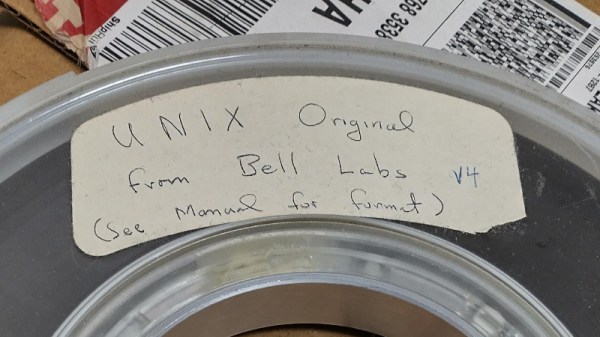
UNIX version 4 is quite special on account of being the first UNIX to be written in C instead of PDP-11 ASM, but it was also considered to have been lost to the ravages of time. Joyfully, we can report that the more than fifty year old magnetic tape that was recently discovered in a University of Utah storeroom did in fact contain the UNIX v4 source code. As reported by Tom’s Hardware, [Al Kossow] of Bitsavers did the recovery by passing the raw flux data from the tape read head through the ReadTape program to reconstruct the stored data.

Since the tape was so old there was no telling how much of the data would still be intact, but fortunately it turned out that the tape was not only largely empty, but the data that was on it was in good nick. You can find the recovered files here, along with a README, with Archive.org hosting the multi-GB raw tape data. The recovered data includes the tape file in SimH format and the filesystem

Suffice it to say that you will not run UNIX v4 on anything other than a PDP-11 system or emulated equivalent, but if you want to run its modern successors in the form of BSD Unix, you can always give FreeBSD a shot.

39C3: Hardware, And The Hard Bit

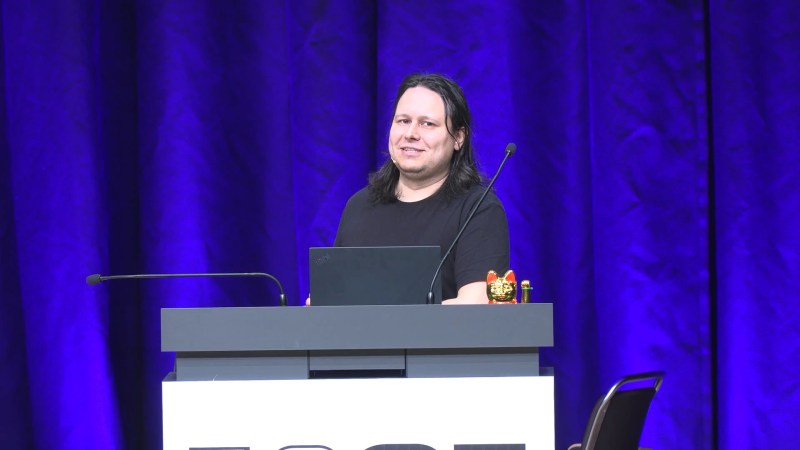
The 39th annual Chaos Communication Congress (39C3) is underway, and it kicked off with a talk that will resonate deeply with folks in the Hackaday universe. [Kliment] gave an impassioned invitation for everyone to start making hardware based on his experience both in the industry and in giving an intro-to-surface-mount workshop to maybe thousands of hackers over the years.

His main points are that the old “hardware is hard” cliche is overdone. Of course, working on a complicated high-reliability medical device isn’t child’s play, but that’s not where you start off. And getting started in hardware design and hobby-scale manufacture has never been easier or cheaper, and the open-source tooling gives you a foot in the door.

He tells the story of an attendee at a workshop who said “I kept waiting for the hard part to come, but then I was finished.”  Starting off with the right small-scale projects, learning a few techniques, and ramping up skills built on skills is the way to go. ([Kliment] is a big proponent of hand-placed hot-plate reflow soldering, and we concur.)

This is the talk that you want to show to your software friends who are hardware-curious. It’s also a plea for more experimentation, more prototyping, more hacking, and simply more people in the hardware / DIY electronics scene. Here at Hackaday, it’s maybe preaching to the choir, but sometimes it’s just nice to hear saying it all out loud.