Ask Hackaday: Do You Curb Shop Components?

I’m not proud. When many of us were kids, we were unabashedly excited when trash day came around because sometimes you’d find an old radio or — jackpot — an old TV out by the curb. Then, depending on its size, you rescued it, or you had your friends help, or, in extreme cases, you had to ask your dad. In those days, people were frugal, so the chances of what you found being fixable were slim to none. If it was worth fixing, the people would have probably fixed it.

While TVs and radios were the favorites, you might have found other old stuff, but in those days, no one was throwing out a computer (at least not in a neighborhood), and white goods like refrigerators and washing machines had very little electronics. Maybe a mechanical timer or a relay, but that’s about it.

Continue reading “Ask Hackaday: Do You Curb Shop Components?”

An SD Card Of Your Own For Microcontroller Projects

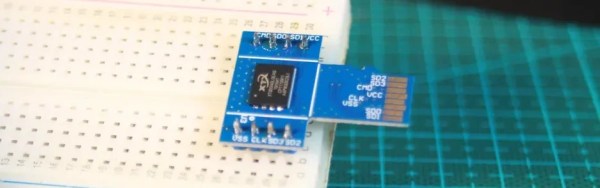
If you’ve wiring up a microcontroller and need some kind of storage, it’s likely you’ll reach for an SD card. Compared to other ways of holding data on your project, SD cards are just so much cheaper, resilient to physical and magnetic shocks, and simpler to work with from both a hardware and software perspective. On the other hand, it might seem silly to put a SD card slot on a board that’s never going to see a replacement card. [DIY GUY Chris] wants to advertise a solution for that: a cardless SD card chip by XTX that can act as a drop-in replacement for your projects. 

The XTXD0*G series are NAND flash chips of precisely the sort you’d find in an SD card, except without the SD card. That means you can use your usual SD card access libraries to speed prototyping, but skip the BOM cost of an actual card reader. In his Instructable and the video embedded below [Chris] shows how he used the 4 Gbit version, the XTSD04GLGEAG to make a custom SD-compatible breakout board that is equally happy in your laptop’s card reader or on a breadboard.

To get it plugged into the breadboard, [Chris] is using the standard 2.54 mm headers you can get anywhere; to get it plugged into a card reader, he’s just relying on the PCB being cut to shape. [Chris] notes that you’ll want to have the board built at 0.6 mm thickness if you’re going to plug it in like a micro SD card.

Of course once you’ve gotten used to the little NAND chips, there’s no need to put them on breakouts but this looks like a fun way to test ’em out. You don’t need to keep your flash chip on an SD-card sized PCB, either; we saw something similar used to make modern game cartridges. If you insist on using a standard SD card and don’t want to buy a slot, you can certainly DIY that instead. 

Continue reading “An SD Card Of Your Own For Microcontroller Projects”

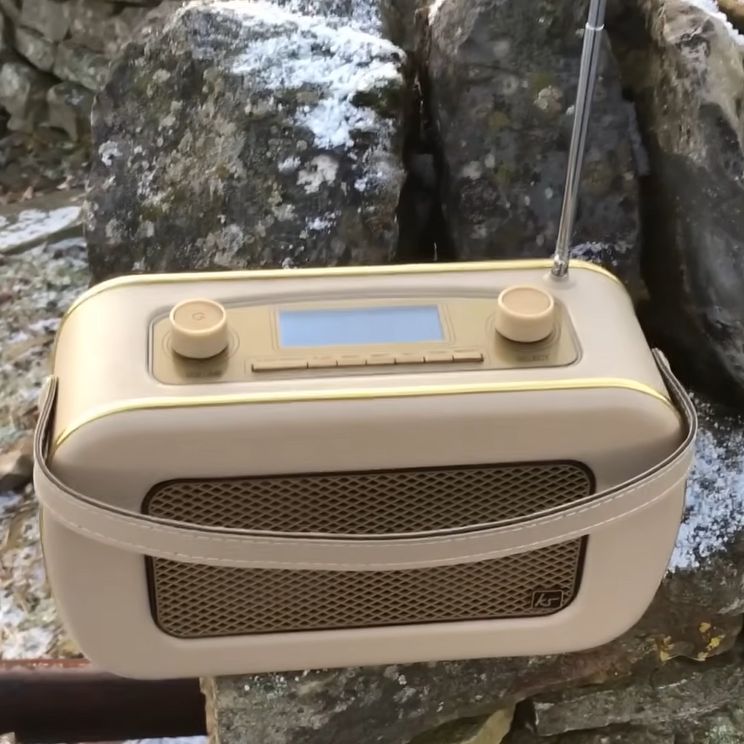
Fixing A KS Jive DAB Radio With A Dash Of Fake ICs

The radio unit after a successful repair. (Credit: Buy it Fix it, YouTube)

The exciting part about repairing consumer electronics is that you are never quite sure what you are going to find. In a recent video by [Mick] of Buy it Fix it on YouTube the subject is a KS Jive radio that throws a few curve balls along the way. After initially seeing the unit not power on with either batteries or external power, opening it up revealed a few loose wires that gave the false hope that it would be an easy fix.

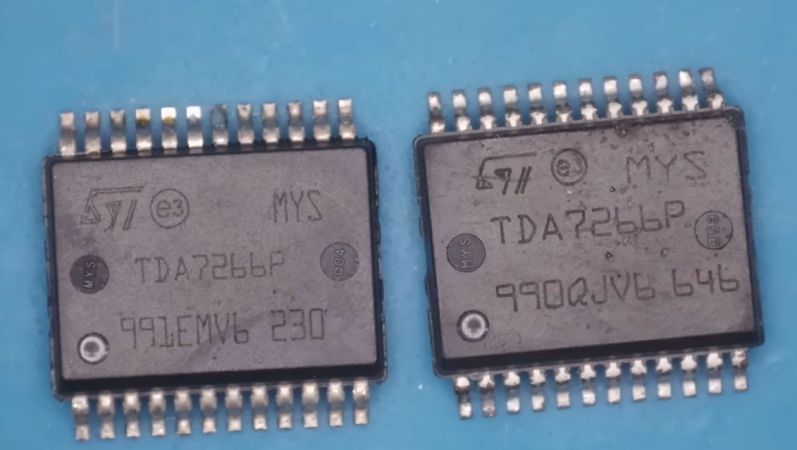
As is typical, the cause of the unit failing appears to have been a power surge that burned out a trace and obliterated the 3.3V LDO and ST TDA7266P amplifier. While the trace was easily fixed, and AMS1117 LDOs are cheap and plentiful, the amplifier chip turned out to be the real challenge on account of being an EOL chip.

The typical response here is to waddle over to purveyors of scrap hardware, like AliExpress sellers. Here [Mick] bought a ‘new’ TDA7266P, but upon receiving his order, he got suspicious after comparing it with the busted original. As can be seen in the top image, the markings, logo and even typeface are wildly different. Thus [Mick] did what any reasonable person does and x-rayed both chips to compare their internals.

Continue reading “Fixing A KS Jive DAB Radio With A Dash Of Fake ICs”