
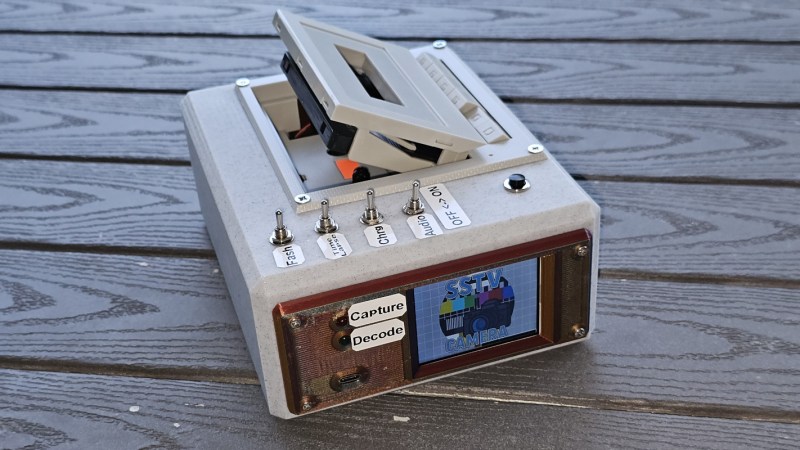
Ham radio operators may be familiar with slow-scan television (SSTV) where an image is sent out over the airwaves to be received, decoded, and displayed on a computer monitor by other radio operators. It’s a niche mode that isn’t as popular as modern digital modes like FT8, but it still has its proponents. SSTV isn’t only confined to the radio, though. [BLANCHARD Jordan] used this encoding method to store digital images on a cassette tape in a custom-built tape deck for future playback and viewing.
The self-contained device first uses an ESP32 and its associated camera module to take a picture, with a screen that shows the current view of the camera as the picture is being taken. In this way it’s fairly similar to any semi-modern digital camera. From there, though, it starts to diverge from a typical digital camera. The digital image is converted first to analog and then stored as audio on a standard cassette tape, which is included in the module in lieu of something like an SD card.
To view the saved images, the tape is played back and the audio signal captured by an RP2040. It employs a number of methods to ensure that the reconstructed image is faithful to the original, but the final image displays the classic SSTV look that these images tend to have as a result of the analog media. As a bonus feature, the camera can use a serial connection to another computer to offload this final processing step.
We’ve been seeing a number of digital-to-analog projects lately, and whether that’s as a result of nostalgia for the 80s and 90s, as pushback against an increasingly invasive digital world, or simply an ongoing trend in the maker space, we’re here for it. Some of our favorites are this tape deck that streams from a Bluetooth source, applying that classic cassette sound, and this musical instrument which uses a cassette tape to generate all of its sounds.












For bonus points interface to a surplus 3.5in floppy drive, write one image per track, and recreate the floppy cameras. But I suspect that requires very high-speed dac output. and maybe some modifications.
One image per track might actually just fit. It might be an interesting challenge to spin the disk slowly enough. To get 160 images on a floppy would be neat.
The normal rotation rate of a floppy roughly matches the line rate of many SSTV formats, but only gives you 80 or 160 lines, but that might be interesting too: one image per floppy.
The original Sony Mavica cameras stored one frame of analog video per track. Those used a special floppy format designed to store analog data though.
The later ones were digital and used ordinary 3.5″ floppy disks.
Floppy RAID?
PXL-2000 still cam.
Back in the day, they were storing audio data as analog video. Audio was digitized and stored on 3/4″ U-Matic analog video tape and used as a master format for producing audio CD’s.
https://hackaday.com/2022/07/07/retrotechtacular-1990s-cd-mastering-fit-for-a-king/
What about film with audio tracks in the margin?
https://en.wikipedia.org/wiki/Sound-on-film?wprov=sfla1
Didn’t that fellow Benn Jordan on YouTube store image data on a bird?
There’s lot of daily SSTV activity on 14.230 Mc/s.
SSTV is used as an easter-egg in the game Portal, too.
In the 70s, SSTV images were stored/played and shared via music cassette.
https://www.youtube.com/watch?v=kaVMrGkLWk4
Really?
I miss my Robot SSTV interface, and while I have been QRT for a long time and now again experimenting with FT8 etc, it would be nice to try SSTV again.
Several years ago I tested the speed stability of a 1950s reel-to-reel recorder using SSTV. The speed has to be quite stable in order to avoid the image being warped or skewed, at least without the automatic alignment that MMSSTV does. SSTV also works quite well over the phone provided that a landline or a VoIP provider that supports u-law is used. (Or a-law in Europe)
The original 7.2s and 8s monochrome SSTV (direct predecesssor to Robot-8) had used sync pulses to keep the image stable.
Like a carriage return on a typewriter it signaled a new line.
Unfortunately, whole lines got lost on noisy shortwave if the sync pulses were lost.
That’s why modern SSTV is “free-running” by drfault.
Unfortunelty, to this to work needs highly stable software and transceivers.
PS: Modern software isn’t automatically best, it simply has become mainstream slop rather.
Thus, I recommend trying out vintage SSTV equipment (Robot Model 400/400C, Robot Model 1200, Wraase)
or DOS-based solutions (JV-Fax 7 with 741 modem, SB16 or custom interface; GSHPC aka “SAW SCAN” etc).
Or maybe let’s give Multimode a try, which has been available to Macs since the 90s and uses soundcard. :)
https://www.rigpix.com/textandimaging/robot_1200c.htm
https://www.wraase.de/de/history/
https://www.qsl.net/kd2bd/sstv.html
Even if it now seems logical to me, I hadn’t anticipated the synchronization problems and deviation that could result from the lack of speed stability of a cheap cassette player.
I remembered decoding images received in SSTV by radio where there was more noise than images without it causing any synchronization problem, so I told myself that from a cassette it would be easy 😅
The Voyager gold record is audio-to-photo!
Could it be said it was John Logie Baird who first came up with the concept of recording analog video at audio frequencies on standard phonograph records? Baird made the recordings in the early 30s and then could not play them back! Someone finally decided the records fairly recently.